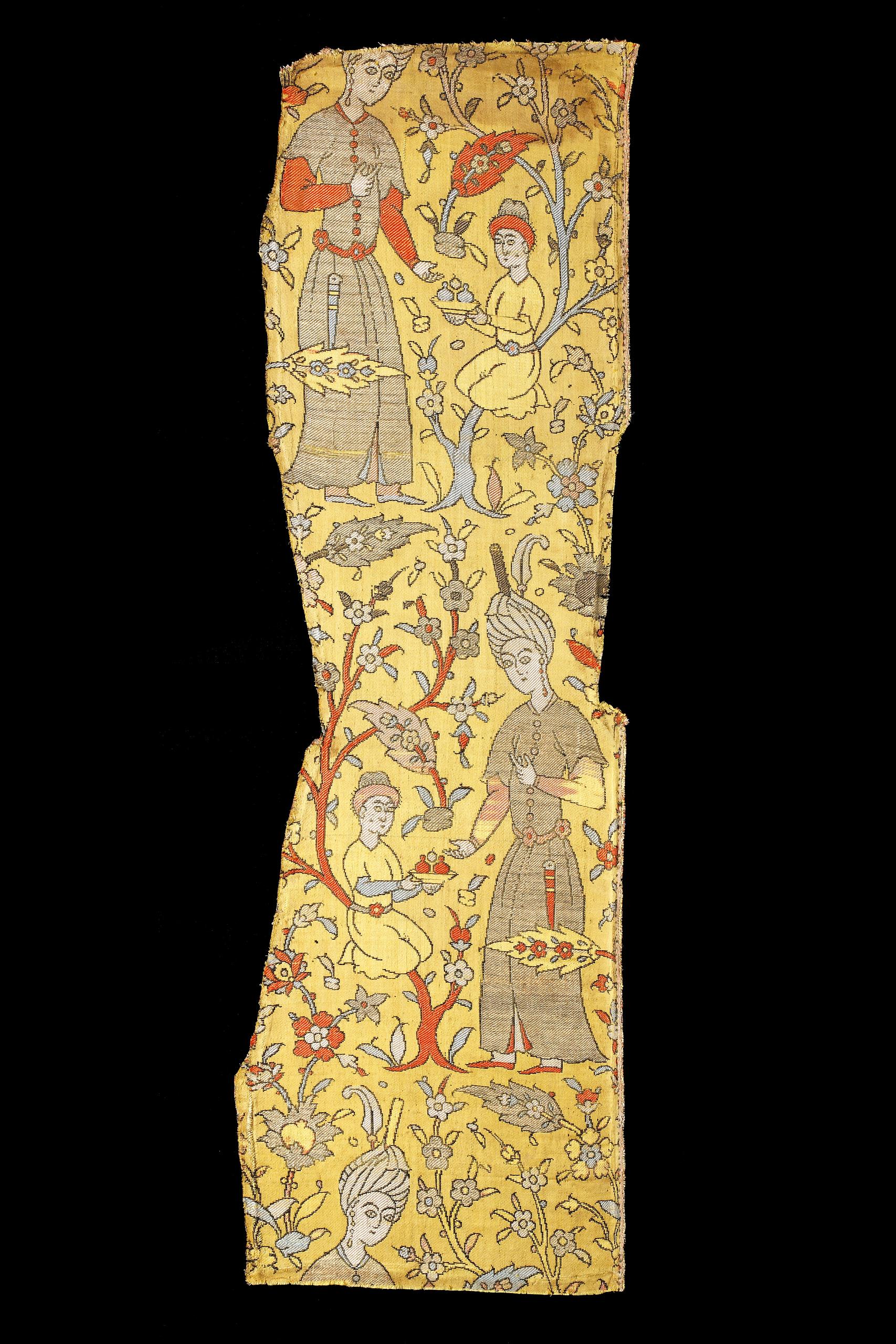
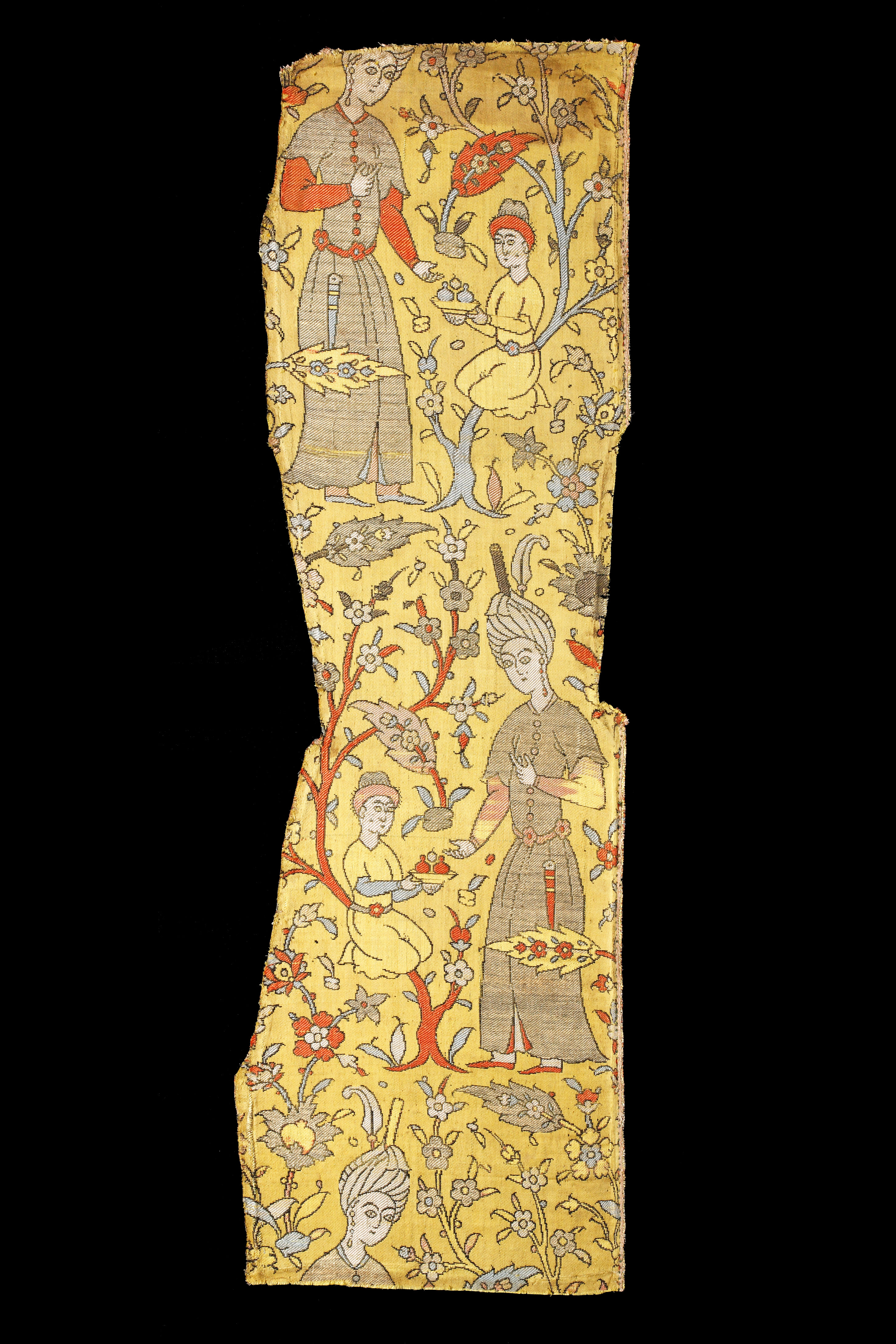
Fragment of a lampas-woven textile, silk with metal lamella spun around a silk core
Iran; 2nd half of 16th century
H: 76: W: 34 cm
Inventory number 29/2008
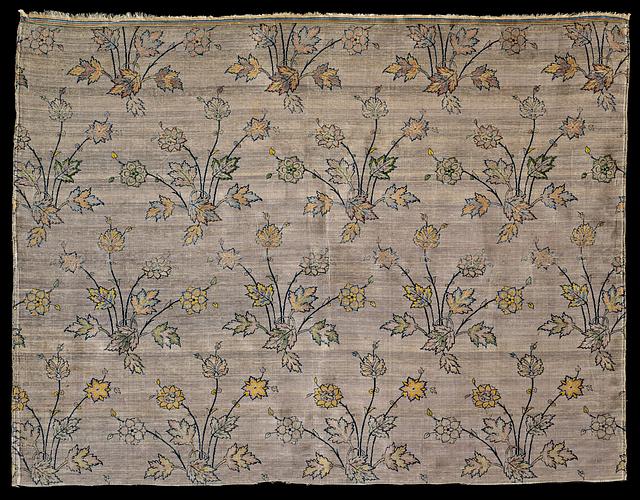
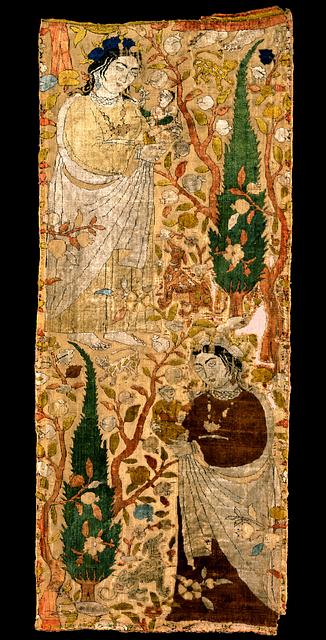
The 16th century saw the appearance of the first Safavid silk textiles decorated with people in various situations in a garden-like setting. The figures were found in small groups, and for technical reasons, variety was created by using mirror images of the motif in the direction of the weave or by changing color combinations. The motifs were influenced by contemporary miniature painting.
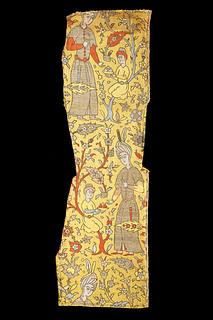
On this silk, a page offers fruit to his young master, who is wearing the Safavid turban topped by a stick and a long caftan of unpatterned cloth.
Although clothing with figurative motifs is not found in miniature painting, the way this textile was cut shows that it must have been used for a garment.
On this silk, a page offers fruit to his young master, who is wearing the Safavid turban topped by a stick and a long caftan of unpatterned cloth.
Although clothing with figurative motifs is not found in miniature painting, the way this textile was cut shows that it must have been used for a garment.
Published in
Published in
Catalogue of the International exhibition of Persian art at the Royal Academy of Arts, Royal Academy of Arts, London 1931, 3. ed., cat.no. 389;
Arthur Upham Pope og Phyllis Ackerman (eds.): A survey of Persian art: from prehistoric times to the present, London 1938-39, pl. 1013B;
Boisgirard, Paris, 22/5-2008, lot 287;
Kjeld von Folsach, Joachim Meyer: The Human Figure in Islamic Art – Holy Men, Princes, and Commoners, The David Collection, Copenhagen 2017, fig. 36, p. 144;
Seyed Reza Hoseini, Zohreh Sepasi: “A comparative study of Safavid fabric designs with miniatures in school of second Tabriz: (With a focus on the works of Sultan Mohammad, Mir-Musavvir and Mir-Sayyid Alî)” in Journal of History, Culture and Art Research, 2018, 7:5, fig. 30, pp. 287-288;
Arthur Upham Pope og Phyllis Ackerman (eds.): A survey of Persian art: from prehistoric times to the present, London 1938-39, pl. 1013B;
Boisgirard, Paris, 22/5-2008, lot 287;
Kjeld von Folsach, Joachim Meyer: The Human Figure in Islamic Art – Holy Men, Princes, and Commoners, The David Collection, Copenhagen 2017, fig. 36, p. 144;
Seyed Reza Hoseini, Zohreh Sepasi: “A comparative study of Safavid fabric designs with miniatures in school of second Tabriz: (With a focus on the works of Sultan Mohammad, Mir-Musavvir and Mir-Sayyid Alî)” in Journal of History, Culture and Art Research, 2018, 7:5, fig. 30, pp. 287-288;