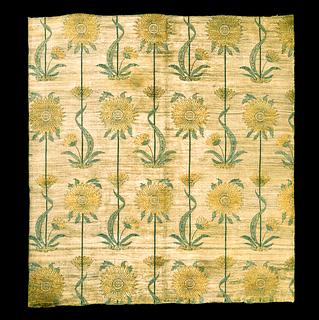
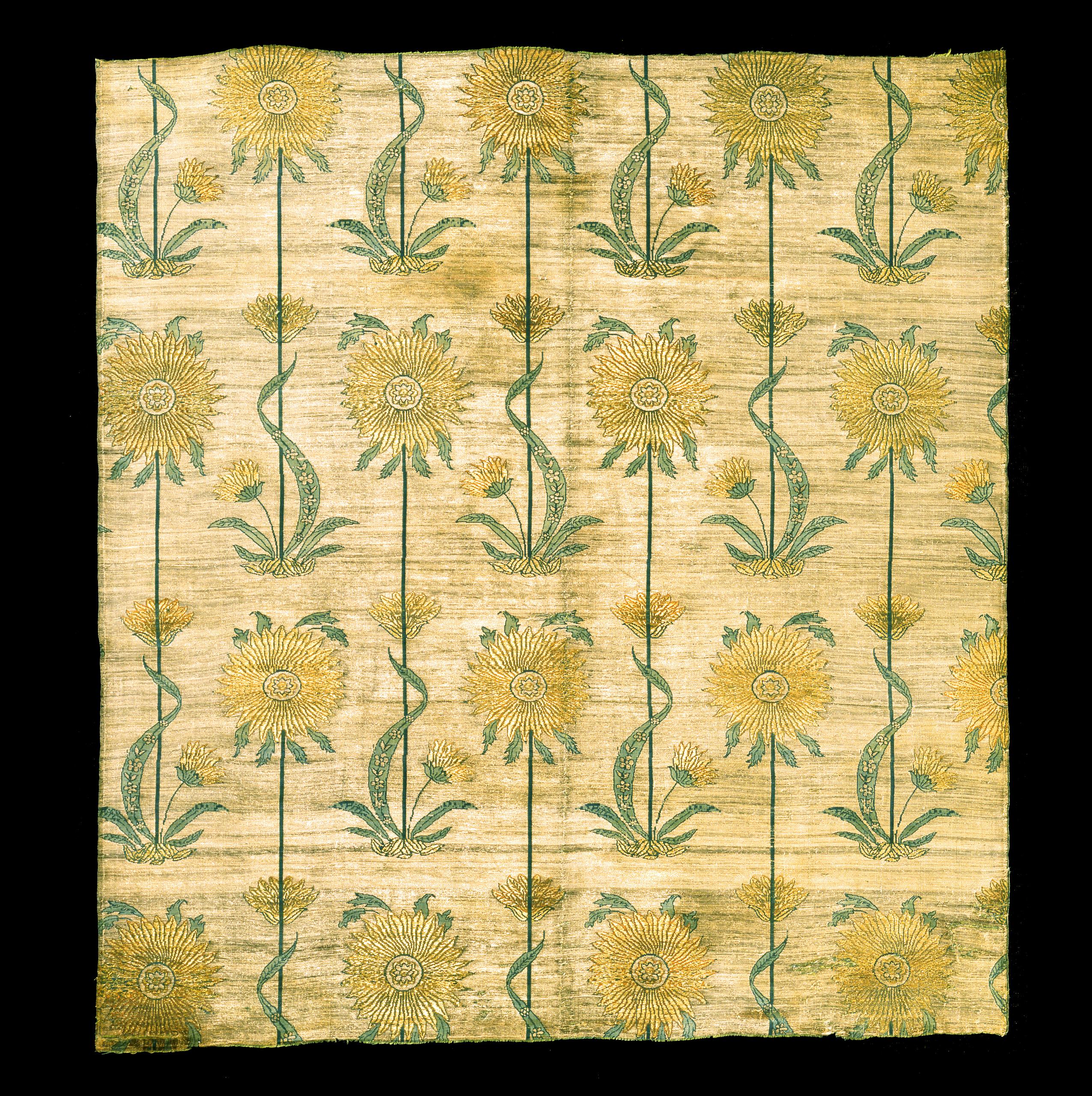
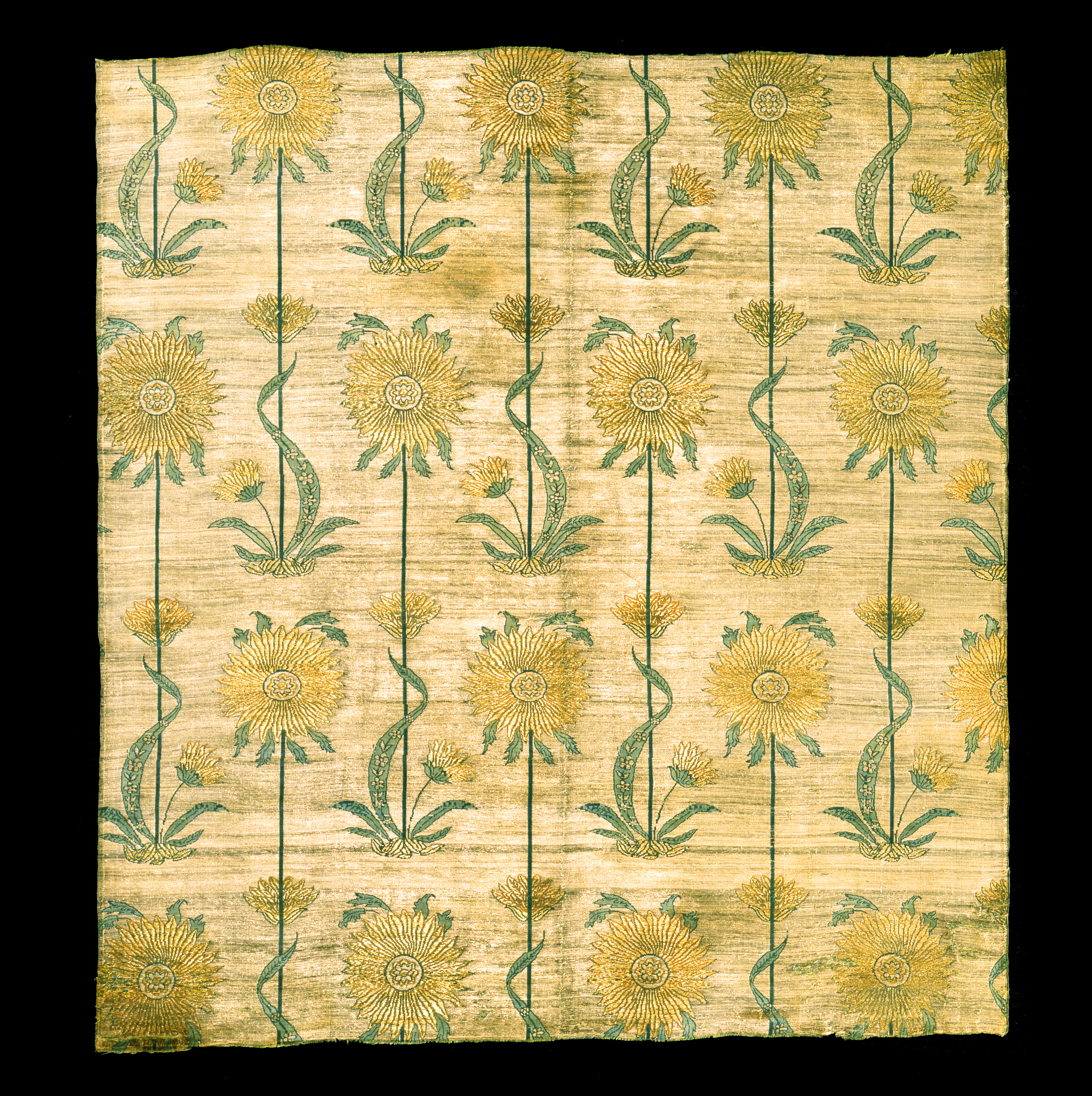
Samitum-woven textile with sunflowers, silk and metal lamella
Iran; 1st half of 17th century
H: 77; W: 70.5 cm
Inventory number 23/1997
Flowers were a favorite motif for the textiles woven in the three great “gunpowder empires” – Safavid Iran, Ottoman Turkey, and India under the Great Mughals. Some are highly stylized, while others are more naturalistic, like this one. The sunflower or chrysanthemum-like flower is seen in full bloom en face in some places, and in a more bud-like stage in profile in others. The elegant, scrolling leaves are contrasted with the perfectly vertical stems, and a purely ornamental feature is the little flowers that decorate the largest leaf.
Metal was used in profusion, and an even greater effect was achieved by winding the silver lamella around a beige silk core, while gold thread was wound around yellow silk.
Metal was used in profusion, and an even greater effect was achieved by winding the silver lamella around a beige silk core, while gold thread was wound around yellow silk.
Published in
Published in
Kjeld von Folsach: Art from the World of Islam in The David Collection, Copenhagen 2001, cat.no. 671;
Sheila S. Blair and Jonathan M. Bloom (eds.): Cosmophilia. Islamic Art from the David Collection, Copenhagen, McMullen Museum of Art, Boston College, Boston 2006, cat.no. 73;
Kjeld von Folsach: Flora islamica: plantemotiver i islamisk kunst, Davids Samling, København 2013, cat.no. 58;
Sheila S. Blair and Jonathan M. Bloom (eds.): Cosmophilia. Islamic Art from the David Collection, Copenhagen, McMullen Museum of Art, Boston College, Boston 2006, cat.no. 73;
Kjeld von Folsach: Flora islamica: plantemotiver i islamisk kunst, Davids Samling, København 2013, cat.no. 58;