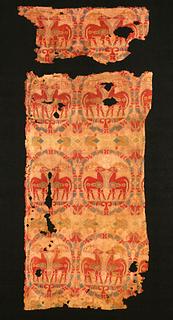
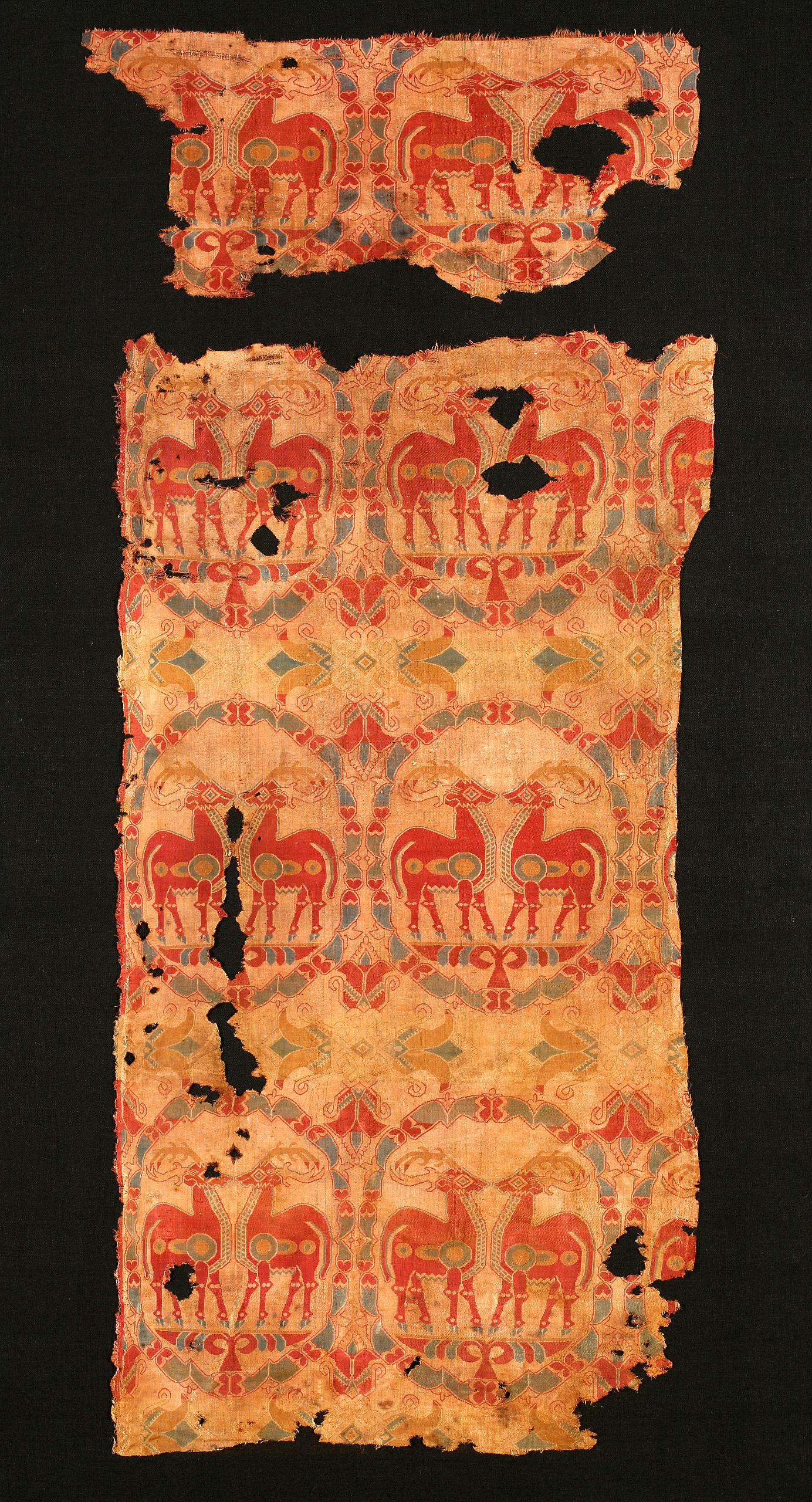
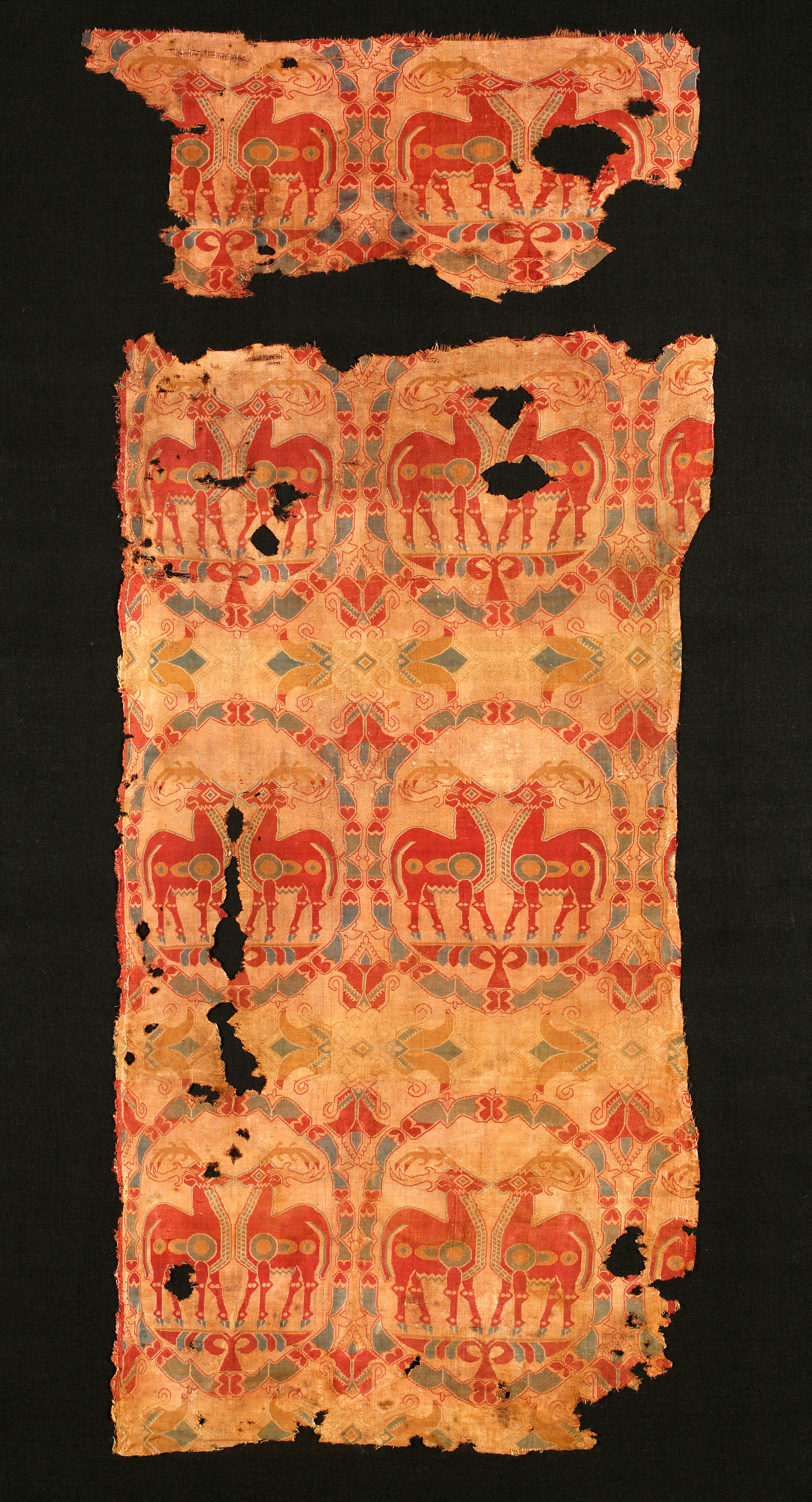
Samitum-woven silk with confronted deer in medallions
Central Asia; 7th-8th century
H: 104.5; W: 45.5 cm
Inventory number 4/2005
This magnificent textile with confronted deer placed on winged palmettes in medallions was probably made in Sogdiana, the area north and east of the Amu Darya (Oxus) River.
The motif comes from Sasanian Iran, but the rendition of this piece is stiffer than that of its models. Medallion motifs with single or confronted figures are also known from Byzantium (and China), and survived in the Islamic world right to the 14th century, when they went out of fashion. The use of non-naturalistic, circular decorations above the limbs of four-legged creatures or on the wings of birds was also found in the Islamic period in both textiles and metalwork.
The motif comes from Sasanian Iran, but the rendition of this piece is stiffer than that of its models. Medallion motifs with single or confronted figures are also known from Byzantium (and China), and survived in the Islamic world right to the 14th century, when they went out of fashion. The use of non-naturalistic, circular decorations above the limbs of four-legged creatures or on the wings of birds was also found in the Islamic period in both textiles and metalwork.
Published in
Published in
Institute of Ismaili Studies: Encounters in Muslim History, Student reader 1, London 2013, (reprint. 2017), p. 19;
Mariachiara Gasparini: Transcending patterns: Silk Road cultural and artistic interactions through Central Asian textile images, Honolulu 2020, pl. 5b and p. 26 (wrong acc.no. in book);
Mariachiara Gasparini: Transcending patterns: Silk Road cultural and artistic interactions through Central Asian textile images, Honolulu 2020, pl. 5b and p. 26 (wrong acc.no. in book);