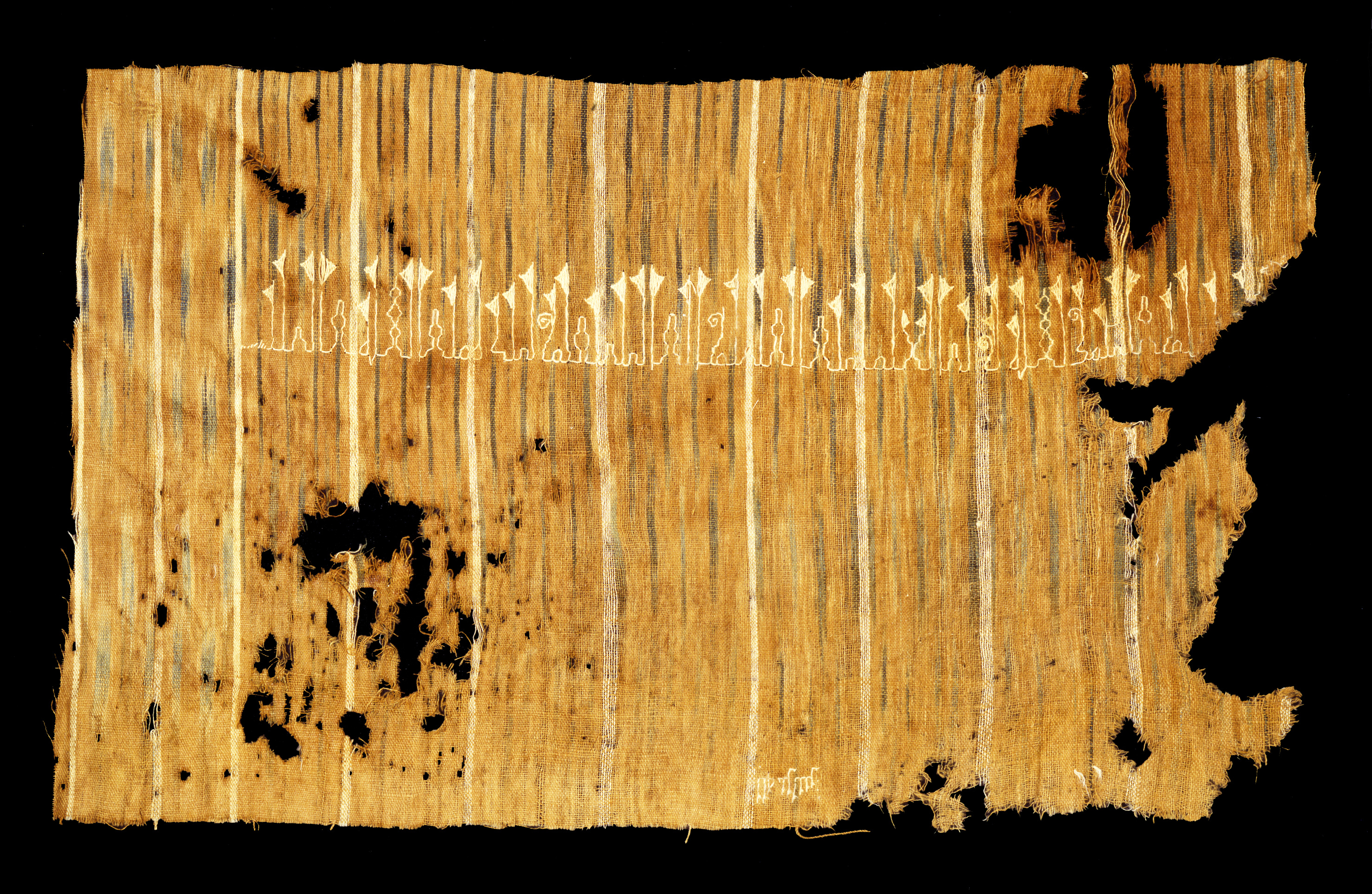
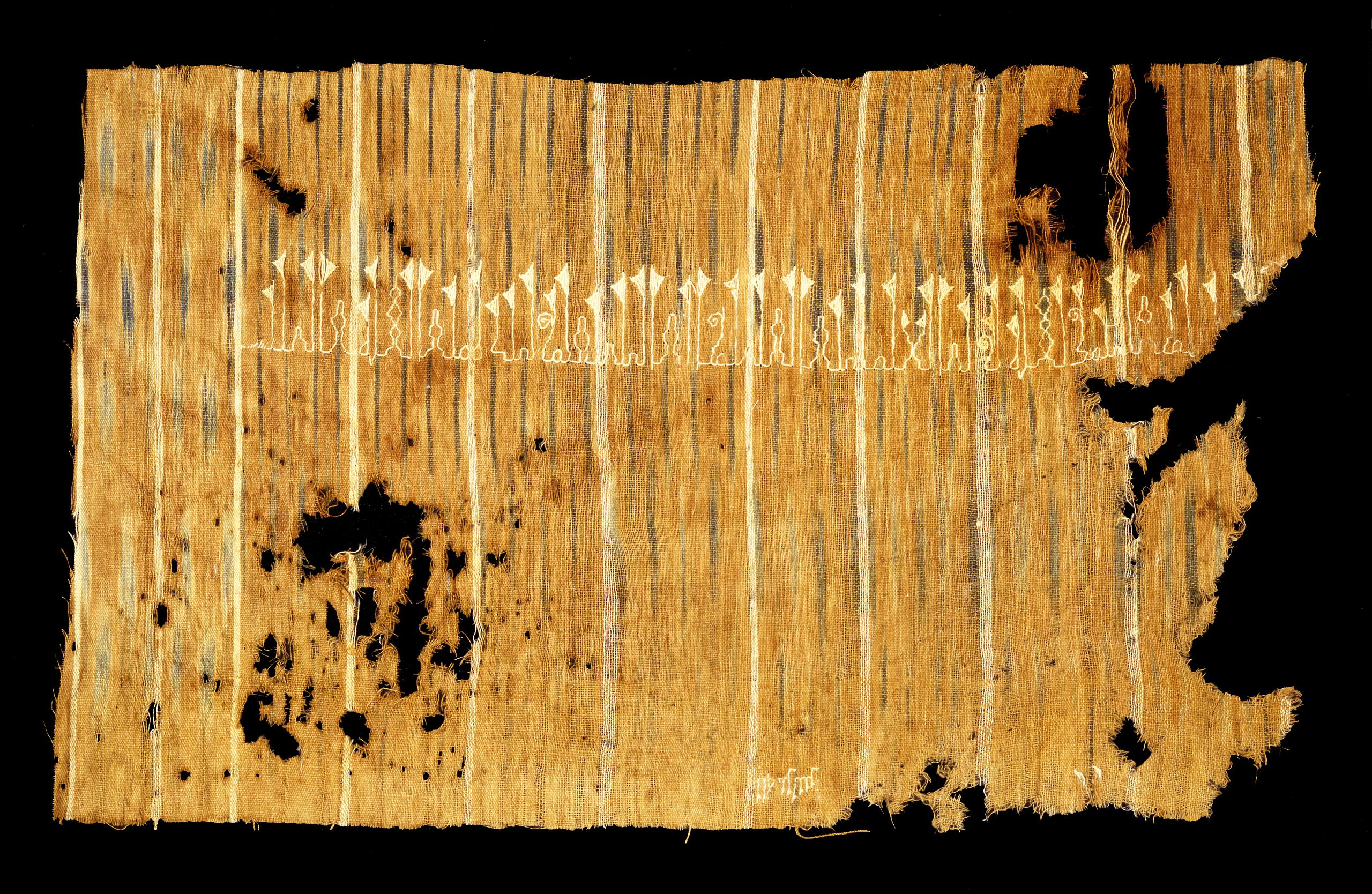
Ikat textile, cotton tabby, with embroidery
Yemen; 10th century
H: 32; W: 51 cm
Inventory number 47/1992
The weavers of Yemen were among the first in the Islamic world to use the ikat technique, in which the heavy warps were reserved dyed. This involved tying skeins of yarn in different places with thread so that dye only colored the yarn where it was uncovered. The warps in shades of blue, brown, and white were arranged in vertical stripes, giving the textile a distinctive flamed structure after the monochrome wefts were woven in.
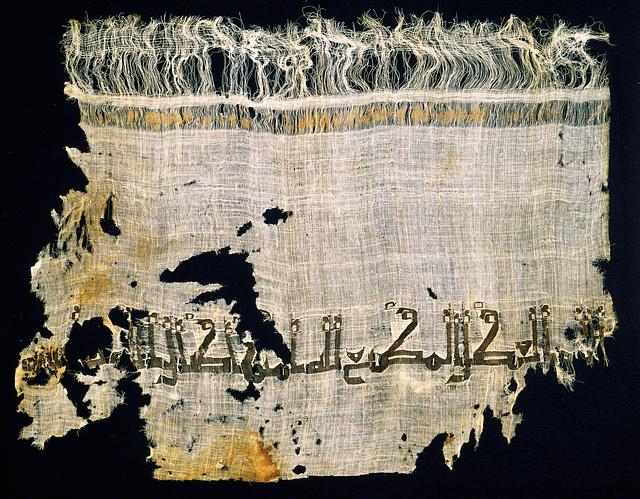
Yemenite ikat textiles were almost always embellished with Arabic inscriptions (tiraz) with varying degrees of legibility. They might be painted on in gold or, as here, embroidered in white or dyed cotton. The letters were typically executed with distinctive flag-like stems and the inscriptions were furnished with purely decorative elements, for example arches.
Yemenite ikat textiles were almost always embellished with Arabic inscriptions (tiraz) with varying degrees of legibility. They might be painted on in gold or, as here, embroidered in white or dyed cotton. The letters were typically executed with distinctive flag-like stems and the inscriptions were furnished with purely decorative elements, for example arches.
Published in
Published in
Kjeld von Folsach and Anne-Marie Keblow Bernsted: Woven Treasures: Textiles from the World of Islam, The David Collection, Copenhagen 1993, cat.no. 5;
Kjeld von Folsach, Torben Lundbæk and Peder Mortensen (eds.): Sultan, Shah and Great Mughal: the history and culture of the Islamic world, The National Museum, Copenhagen 1996, cat.no. 68;
Kjeld von Folsach: Art from the World of Islam in The David Collection, Copenhagen 2001, cat.no. 628;
Sheila S. Blair and Jonathan M. Bloom (eds.): Cosmophilia. Islamic Art from the David Collection, Copenhagen, McMullen Museum of Art, Boston College, Boston 2006, cat.no. 28;
Kjeld von Folsach, Torben Lundbæk and Peder Mortensen (eds.): Sultan, Shah and Great Mughal: the history and culture of the Islamic world, The National Museum, Copenhagen 1996, cat.no. 68;
Kjeld von Folsach: Art from the World of Islam in The David Collection, Copenhagen 2001, cat.no. 628;
Sheila S. Blair and Jonathan M. Bloom (eds.): Cosmophilia. Islamic Art from the David Collection, Copenhagen, McMullen Museum of Art, Boston College, Boston 2006, cat.no. 28;
.jpg)