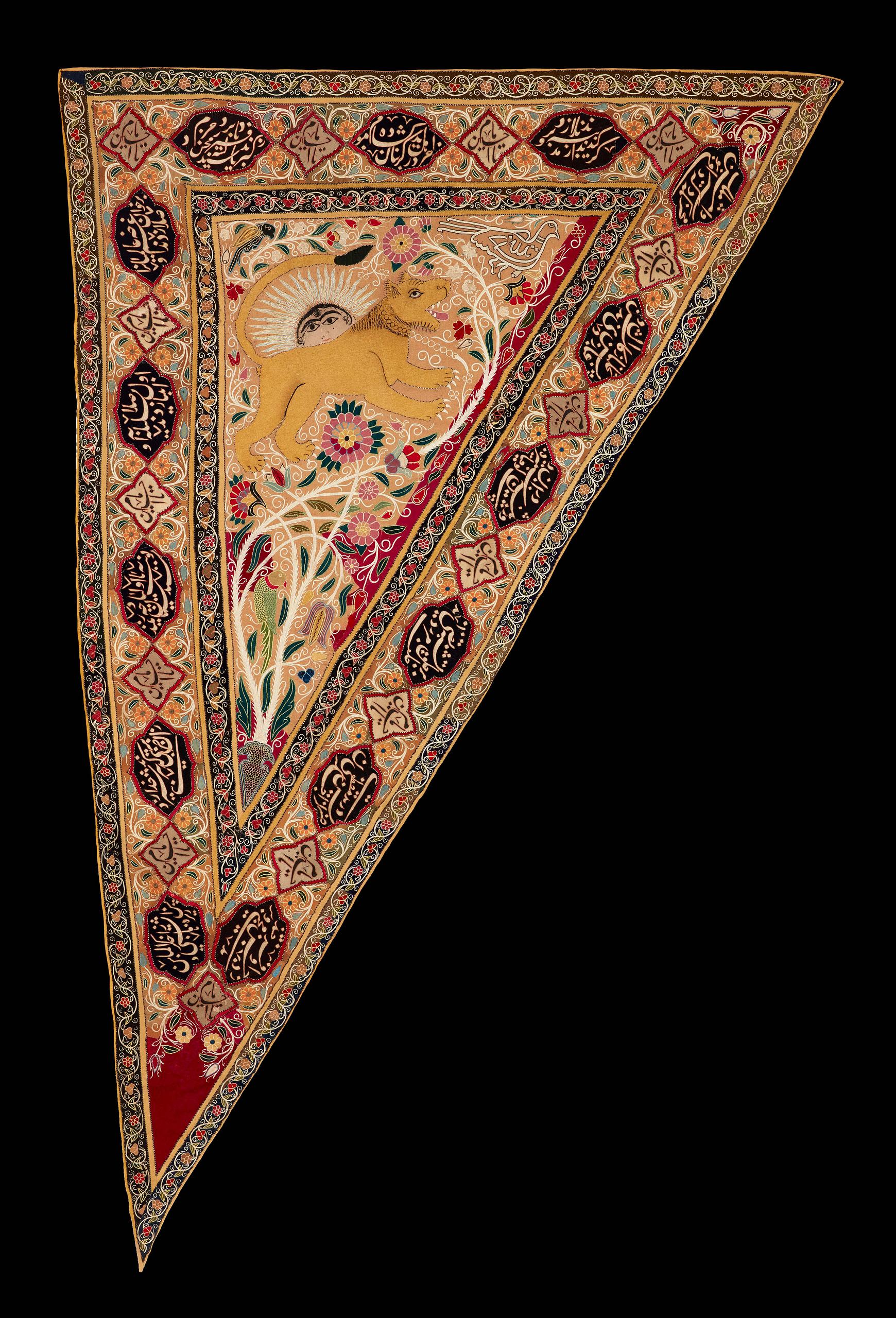
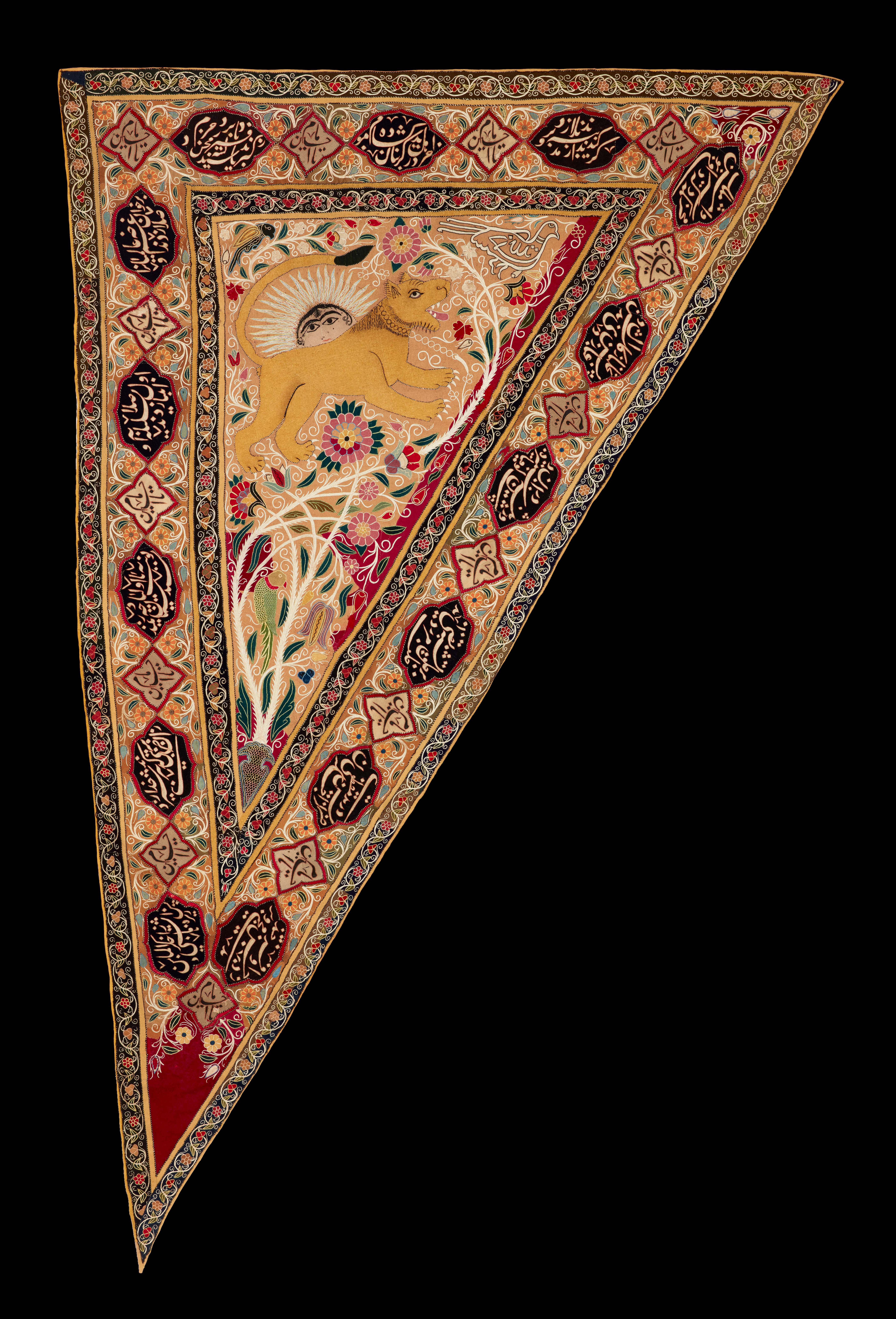
Standard of felt-like fabric with inserted elements of differently coloured wool decorated with silk embroidery
Iran; Mid-19th century
L: 246; W: 159 cm
Inventory number 16/2019
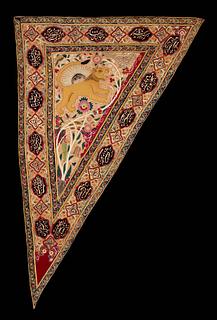
The triangular standard consists of a correspondingly triangular central field with the Lion and Sun motif (Shir-u Khurshid) surrounded by trailing vines growing out of a vase. Amidst the stems and flowers of the plant are three birds, one of which is a calligram forming the basmala in reverse. Around the central field are two narrow borders with vines and between these a wider one, also with floral ornamentation and featuring uniform larger and smaller cartouches. The smaller of these repeat the phrase ‘O Imam Husayn’, while the larger ones contain various poetry on Imam Husayn written by the Persian Shiite poet Muhtasham Kashani (1500–88).
Standards of this type were used in connection with Ashura or Muharram processions of the kind enacted particularly by Shiites to commemorate the martyrdom of the Prophet Muhammad’s grandson Imam Husayn during the Battle of Kerbala in the month of Muharram 680.1
The differently coloured pieces of felt are sewn together along the edges, while others are cut-outs inserted into corresponding holes in the larger felt pieces. The joins are covered with sewn-on thick silk cords or silk embroidery done in chain stitch, which is also used to create independent patterns. This type of work, reminiscent of patchwork, is known in Iran as resht, named after a city of the same name south of the Caspian Sea.2 A similar technique is also known from Ottoman textiles (see 18/1989). A significant part of the original felt and silk embroidery has been replaced at a later date, and the standard has been backed with modern, tabby-woven fabric.
Standards of this type were used in connection with Ashura or Muharram processions of the kind enacted particularly by Shiites to commemorate the martyrdom of the Prophet Muhammad’s grandson Imam Husayn during the Battle of Kerbala in the month of Muharram 680.1
The differently coloured pieces of felt are sewn together along the edges, while others are cut-outs inserted into corresponding holes in the larger felt pieces. The joins are covered with sewn-on thick silk cords or silk embroidery done in chain stitch, which is also used to create independent patterns. This type of work, reminiscent of patchwork, is known in Iran as resht, named after a city of the same name south of the Caspian Sea.2 A similar technique is also known from Ottoman textiles (see 18/1989). A significant part of the original felt and silk embroidery has been replaced at a later date, and the standard has been backed with modern, tabby-woven fabric.
Published in
Published in
Bonhams and Brooks, 2/5-2001, lot 572;
Bonhams, 30/4-2019, lot 78;
Bonhams, 30/4-2019, lot 78;
Footnotes
Footnotes
1.
See Patricia L. Baker: Islamic Textiles, London 1995, pp. 137–139 and Jennifer Wearden and Patricia L. Baker: Iranian Textiles, Victoria and Albert Museum, London 2010, pp. 62–65.
2.
Two closely related standards are published in Bonhams, London, 2/10-2012, lot 143.