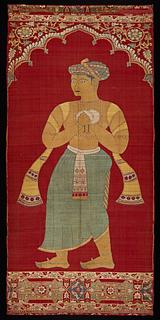
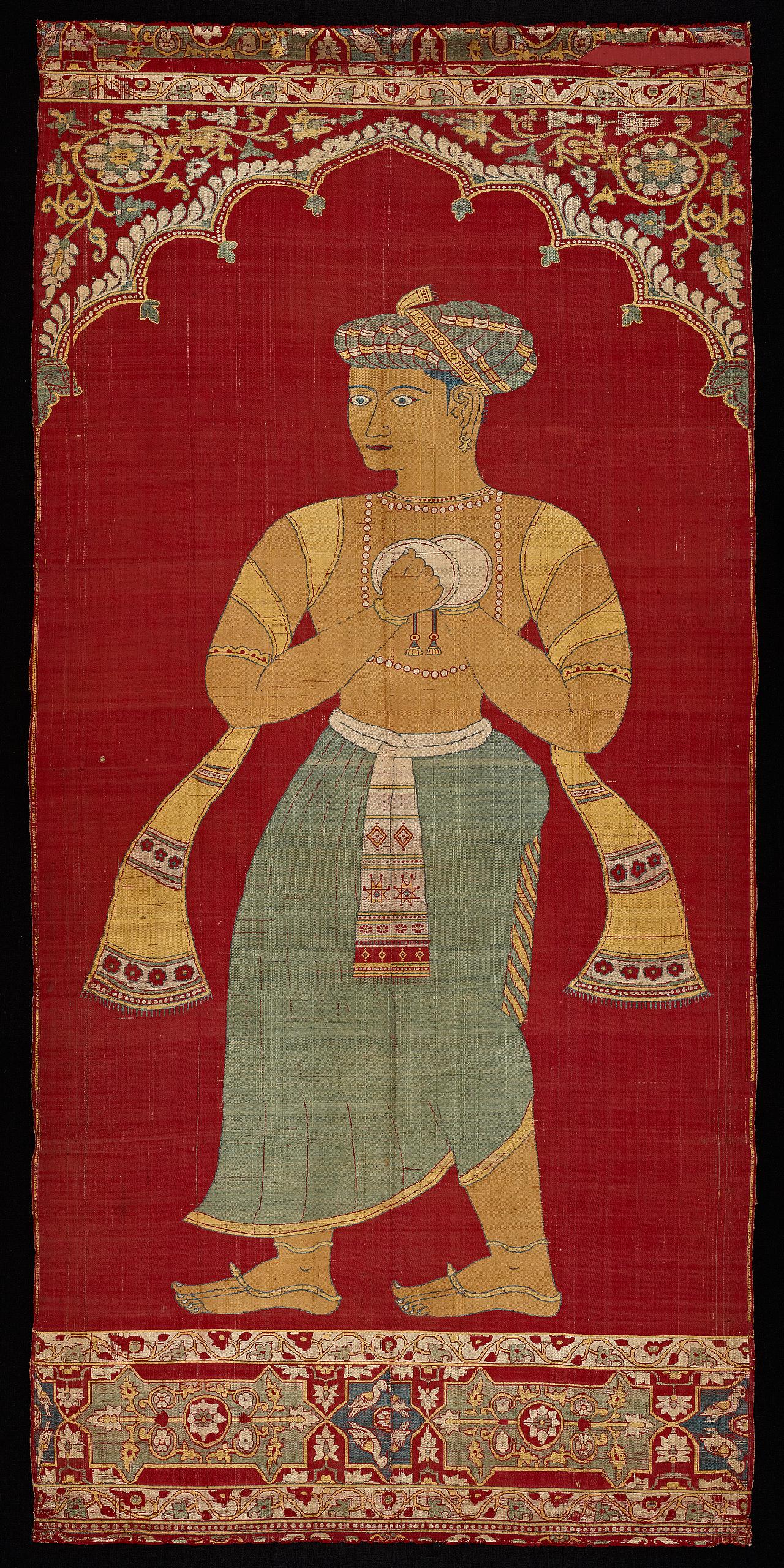
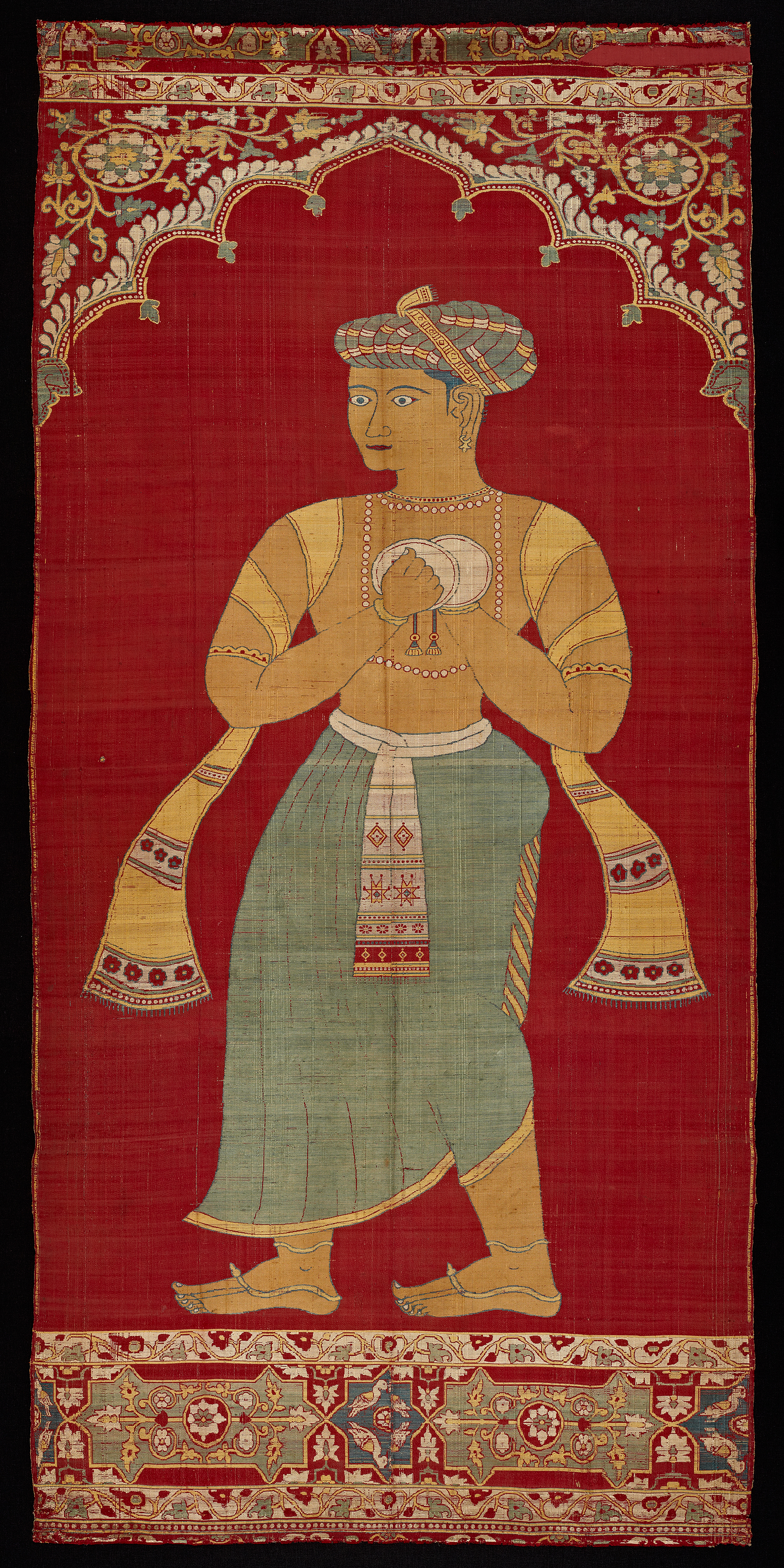
Lampas-woven textile, silk. “Musician with cymbals”
India; c. 1600–1620
H: 201.5; W: 97 cm
Inventory number 19/2011
This textile, just over two meters tall, was presumably woven in one of the Great Mughal’s studios to be sewn together with similar pieces to decorate a princely tent.
A highly Indian niche encloses a musician who can be seen from both the front and the side. He wears a typical Mughal turban, two shawls, and a loincloth (dhoti). Very much alive yet statue-like, he must have made a fantastic impression alongside other figures.
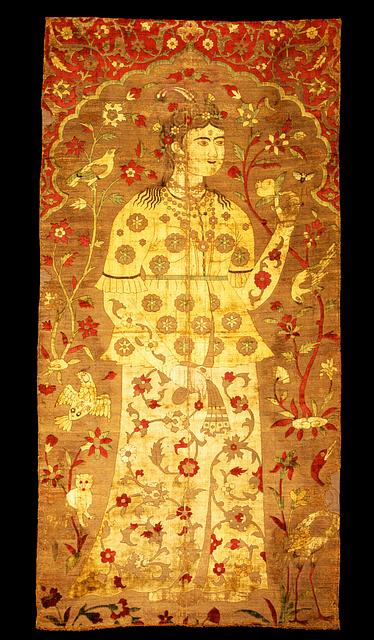
There are two related tent panels (qanat), one with an elegant courtier in the Los Angeles County Museum of Art and another with a female harem guard in the Khalili Collection in London. Both, however, are in rather poor condition.
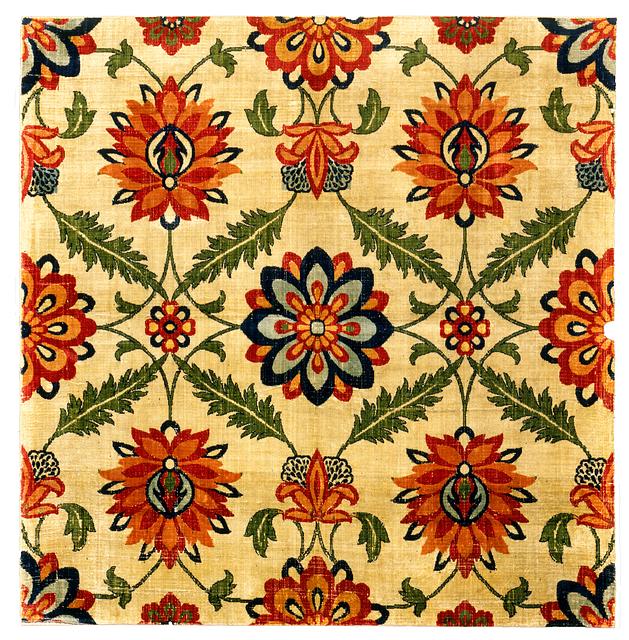
Making such large and complex figurative textiles without repeating the motif requires a true overview of the whole, and they were hardly surpassed anywhere in their day.
The tent panel most likely comes from the Amber Palace in Jaipur.
A highly Indian niche encloses a musician who can be seen from both the front and the side. He wears a typical Mughal turban, two shawls, and a loincloth (dhoti). Very much alive yet statue-like, he must have made a fantastic impression alongside other figures.
There are two related tent panels (qanat), one with an elegant courtier in the Los Angeles County Museum of Art and another with a female harem guard in the Khalili Collection in London. Both, however, are in rather poor condition.
Making such large and complex figurative textiles without repeating the motif requires a true overview of the whole, and they were hardly surpassed anywhere in their day.
The tent panel most likely comes from the Amber Palace in Jaipur.
Published in
Published in
Francesca Galloway: Imperial past: India 1600-1800, Galloway, London 2011, pp. 2-5;
Rahul Jain: Indian lampas-weave silks in the collection of the Calico Museum of Textiles, Ahmedabad, Ahmedabad 2013, mentioned p. 26;
Steven Cohen: “Two outstanding Mughal qanat panels in the David Collection, with technical analyses and drawings of weaving structures by Anne-Marie Keblow Bernsted” in Journal of the David Collection, 4, 2014, p. 170, figs. 1, 7 and 13;
Louise W. Mackie: Symbols of power: luxury textiles from Islamic lands, 7th–21st century, Cleveland 2015, fig. 10.6, p. 414;
Rosemary Crill (ed.): The fabric of India, Victoria & Albert Museum, London 2015, fig 106, p. 104:
Ole Zethner [et al.]: South Asian ways of silk: a patchwork of biology, manufacture, culture and history, Guwahati, Assam 2015, p. 123;
Rahul Jain: Textiles and garments at the Jaipur court, New Delhi 2016, cat.no. 5, pp. 44-45;
Kjeld von Folsach, Joachim Meyer: The Human Figure in Islamic Art – Holy Men, Princes, and Commoners, The David Collection, Copenhagen 2017, cat.no. 16;
Rahul Jain: Indian lampas-weave silks in the collection of the Calico Museum of Textiles, Ahmedabad, Ahmedabad 2013, mentioned p. 26;
Steven Cohen: “Two outstanding Mughal qanat panels in the David Collection, with technical analyses and drawings of weaving structures by Anne-Marie Keblow Bernsted” in Journal of the David Collection, 4, 2014, p. 170, figs. 1, 7 and 13;
Louise W. Mackie: Symbols of power: luxury textiles from Islamic lands, 7th–21st century, Cleveland 2015, fig. 10.6, p. 414;
Rosemary Crill (ed.): The fabric of India, Victoria & Albert Museum, London 2015, fig 106, p. 104:
Ole Zethner [et al.]: South Asian ways of silk: a patchwork of biology, manufacture, culture and history, Guwahati, Assam 2015, p. 123;
Rahul Jain: Textiles and garments at the Jaipur court, New Delhi 2016, cat.no. 5, pp. 44-45;
Kjeld von Folsach, Joachim Meyer: The Human Figure in Islamic Art – Holy Men, Princes, and Commoners, The David Collection, Copenhagen 2017, cat.no. 16;