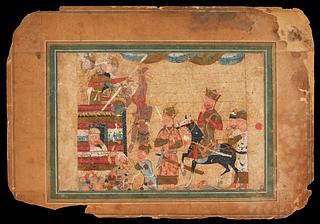
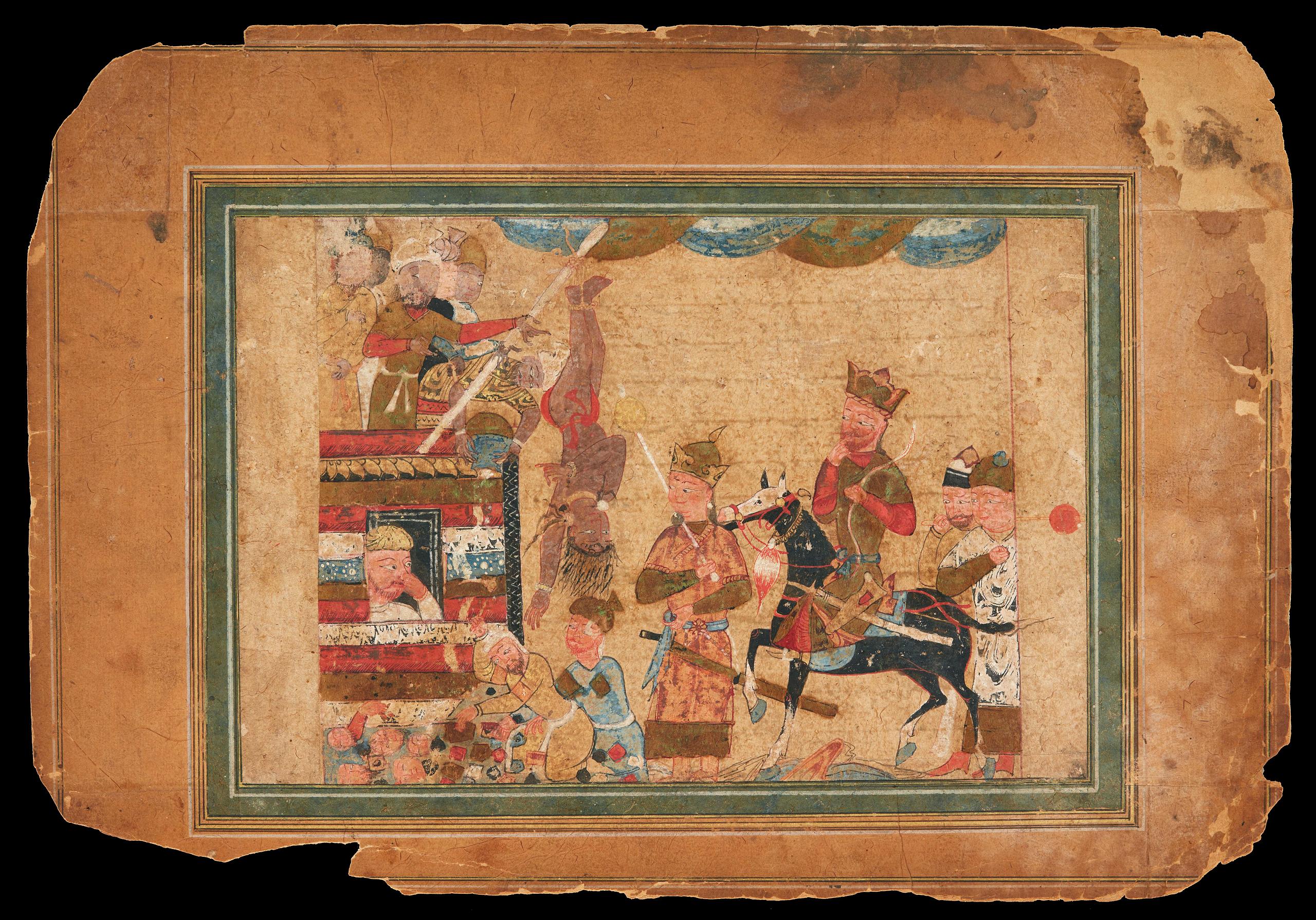
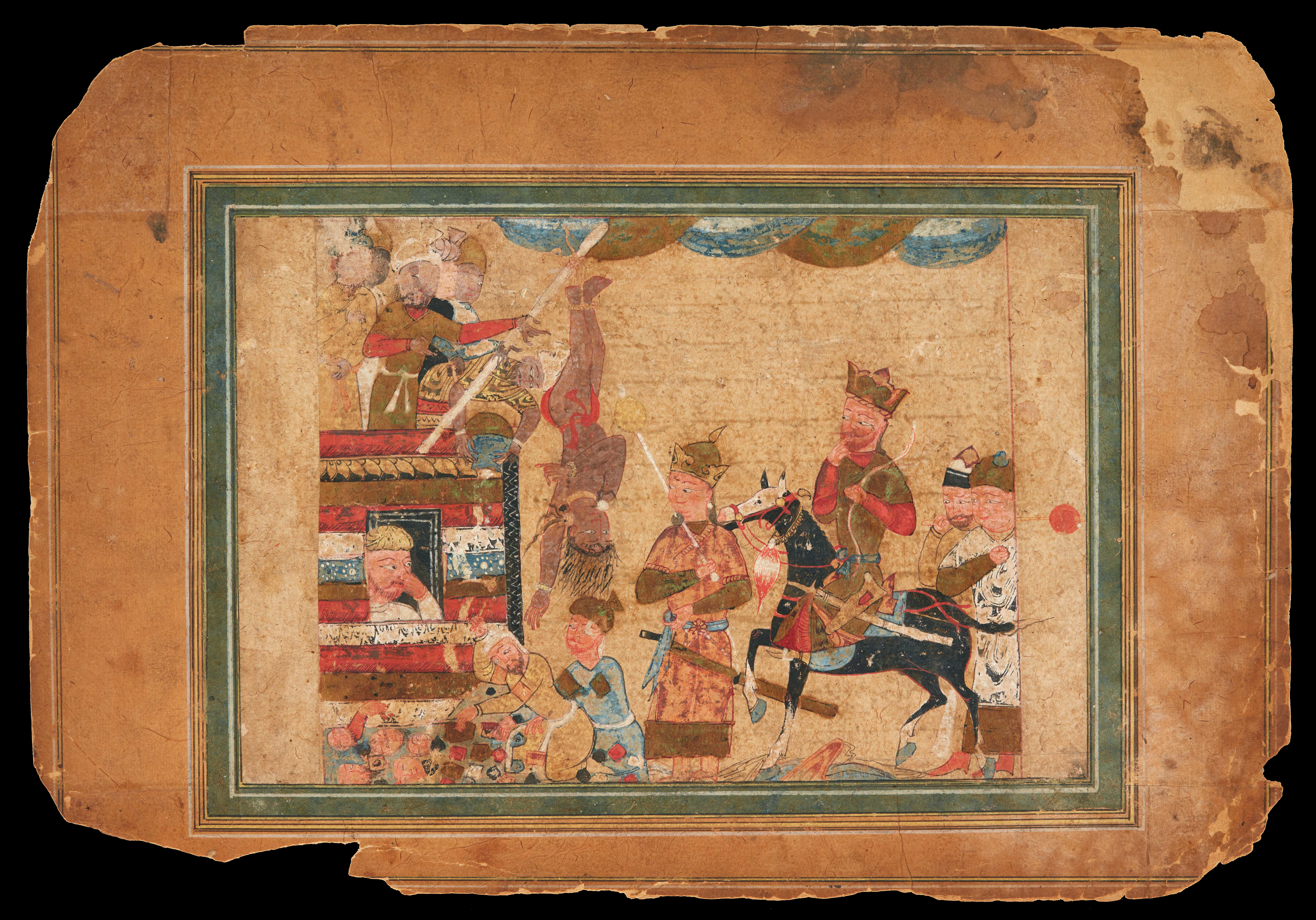
Miniature mounted on cardboard. ‘A Prince Watching a Man Being Tortured’
India; Second half of the 15th century
The miniature: 15.2 x 22.4 cm
Inventory number 16/2018
The subject matter of this painting is enigmatic. On the right, a group including a mounted prince watches the scene unfolding to the left. Here, a dark-skinned, almost naked man hangs by his legs from a pole resting on the flat top of a building. On the roof of the structure, another person is emptying a round jar down its façade. In a window in the building below, a man pinches his nose – either because of the smell of what is being poured from the roof in front of him, or because of the smell rising from the scene unfolding on the ground below the window. Here, a kneeling man appears to be in the process of excavating corpse parts from a grave, using a small pickaxe for the task.
The painting was made in Sultanate India. The figures are square built with broad heads and small, narrow eyes. They wear turbans with an upright tip of fabric as well as caftans, which in some cases fall in the wavy, fold-like manner encountered in older Byzantine-influenced painting in the Levantine area (see, for example, 20/1988 and 19/2019). Depicting the sky as twisted bands of clouds is also a distinctive trait of this group of paintings, which includes 25/1980 as well.1 But while these paintings are generally very colourful and employ bold, uniform colours as a background, A Prince Watching a Man Being Tortured is unusual in that it allows the untreated, uncoloured paper to form the background.
The painting has been cut from a manuscript, and none of the text is preserved. It may be an illustration for a scene from the marvellous story of Iskandar (Alexander the Great), either from an Iskandarnama (the fifth poem in Nizami’s Khamsa) or from an Aina-i Sikandari (the fourth poem in Amir Khusraw Dihlawi’s Khamsa).
The painting was made in Sultanate India. The figures are square built with broad heads and small, narrow eyes. They wear turbans with an upright tip of fabric as well as caftans, which in some cases fall in the wavy, fold-like manner encountered in older Byzantine-influenced painting in the Levantine area (see, for example, 20/1988 and 19/2019). Depicting the sky as twisted bands of clouds is also a distinctive trait of this group of paintings, which includes 25/1980 as well.1 But while these paintings are generally very colourful and employ bold, uniform colours as a background, A Prince Watching a Man Being Tortured is unusual in that it allows the untreated, uncoloured paper to form the background.
The painting has been cut from a manuscript, and none of the text is preserved. It may be an illustration for a scene from the marvellous story of Iskandar (Alexander the Great), either from an Iskandarnama (the fifth poem in Nizami’s Khamsa) or from an Aina-i Sikandari (the fourth poem in Amir Khusraw Dihlawi’s Khamsa).
Published in
Published in
Stanislaw Czuma: Indian art from the George P. Bickford Collection, Cleveland Museum of Art, Cleveland 1975, cat.no. 43;
Pauline C. M. Lunsingh-Scheurleer (ed.): Miniaturen uit India : de verzameling van dr. P. Formijne, Rijksprentenkabinet, Amsterdam 1978, p. 20, cat.no. 22;
Mentioned p. 28 in Anand Krishna (ed.): Chhavi. 2, Rai Krishnadasa felicitation volume, Varanasi 1981;
Sotheby’s, New York, 20-21/9-1985, lot 447;
J. Bautze in Claus-Peter Haase, Jens Kröger, Ursula Lienert (eds.): Oriental splendour. Islamic art from German private collections, Museum für Kunst und Gewerbe, Hamburg 1993, cat.no. 181;
Éloïse Brac de la Perrière: L'art du livre dans l'Inde des sultanats, Paris 2008, no. 6, pp. 63-64 and 274;
Losty, J. P.: Indian Painting 1450-1850, Francesca Galloway, London 2018, cat. 1;
Pauline C. M. Lunsingh-Scheurleer (ed.): Miniaturen uit India : de verzameling van dr. P. Formijne, Rijksprentenkabinet, Amsterdam 1978, p. 20, cat.no. 22;
Mentioned p. 28 in Anand Krishna (ed.): Chhavi. 2, Rai Krishnadasa felicitation volume, Varanasi 1981;
Sotheby’s, New York, 20-21/9-1985, lot 447;
J. Bautze in Claus-Peter Haase, Jens Kröger, Ursula Lienert (eds.): Oriental splendour. Islamic art from German private collections, Museum für Kunst und Gewerbe, Hamburg 1993, cat.no. 181;
Éloïse Brac de la Perrière: L'art du livre dans l'Inde des sultanats, Paris 2008, no. 6, pp. 63-64 and 274;
Losty, J. P.: Indian Painting 1450-1850, Francesca Galloway, London 2018, cat. 1;
Footnotes
Footnotes
1.
Éloïse Brac de la Perrière: L’art du livre dans l’Inde des sultanats, Paris 2008, pp. 60–61.
Miniature Paintings
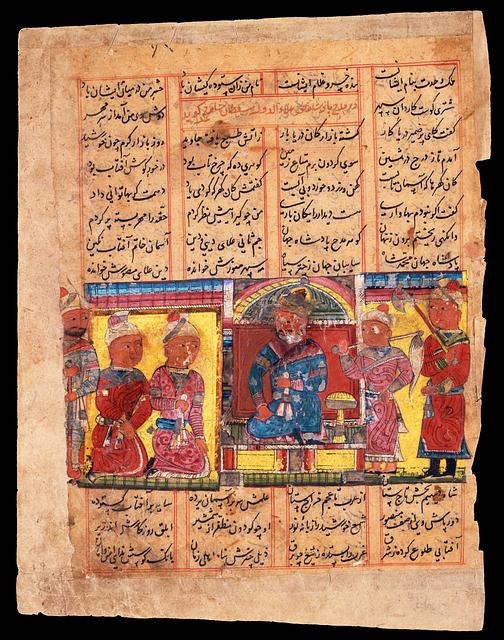
Miniature from a copy of Amir Khusraw Dihlawi’s Khamsa. ‘Amir Khusraw Dedicates his Work to Ala al-Din Muhammad Shah Khalji, Sultan of Delhi’
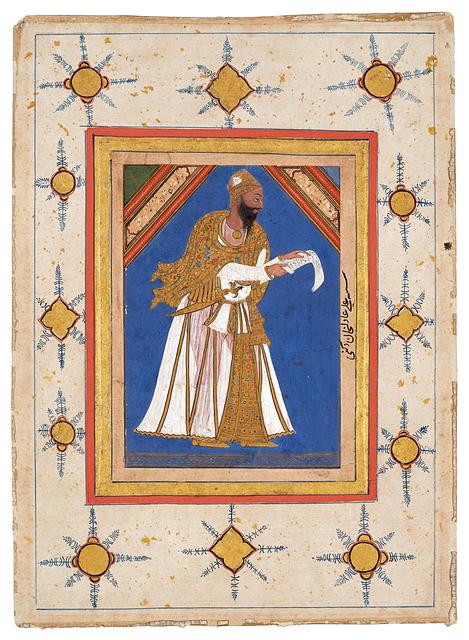
Miniature pasted on an album leaf. ‘Portrait of Sultan Ali Adil Shah I of Bijapur’
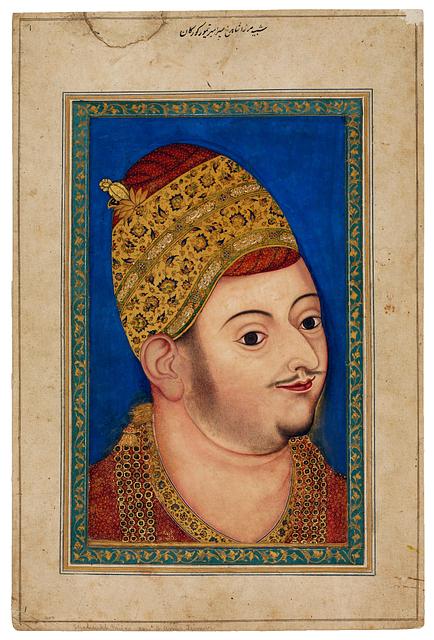
Miniature pasted on an album leaf. ‘Portrait of Sultan Ibrahim Adil Shah II of Bijapur’
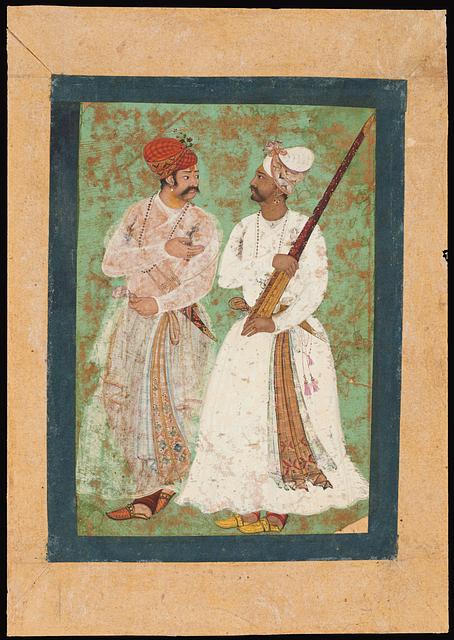
Miniature pasted on an album leaf. ‘Two Brothers in Conversation’