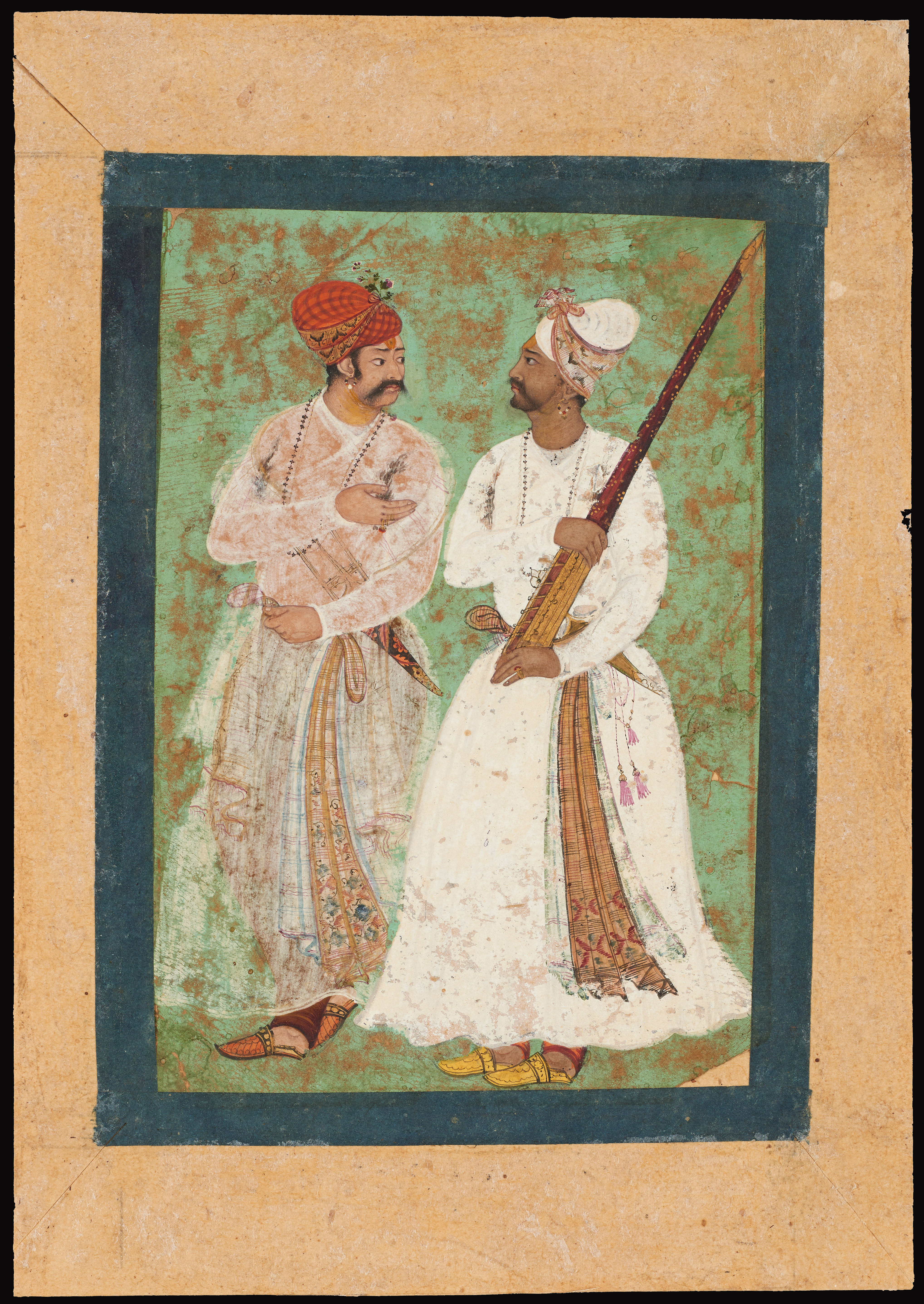
Miniature pasted on an album leaf. ‘Two Brothers in Conversation’
India, Deccan, Ahmadnagar; 1590-1595
Leaf: 17.9 × 12.8 cm
Miniature: 12 × 8.5 cm
Miniature: 12 × 8.5 cm
Inventory number 1/2015
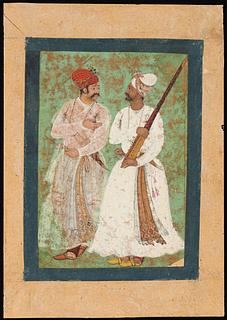
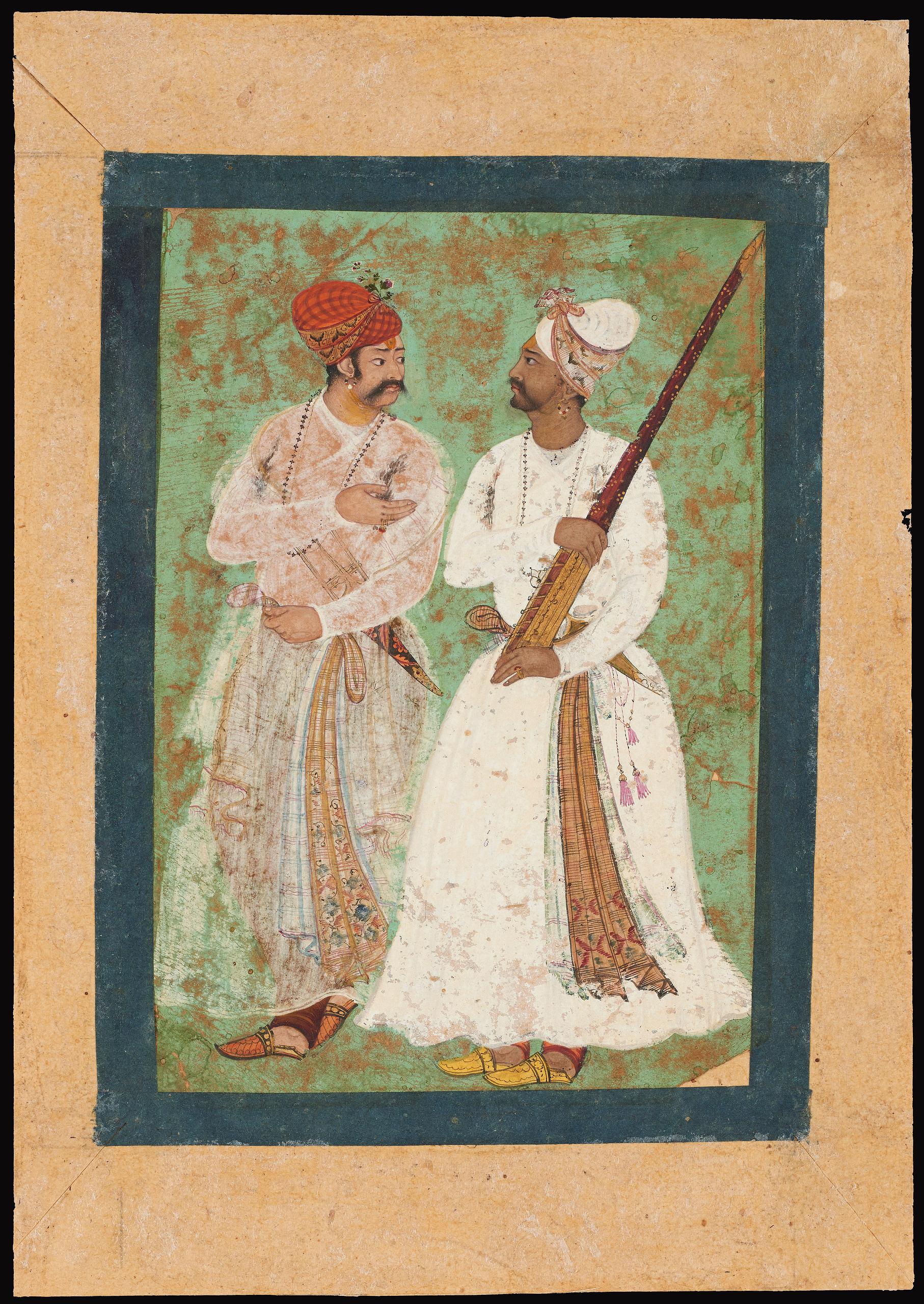
On the back of the album leaf is an inscription in Nastaliq that has been read as “Siva Basavanna and Gahami, two brothers.” The yellowish orange marks on their foreheads show that they are Hindus, which was unusual for members of the Muslim princely courts in the Deccan.
The two men are very vividly portrayed. The one on the right is shown in quarter profile, gesticulating enthusiastically as he grasps his sash firmly. The other, in profile, is listening as he holds something that resembles a musical instrument, though it cannot be identified. Both are finely dressed, their tall turbans tied elegantly, and clad in the white garments typical of the Deccan that like their sashes seem to be fluttering. The fine, vivacious faces, in particular, indicate that they were painted under the Nizam Shahis in Ahmadnagar, the northernmost of the Deccan sultanates and the first to be conquered by the Mughals in the first third of the 17th century.
The lively eyes, whose contours follow the round shape of the eyeballs, and the finely detailed mustaches are typical of Ahmadnagar, while the incipient influence of Mughal painting can be detected in the green background.
The two men are very vividly portrayed. The one on the right is shown in quarter profile, gesticulating enthusiastically as he grasps his sash firmly. The other, in profile, is listening as he holds something that resembles a musical instrument, though it cannot be identified. Both are finely dressed, their tall turbans tied elegantly, and clad in the white garments typical of the Deccan that like their sashes seem to be fluttering. The fine, vivacious faces, in particular, indicate that they were painted under the Nizam Shahis in Ahmadnagar, the northernmost of the Deccan sultanates and the first to be conquered by the Mughals in the first third of the 17th century.
The lively eyes, whose contours follow the round shape of the eyeballs, and the finely detailed mustaches are typical of Ahmadnagar, while the incipient influence of Mughal painting can be detected in the green background.
Published in
Published in
Ernst Kühnel: ”Die indischen Miniaturen der Sammlung Otto Sohn-Rethel” in Pantheon : Monatsschrift für Freunde und Sammler der Kunst, 1931, Hft 8, fig. 7;