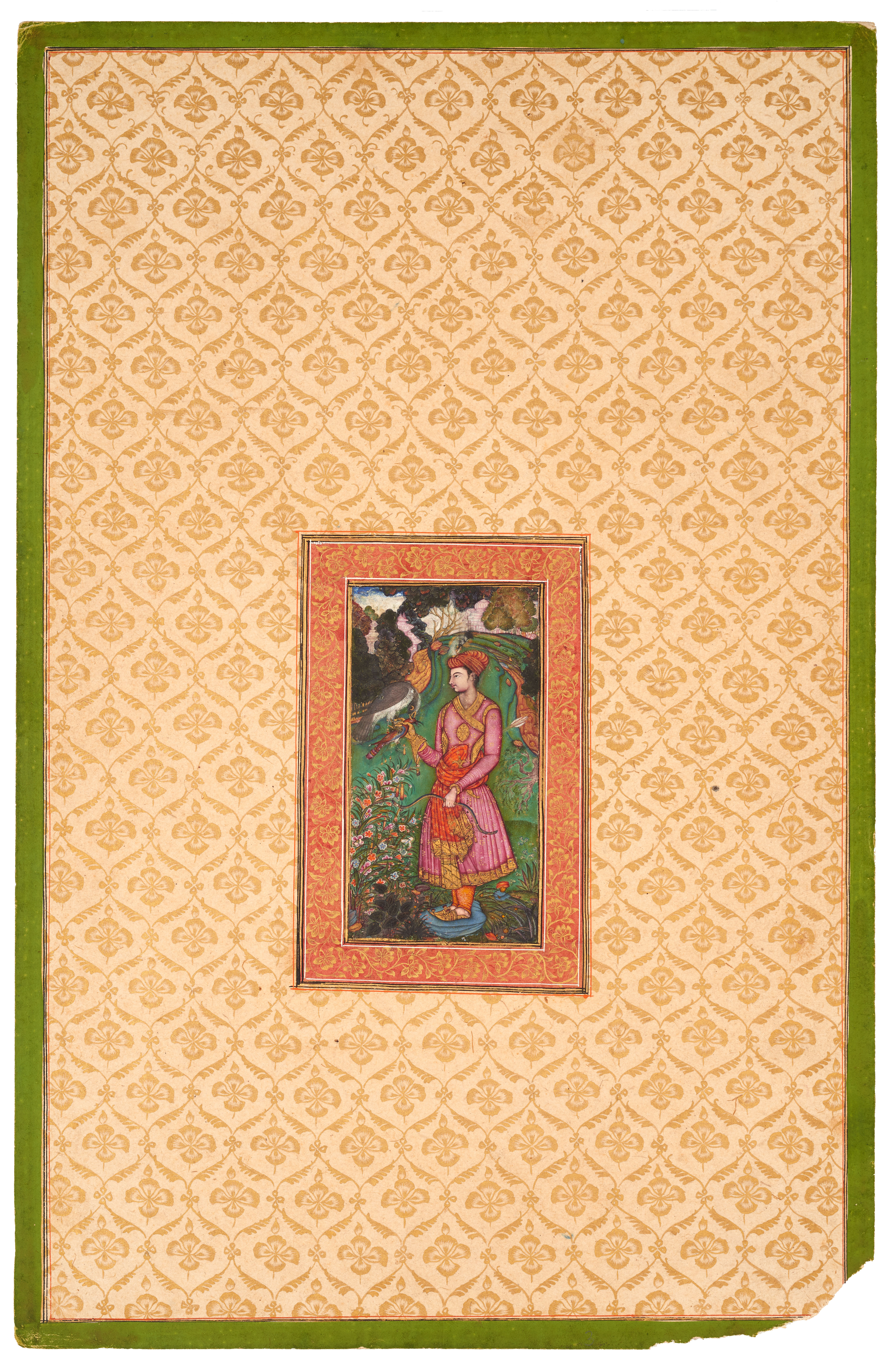
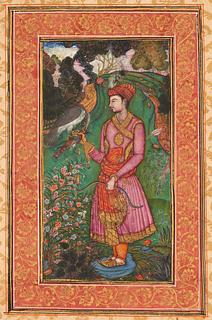
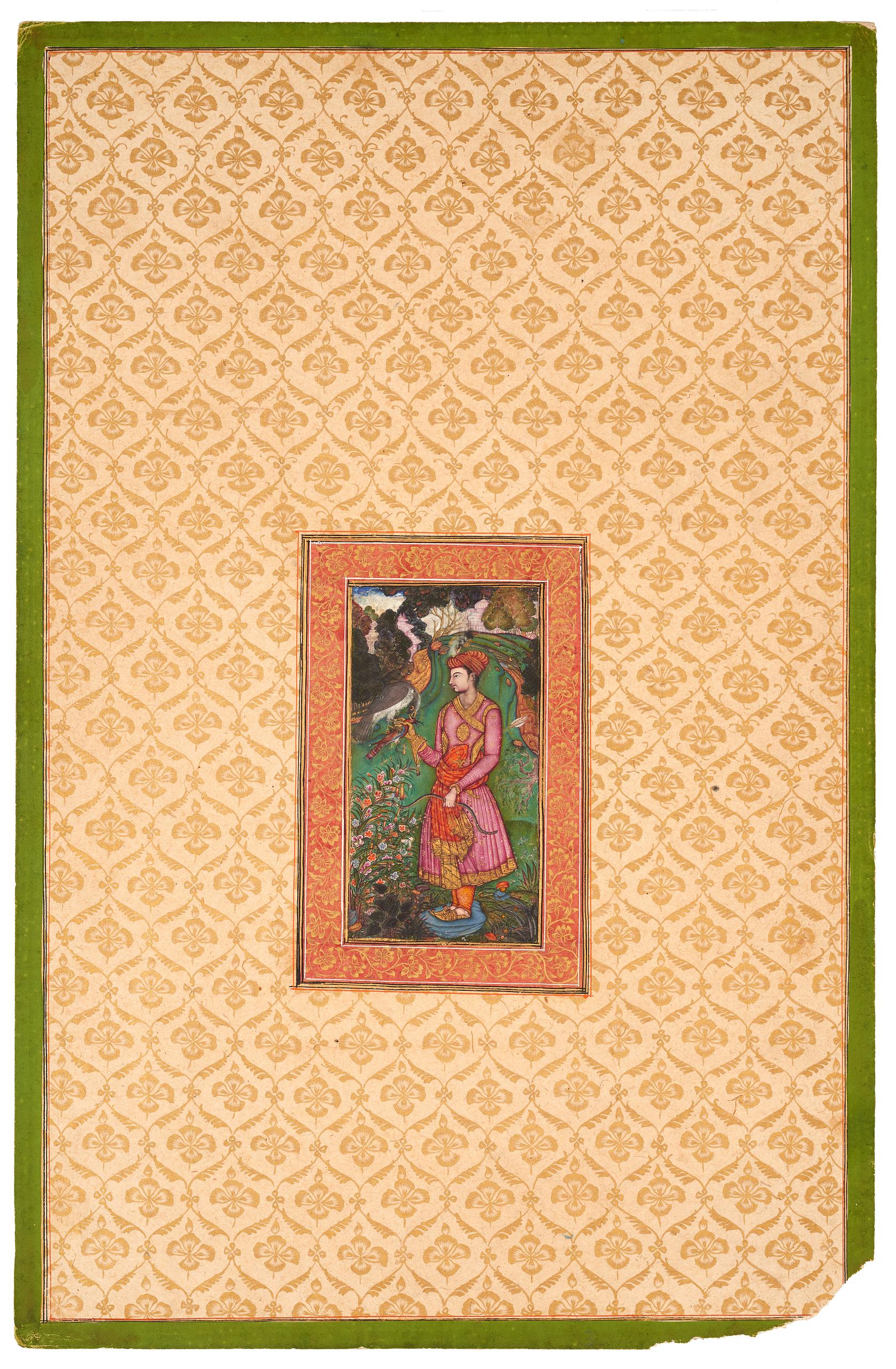
Miniature pasted on an album leaf. ‘A young prince with a falcon’
India, Deccan, Bijapur; c. 1600
Leaf H: 42.5; W: 27.5 cm. Miniature H: 11.4; W: 6 cm
Inventory number 12/2016
With its glowing colors, lush vegetation, and elegant, slightly mannered way of depicting the character, this miniature is a good example of visual art as it developed in Bijapur under Sultan Ibrahim Adil Shah (r. 1579-1626). Because of his strong personal involvement, many art forms flourished during his long reign, from music and poetry to painting and architecture.
One can detect a measure of influence from the Persian artist Farrukh Beg, who after a period at the court of the Great Mughal Akbar came to the Deccan, where he was active from 1590 to around 1605-1609 and developed a highly personal style.1
The painting has a poetic undertone and a lack of focus on naturalism, something emphasized by the rich use of gold — not only in the prince’s costly garments and weapons, but also in the landscape and the over-dimensioned falcon’s beak and eyes.
It is uncertain who produced this expressive miniature. A related painting in the Chester Beatty Library in Dublin has an inscription with the name Abd al-Karim, but the colors in that work are more garish and the drawing style is harder.2
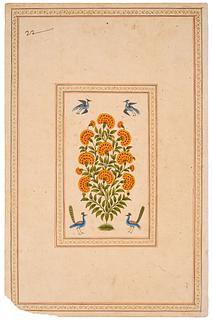
On the obverse is an 18th century painting of a tall and stylized marigold plant flanked by a pair of much smaller peacocks below and flying peahens above.
One can detect a measure of influence from the Persian artist Farrukh Beg, who after a period at the court of the Great Mughal Akbar came to the Deccan, where he was active from 1590 to around 1605-1609 and developed a highly personal style.1
The painting has a poetic undertone and a lack of focus on naturalism, something emphasized by the rich use of gold — not only in the prince’s costly garments and weapons, but also in the landscape and the over-dimensioned falcon’s beak and eyes.
It is uncertain who produced this expressive miniature. A related painting in the Chester Beatty Library in Dublin has an inscription with the name Abd al-Karim, but the colors in that work are more garish and the drawing style is harder.2
On the obverse is an 18th century painting of a tall and stylized marigold plant flanked by a pair of much smaller peacocks below and flying peahens above.
Published in
Published in
Kjeld von Folsach, Joachim Meyer and Peter Wandel: Fighting, Hunting, Impressing. Arms and Armour from the Islamic World 1500-1850, The David Collection, Copenhagen 2021, cat.no. 79;
Footnotes
Footnotes
1.
See Milo C. Beach “Farrukh Beg” in Milo C. Beach, Eberhard Fischer, and B.N. Goswamy (eds.): Masters of Indian Painting. Vol. 1: 1100-1650, [Zürich] 2011, pp. 187-210.
2.
Linda York Leach: Mughal and other Indian Paintings from the Chester Beatty Library, London 1995, vol. 1, pp. 405-407.
.jpg)