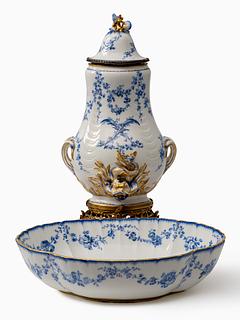
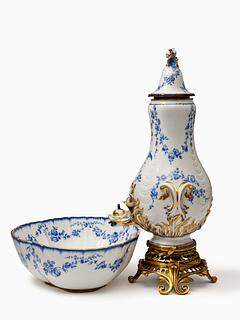
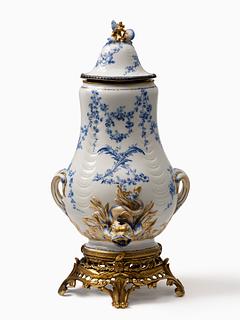
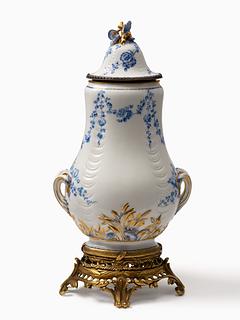
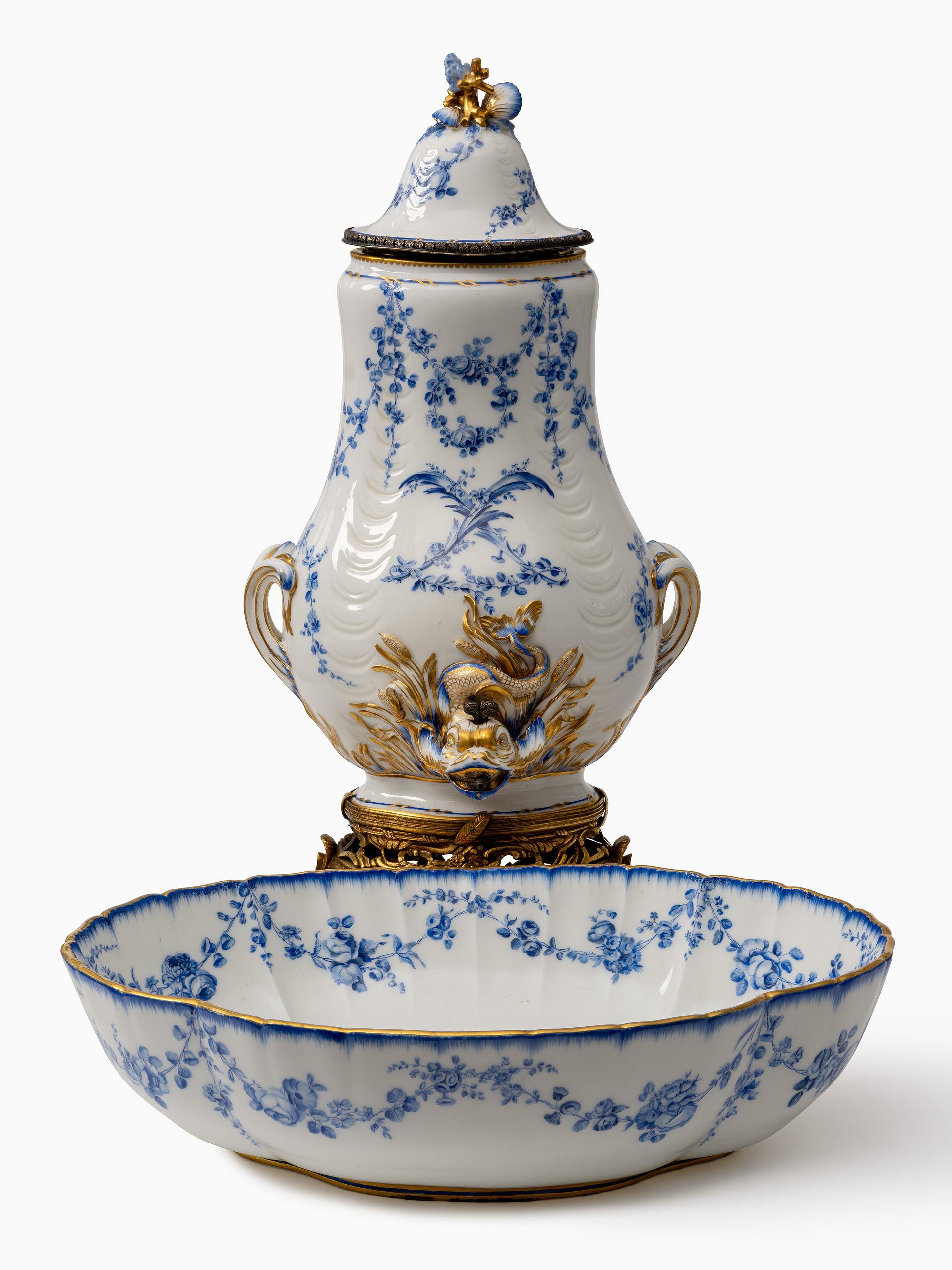
Fountain with basin (Fontaine à roseaux); soft-paste porcelain, silver and bronze
Vincennes, 1755
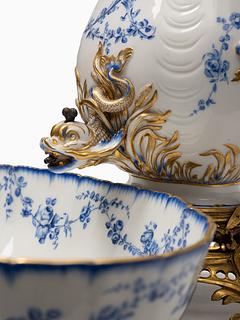
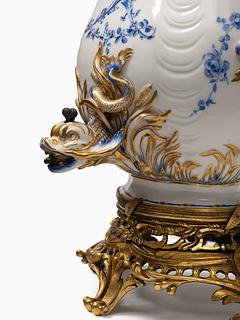
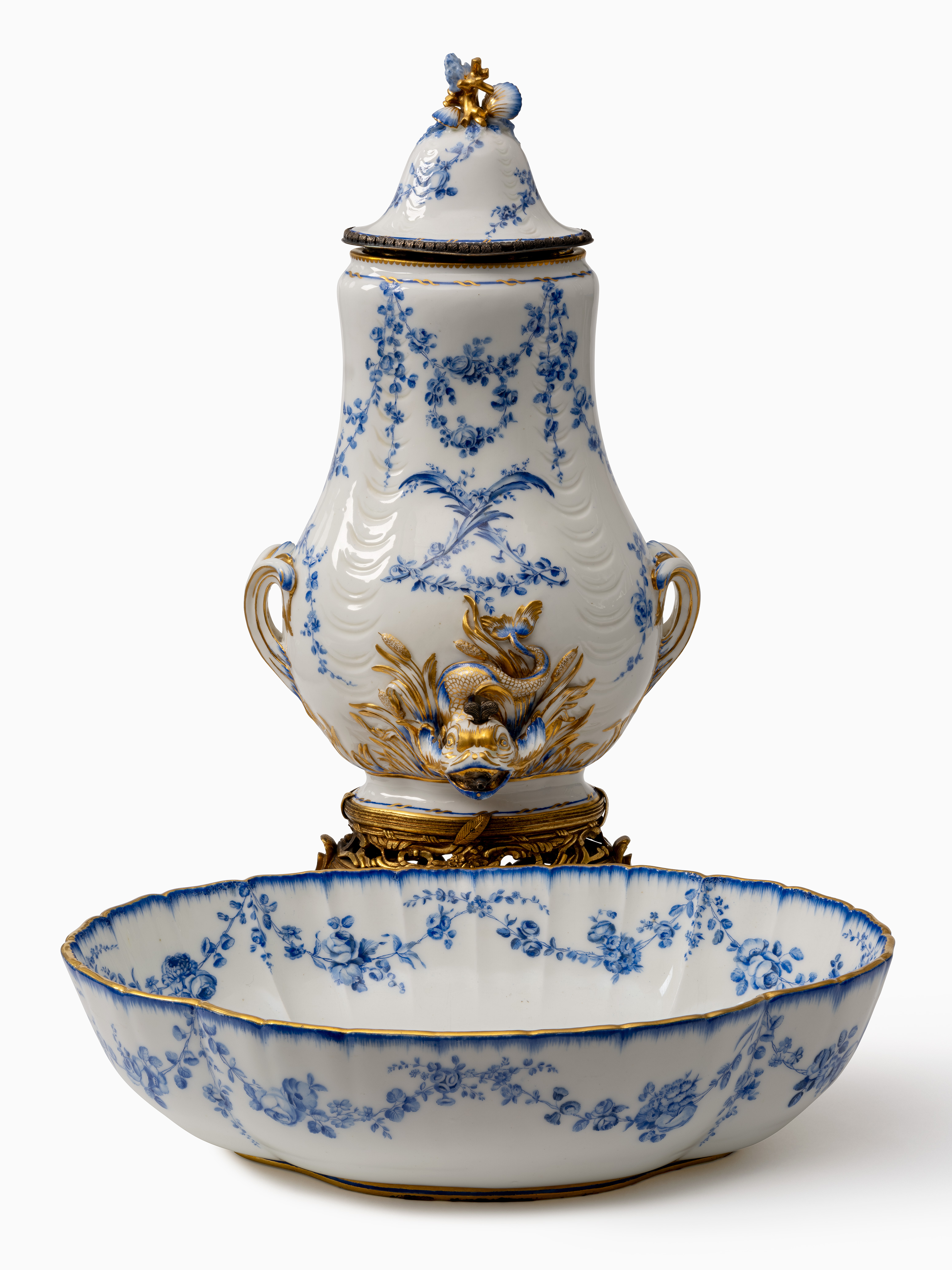
The fountain has a flattened, pear-shaped body with a cover and two handles, and rests on a gilt-bronze base with rocaille motifs. The spout is modelled as a dolphin and positioned so that its outlet aligns with the rim of the accompanying basin. The body of the fountain is decorated in relief with reeds and bulrushes, as well as shells and branches of coral. The painted decoration is executed in blue camaïeu and consists of floral garlands, rocaille ornaments and a large mirror monogram of two interlaced Ls on the front of the fountain. The upper edge and cover are fitted with silver bands, while the finial of the cover is adorned with a gilt porcelain branch surrounded by open cockle shells, modelled in such a way as to create the illusion of water flowing from them. The gently curving grooves on the body of the fountain may be understood as a visual reference to ripples on the surface of water.
The fountain was created by Jean-Claude Duplessis (c. 1699–1774), who from the late 1740s was the Vincennes manufactory’s most important designer and creative driving force. As head of modelling, he set the direction for the manufactory’s formal language and aesthetics, and he had a decisive influence on the artistic profile that came to characterise Vincennes in the mid-eighteenth century. Duplessis originally trained as a goldsmith and worked also as a sculptor, bronze founder and designer. He continually experimented with new forms and types, and his works are characterised by an extravagant and imaginative Rococo idiom in which plastic richness and technical virtuosity go hand in hand.2
Duplessis’s fountain is known in two variants with the same basic form, but with variations in the surface decoration.3 The earliest traces of the fountain are two profile drawings dated 6 March 1754 and inscribed ‘pour Mme la Dauphine’, suggesting that the fountain was intended for Maria Josepha Carolina of Saxony (1731–1767), who was married to Louis XV’s eldest son, Louis Ferdinand (1729–1765).4 That same year, the models and moulds were made, and the journals of the Vincennes manufactory record the firing of a fountain and several basins in December 1754. Only a very limited number of fountains were produced – probably no more than six or seven – among them the fountain in The David Collection. At least four were delivered to the court at Versailles in the years 1755–56.5
Published in
Published in
La porcelaine française de 1673 à 1914. La porcelaine contemporaine de Limoges, Pavillon de Marsan, Palais du Louvre, Paris 1929;
Slomann: Tilskueren, 1935, p. 23;
Mit bedste kunstværk. Udstilling i Statens Museum for Kunst, oktober 1941, Copenhagen 1941, cat. 415;
C.L. David: “Fransk blødt porcelæn,” in C.L. Davids Samling, vol. 2, Copenhagen 1953, pp. 74-75, 103-105;
Pierre Verlet, Serge Grandjean and Marcelle Brunet: Les porcelaines de Sèvres, Paris 1953, pl. 20;
Svend Eriksen: The James A. de Rothchild Collection at Waddesdon Manor: Sèvres Porcelain, Fribourg 1968, p. 56, cat. 12;
Erik Lassen: Keramik. En gennemgang af keramikkens historie i Europa fra middelalderen til vor tid, Copenhagen 1969, pp. 136-137;
Marcelle Brunet and Tamara Préaud: Sèvres des origines à nos jours, Fribourg 1978, p. 146, fig. 68;
Svend Eriksen: Davids Samling. Fransk porcelæn = The David Collection. French Porcelain, Copenhagen 1980, p. 29, cat. 43-44, ill. bageste friblad;
Svend Eriksen and Geoffrey du Bellaigue: Sèvres porcelain. Vincennes and Sèvres 1740-1800, London 1987, p. 93-94, 298-299, cat. 109;
Tamara Préaud and Antoine d'Albis: La porcelaine de Vincennes, Paris 1991, p. 191, cat. 228;
Kristian Hvidt: Kunst og kapital. Portræt af C.L. David og hans verden, Copenhagen 2008, pp. 182-183;
Footnotes
Footnotes
Kristian Hvidt: Kunst og kapital. Portræt af C.L. David og hans verden, Copenhagen 2008, p. 182.
Rosalind Savill: The Wallace Collection. Catalogue of Sèvres Porcelain, London 1988. See vol. 3, pp. 977-979.
Svend Eriksen and Geoffrey du Bellaigue: Sèvres porcelain. Vincennes and Sèvres 1740–1800, London 1987, pp. 93-94.
The profile drawing and the two interlaced Ls that form the royal mirror monogram make it likely that the fountain belonged to the royal couple.
Svend Eriksen and Geoffrey du Bellaigue: Sèvres porcelain. Vincennes and Sèvres 1740–1800, London 1987, p. 298.