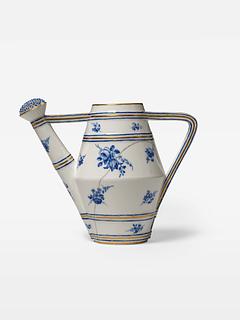
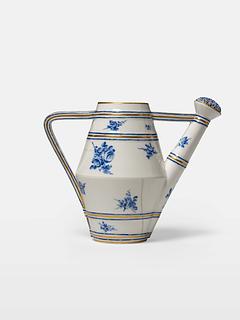
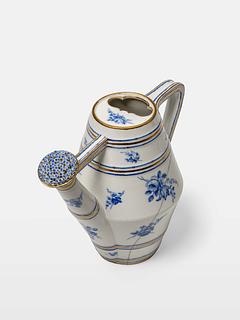
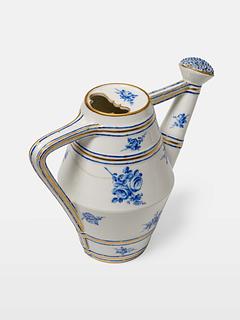
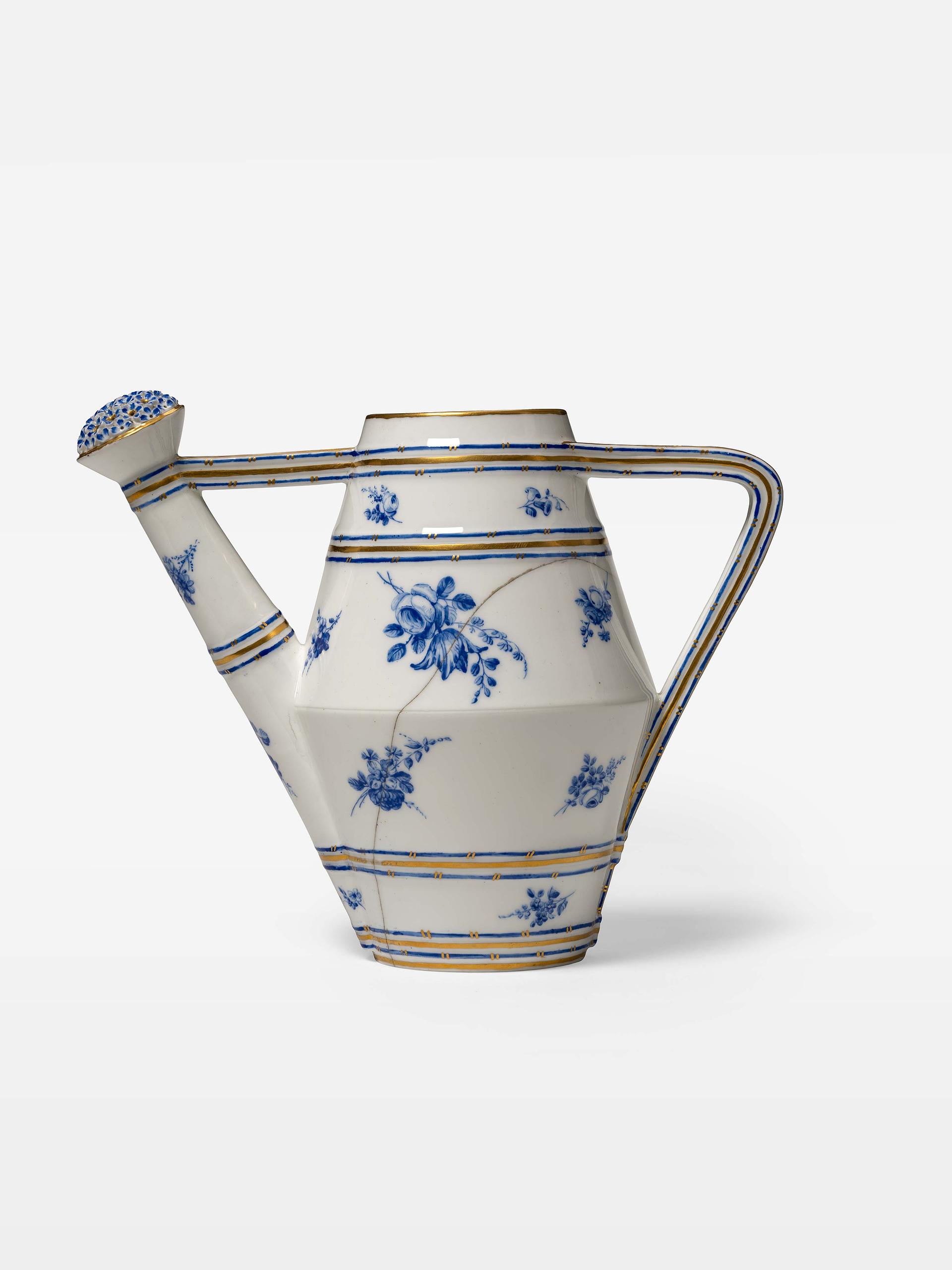
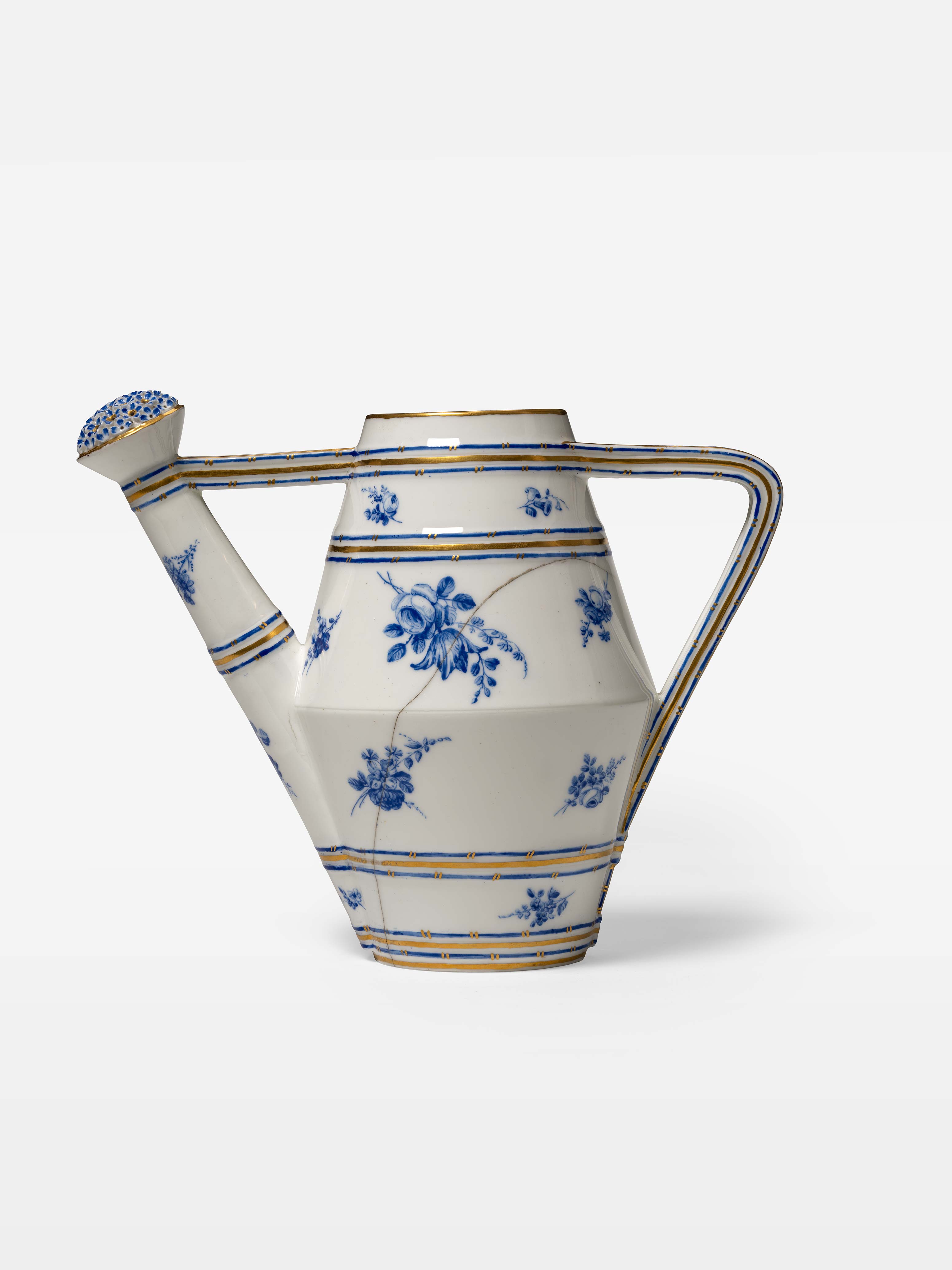
Watering can (Arrosoir); soft-paste porcelain
Vincennes, 1754
Inventory number FK 86
The museum’s founder, C. L. David, had a particular interest in eighteenth-century French ceramics. Even so, a large proportion of the collection’s French objects were acquired after his death, especially porcelain from the Vincennes and Sèvres manufactories. This watering can of soft-paste porcelain – one of the few known examples of this model – is among the objects purchased by David himself.
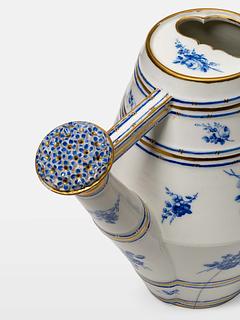
The body of the watering can consists of two broad, outward-curving sections that meet in a clearly defined central seam, giving the form a well-balanced and harmonious appearance. The long, diagonally sloping spout and the angular handle lend it a sculptural, almost architectural quality, with symmetry and proportion brought to the fore.
The watering can is decorated in blue with bouquets and sprays of flowers, including ranunculi, forget-me-nots and roses. Particularly characteristic are the horizontal bands in blue and gold that encircle the foot, body and rim. On the funnel-shaped spout is a bouquet of small flowers, each pierced with fine little holes to distribute the water in a gentle shower. The watering can was probably used indoors for watering potted plants.
This type of vessel, known as an arrosoir, was made at Vincennes in two sizes. The museum’s example belongs to the smaller, rare variant, of which only very few examples survive today.1
Published in
Published in
C. L. David: ‘Fransk blødt porcelæn’, in C. L. Davids Samling, vol. 2, Copenhagen 1953, pp. 74-75, 106-07;
Svend Eriksen: Davids Samling. Fransk porcelæn = The David Collection. French Porcelain, Copenhagen 1980, cat. 39 and ill., rear flyleaf;
Svend Eriksen and Geoffrey de Bellaigue: Sèvres Porcelain. Vincennes and Sèvres 1740–1800, London 1987, p. 287, cat. 100;
Adrian Sassoon: Vincennes and Sèvres Porcelain. Catalogue of the Collections, J. Paul Getty Museum, Malibu 1991, pp. 4-7, cat. 1;
Footnotes
Footnotes
1.
Adrian Sassoon: Vincennes and Sèvres porcelain. Catalogue of the Collections, J. Paul Getty Museum, Malibu 1991, p. 4. A similar watering can is housed in the Gardiner Museum, Toronto; their example has polychrome decoration (inv. G84.1.3).