In 2018, The David Collection acquired an unusual Ottoman manuscript: The Gift of the Kings. It is a manual that describes and guides the reader through various aspects and dimensions of human sexuality. We only know of four different copies of The Gift of the Kings worldwide, and this particular manuscript is the most ambitious of the four, completed in 1817 after at least eighteen years of work.
The Art of Desire – An Ottoman Sex Manual and Its Context
November 6, 2026
Press Release
Over the past four years, three Turkish scholars of ottoman history and art history have translated and analysed the manuscript. In conjunction with the publication of their research, The David Collection now presents an exhibition on this remarkable work and the visual and literary traditions to which it belongs.
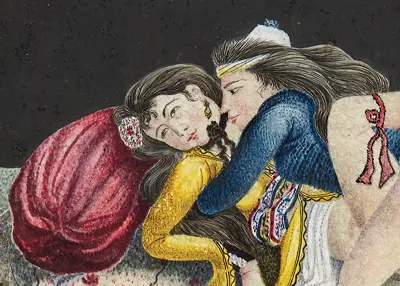
The manuscript’s 85 illuminated paintings make it an exceptional work of art. These paintings represent a pinnacle of late Ottoman visual culture, distinguished by their remarkably well-preserved colours, technical virtuosity, and richness of detail. Many depict sexually explicit scenes, often with a humorous dimension. What is so extraordinay about these paintings is, that they also serve as unique testimonies to contemporary fashion, interiors, everyday life, and the emergence of a globalised world. The exhibition takes selected paintings as its point of departure and explores their artistic, historical, and cultural context.
Commissioned by an unknown patron, the manuscript is a compilation of texts drawn from older Turkish, Persian, and Arabic sources. Its material can be traced back to an Arabic sex manual from the thirteenth century. Through centuries of copying and adaptation it was expanded with fictional stories, poems, and anecdotes, several of which are also known from One Thousand and One Nights. The result is a substantial work that combines erotic literature, scholarship, and storytelling.
Both the text and the images reflect a distinctly male perspective on sexuality, offering a rare insight into the interests of the patron, as well as into a personal and private visual world reserved for a small, affluent elite, existing alongside the wider civil society. This particular manuscript is notable for its strong focus on same-sex relationships, especially between men, and the patron himself may even have be portrayed in several of the book’s illustrations.
The exhibition also places the manuscript within a broader geocultural context. Erotic visual traditions from India, Iran, and Turkey are presented alongside Japanese shunga prints and European graphic works from the same period. Despite geographical and cultural differences, these works testify to artistic traditions that often existed on the margins of contemporary social and religious norms and were therefore subject to censorship.
Several of the exhibition’s images and themes may appear unfamiliar or challenging in relation to present-day norms. Nevertheless, they invite reflection on issues of power, gender, sexuality, consent, and social hierarchies, as well as on the depiction of the private, the controversial, and the forbidden in visual arts. What do we grant art permission to show, and where do we draw the line?
The manuscript is currently undergoing conservation and has therefore been disbound. Following the exhibition, it will be reassembled and rebound, meaning that its extensive visual material will no longer be accessible in the same way. The exhibition thus offers a unique opportunity for the public to experience the manuscript unfolded as a work of visual art. It provides a rare glimpse into a deeply private visual world from before the world went viral.
The exhibition is accompanied by a catalogue published in both Danish and English. In addition, a public events programme will explore themes such as gender identity, power, subcultures, and the body in art from a contemporary perspective.
The Art of Desire – An Ottoman Sex Manual and Its Context
November 6, 2026 – May 2, 2027
For further information or press images, please contact:
[email protected]