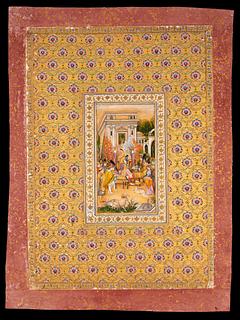
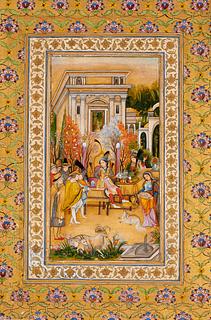
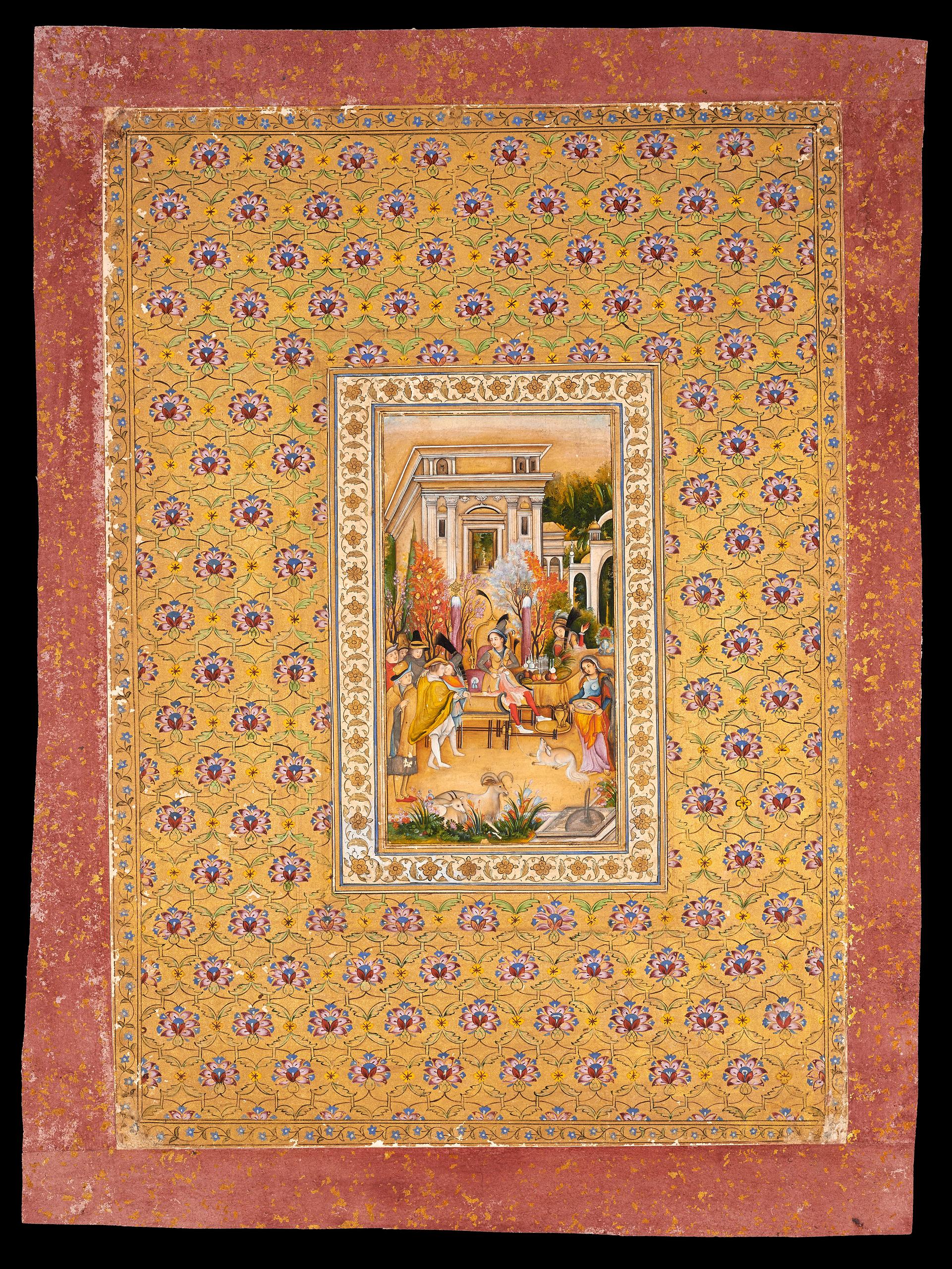
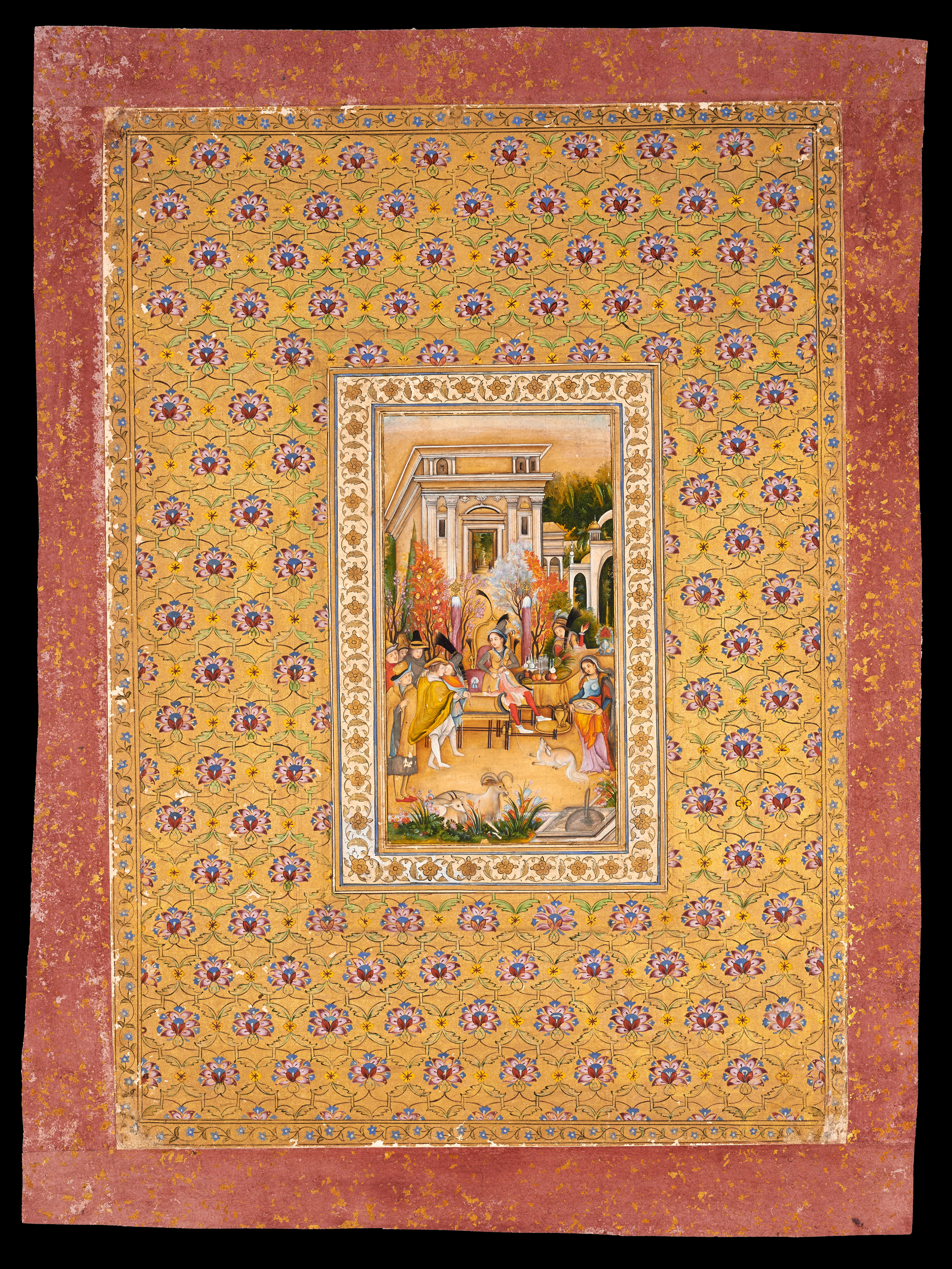
Miniature pasted on an album leaf. ‘A European Banquet.’ Attributed to Mir Kalan Khan
India, Faizabad or Lucknow; 1765-75
Leaf: 52 × 38.5 cm
Inventory number 54/2013
This banquet scene was painted in the quite eccentric style and with a garish palette dominated by yellow nuances that were characteristic of the art of Mir Kalan Khan. After the murder of the Mughal emperor Alamgir II in 1759, he and many other artists left the court in Delhi and found work at the courts in Faizabad and Lucknow in eastern India.
Contact there to the French and English, who were playing an increasingly important political role at the time, was undoubtedly the reason for this period’s “European” motifs based on Western models.
A scene with Herod and Salome with the head of John the Baptist on a platter probably provided the miniature’s curious motif: one woman enthroned at a banquet table and another on the right bearing the head of an animal on a platter.
The architecture is European Renaissance, providing a deep-perspective view through the gateway, and the entire scene is set in a garden with trees and gaudy-colored flowers.
Contact there to the French and English, who were playing an increasingly important political role at the time, was undoubtedly the reason for this period’s “European” motifs based on Western models.
A scene with Herod and Salome with the head of John the Baptist on a platter probably provided the miniature’s curious motif: one woman enthroned at a banquet table and another on the right bearing the head of an animal on a platter.
The architecture is European Renaissance, providing a deep-perspective view through the gateway, and the entire scene is set in a garden with trees and gaudy-colored flowers.
Published in
Published in
Jeremiah P. Losty: A prince's eye: imperial Mughal paintings from a princely collection: art from the Indian courts, Galloway, London 2013, cat.no. 10;
Kjeld von Folsach, Joachim Meyer: The Human Figure in Islamic Art – Holy Men, Princes, and Commoners, The David Collection, Copenhagen 2017, fig. 59, p. 254;
Kjeld von Folsach, Joachim Meyer: The Human Figure in Islamic Art – Holy Men, Princes, and Commoners, The David Collection, Copenhagen 2017, fig. 59, p. 254;