Miniature pasted on an album leaf. ‘A Prince Receiving an Emissary’
India, Delhi or Awadh; c. 1750–60
The leaf: 40 x 28.7 cm
Inventory number 38/1980
The painting is signed by Nidhal Mal. He had worked for the Mughal emperor Muhammad Shah (1719–48) but was among the artists who left Delhi when the Mughal court gradually lost its importance. He set out east for Lucknow in Awadh, one of the provinces which, now being ruled by local governors, achieved de facto independence in the languishing Mughal empire.
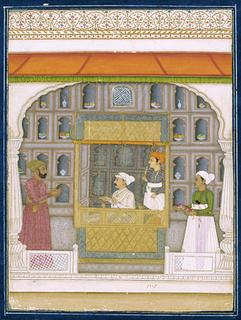
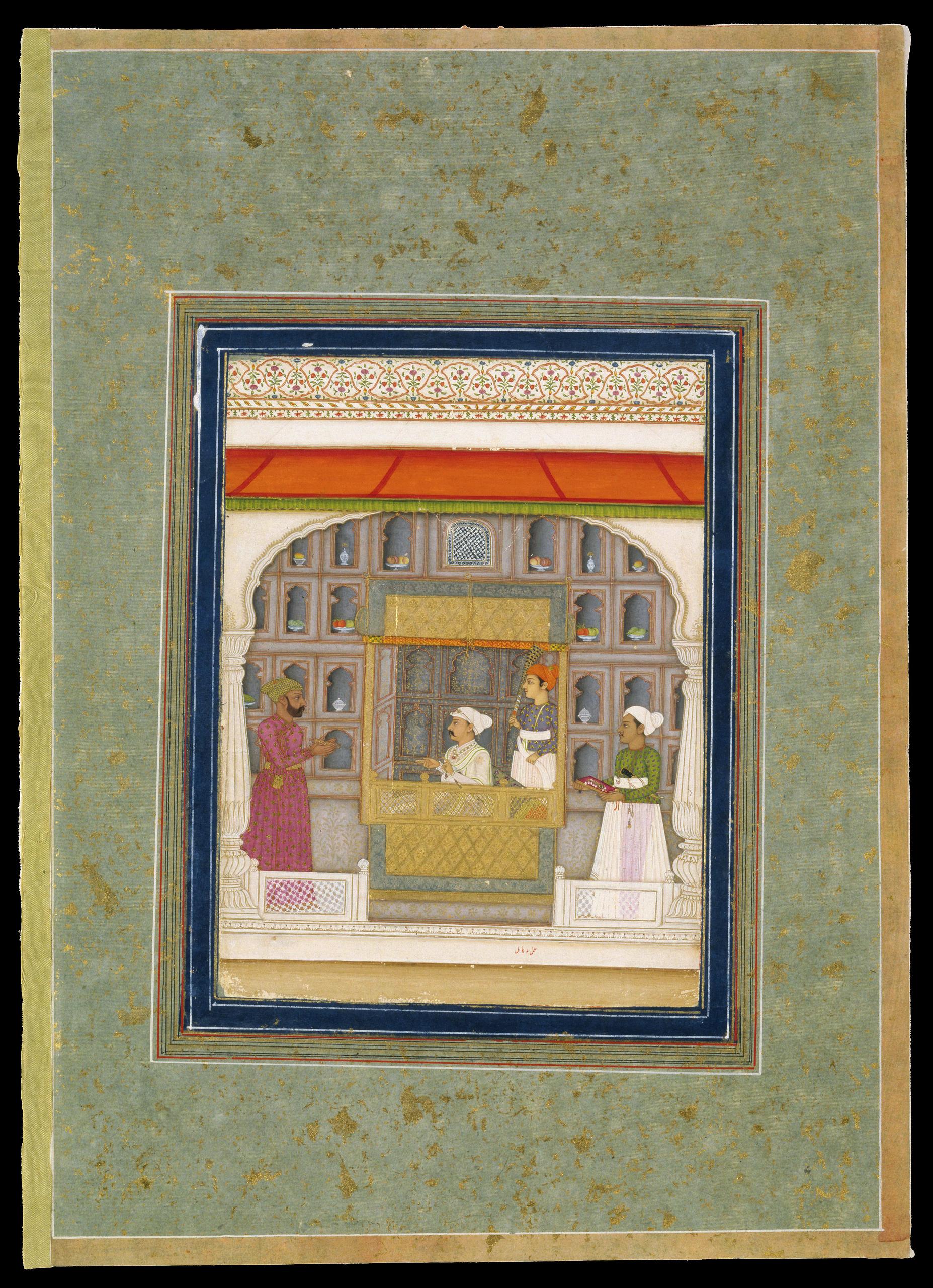
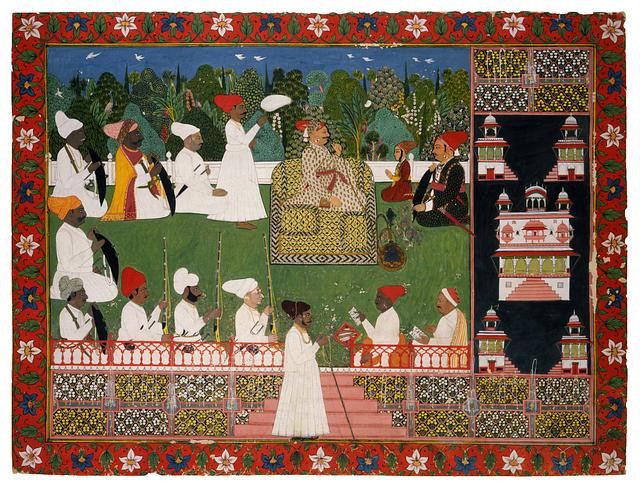
The identity of the central figure of the painting is a matter of dispute. He also appears in another painting attributed to Nidhal Mal, showing him seated underneath a canopy in a palace garden.1 It has been suggested that this is a depiction of Shuja al-Dawla, governor of Awadh (1754–75).2 He might also be Raja Newal Rai, who was deputy governor of Awad in the 1740s and died died in 1751. This is supported by the fact that his name appears in a third painting which seems to depict the same prince. Furthermore, a specific element of his clothes indicates that this is a Hindu prince: his jama opens on the left side as opposed to the one worn by Muslims, which is traditionally opened on the right.3
In any case, the picture shows a prince sitting by a jharokha, a type of bay window found in palaces and from which Indian rulers allowed themselves to be viewed by their subjects. He is about to receive a – compared to himself – darker-skinned emissary bringing a missive in a silken pouch. Behind the prince, a servant stands ready with a turban ornament, which the emissary will undoubtedly receive in return. In the background are sandstone niches holding imported Chinese porcelain.
The identity of the central figure of the painting is a matter of dispute. He also appears in another painting attributed to Nidhal Mal, showing him seated underneath a canopy in a palace garden.1 It has been suggested that this is a depiction of Shuja al-Dawla, governor of Awadh (1754–75).2 He might also be Raja Newal Rai, who was deputy governor of Awad in the 1740s and died died in 1751. This is supported by the fact that his name appears in a third painting which seems to depict the same prince. Furthermore, a specific element of his clothes indicates that this is a Hindu prince: his jama opens on the left side as opposed to the one worn by Muslims, which is traditionally opened on the right.3
In any case, the picture shows a prince sitting by a jharokha, a type of bay window found in palaces and from which Indian rulers allowed themselves to be viewed by their subjects. He is about to receive a – compared to himself – darker-skinned emissary bringing a missive in a silken pouch. Behind the prince, a servant stands ready with a turban ornament, which the emissary will undoubtedly receive in return. In the background are sandstone niches holding imported Chinese porcelain.
Published in
Published in
Sotheby’s, London, 21/4-1980, lot 141;
Kjeld von Folsach, Torben Lundbæk and Peder Mortensen (eds.): Sultan, Shah and Great Mughal: the history and culture of the Islamic world, The National Museum, Copenhagen 1996, cat.no. 313;
Barbara Schmitz: “After the Great Mughals” in Barbara Schmitz (ed.): After the Great Mughals: painting in Delhi and the regional courts in the 18th and 19th centuries, Mumbai 2002, fig. 3, p. 4;
Kjeld von Folsach: For the Privileged Few: Islamic Miniature Painting from The David Collection, Louisiana, Humlebæk 2007, cat.no. 111;
J. P. Losty and Malini Roy: Mughal India: Art, culture and empire: manuscripts and paintings in the British Library, London 2012, pp. 169 and 245, note 62;
Terence McInerney: “The patronage of Shuja-ud-Daula of Awadh and the work and influence of his principal court artists” in Artibus Asiae, 2019, 79: 1, fig. 4, p. 59;
Kjeld von Folsach, Torben Lundbæk and Peder Mortensen (eds.): Sultan, Shah and Great Mughal: the history and culture of the Islamic world, The National Museum, Copenhagen 1996, cat.no. 313;
Barbara Schmitz: “After the Great Mughals” in Barbara Schmitz (ed.): After the Great Mughals: painting in Delhi and the regional courts in the 18th and 19th centuries, Mumbai 2002, fig. 3, p. 4;
Kjeld von Folsach: For the Privileged Few: Islamic Miniature Painting from The David Collection, Louisiana, Humlebæk 2007, cat.no. 111;
J. P. Losty and Malini Roy: Mughal India: Art, culture and empire: manuscripts and paintings in the British Library, London 2012, pp. 169 and 245, note 62;
Terence McInerney: “The patronage of Shuja-ud-Daula of Awadh and the work and influence of his principal court artists” in Artibus Asiae, 2019, 79: 1, fig. 4, p. 59;
Footnotes
Footnotes
1.
The British Library, Johnson Album 24, 7, see J. P. Losty and Malini Roy: Mughal India: Art, Culture and Empire: Manuscripts and Paintings in the British Library, London 2012, fig. 110.
2.
Barbara Schmitz: ‘After the Great Mughals’ in Barbara Schmitz (ed.): After the Great Mughals: Painting in Delhi and the Regional Courts in the 18th and 19th centuries, Mumbai 2002, p. 4 and Terence McInerney: ‘The patronage of Shuja-ud-Daula of Awadh and the work and influence of his principal court artists’, Artibus Asiae, 2019, 79: 1, fig. 4 and p. 79.
3.
J. P. Losty and Malini Roy: Mughal India: Art, Culture and Empire: Manuscripts and Paintings in the British Library, London 2012, s. 169.
.jpg)
.jpg)
.jpg)
.jpg)
.jpg?disposition=attachment)