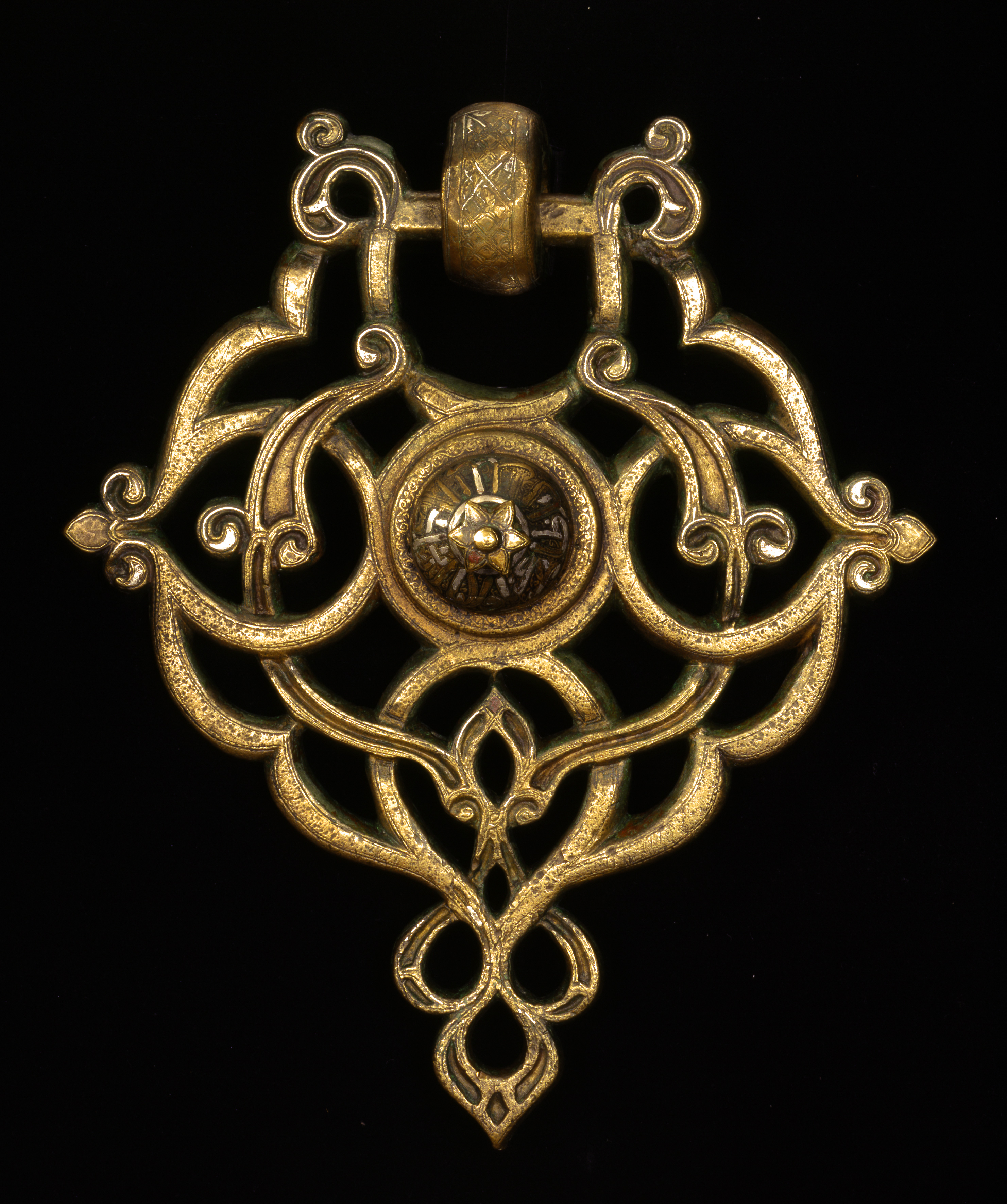
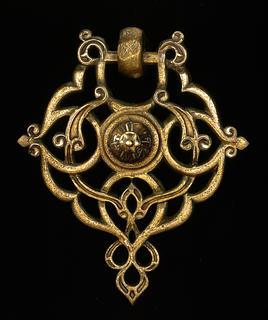
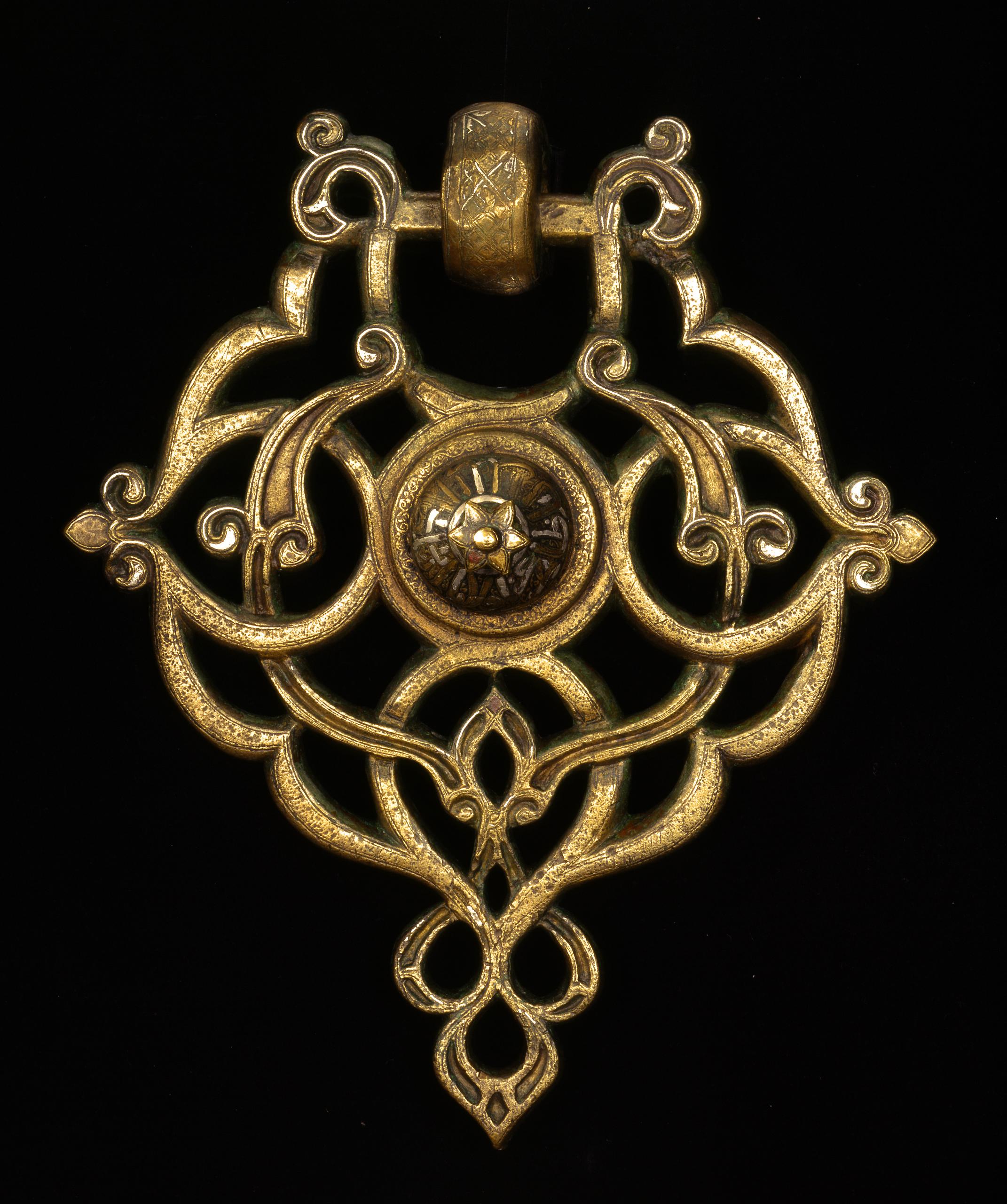
Door handle, bronze with remnants of silver inlay
Egypt; c. 1386
H: 35; W: 29 cm
Inventory number 32/1997
“Honor to our lord Sultan al-Malik al-Zahir,” reads the inscription on the central boss on this door handle, which until around 1900 was on one of the doors of Sultan Barquq’s madrasa (religious school) and khanqah (Sufi monastery) in Cairo. The structure was built between 1384 and 1386 by the court architect Ahmad al-Tuluni and is still one of the finest monuments from the Burji Mamluk period (1382-1517).
The handle can be viewed as a compact symmetrical arabesque that seems more delicate than the museum’s door handles and knockers from Anatolia and Iraq. There are still traces of silver in the inscription and the narrow engravings, while the niello (?) that may have been inlaid in the large hollows has disappeared.
The handle can be viewed as a compact symmetrical arabesque that seems more delicate than the museum’s door handles and knockers from Anatolia and Iraq. There are still traces of silver in the inscription and the narrow engravings, while the niello (?) that may have been inlaid in the large hollows has disappeared.
Published in
Published in
Kjeld von Folsach: Art from the World of Islam in the David Collection, Copenhagen 2001, cat. 516;
Luitgard E. M. Mols: Mamluk Metalwork Fittings in their Artistic and Architectural Context, Delft 2006, pp. 230-231, cat. 26/2 og p. 410, pl. 83;
Carine Juvin (ed.): Mamlouks. 1250-1517, Musée du Louvre, Paris 2025, fig. 185, p. 257 and p. 346, cat. 185;
Carine Juvin (ed.): Mamluks. Legacy of an Empire, Louvre Abu Dhabi, Paris 2025, p. 202, cat. 94;
Luitgard E. M. Mols: Mamluk Metalwork Fittings in their Artistic and Architectural Context, Delft 2006, pp. 230-231, cat. 26/2 og p. 410, pl. 83;
Carine Juvin (ed.): Mamlouks. 1250-1517, Musée du Louvre, Paris 2025, fig. 185, p. 257 and p. 346, cat. 185;
Carine Juvin (ed.): Mamluks. Legacy of an Empire, Louvre Abu Dhabi, Paris 2025, p. 202, cat. 94;
.jpg)