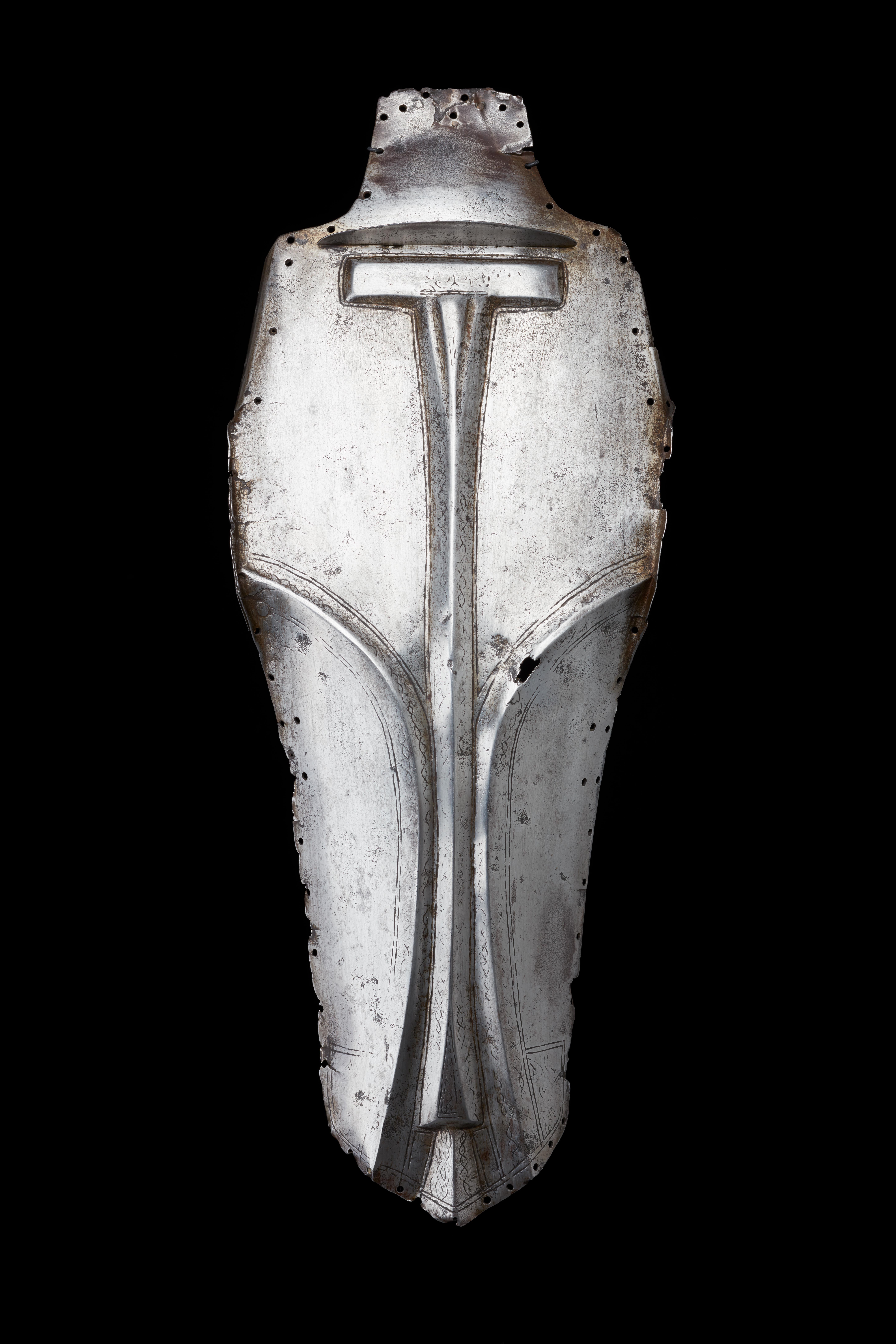
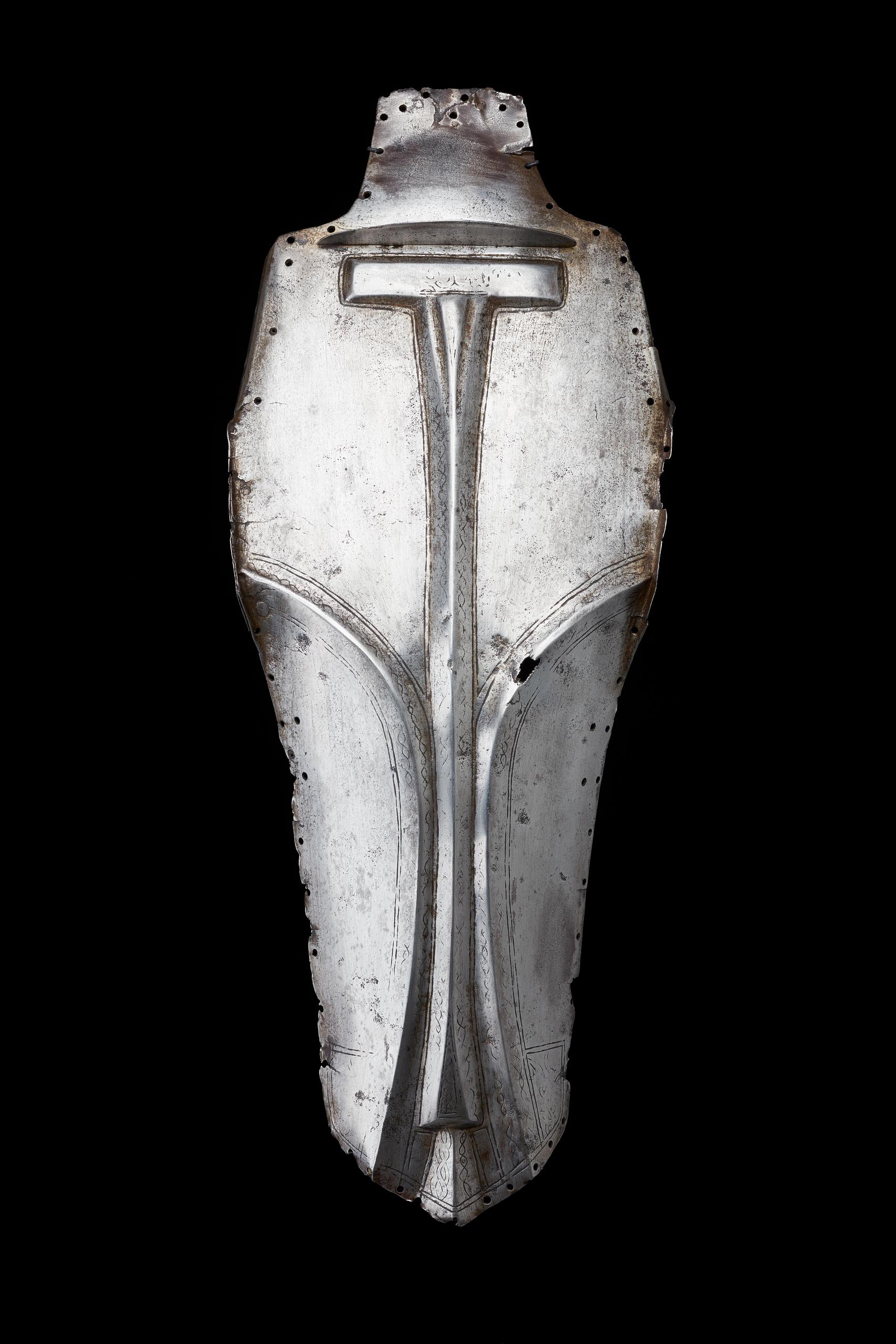
Chamfron of steel
Ottoman Empire; 16th century
H: 44.6 cm
Inventory number 3/1979
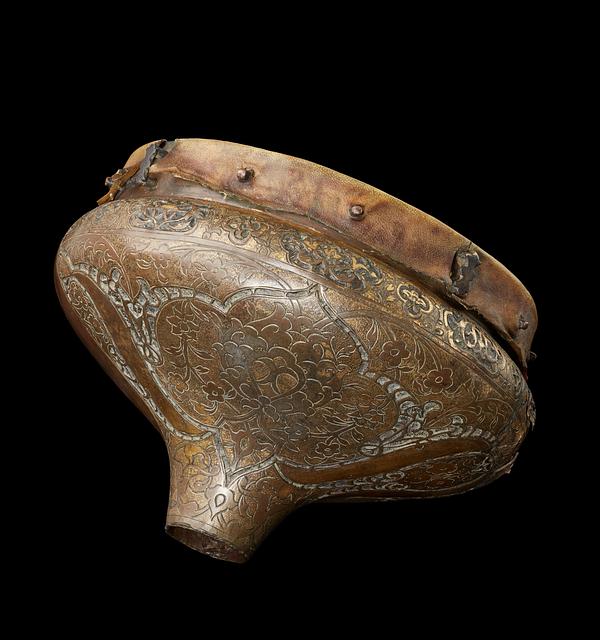
This piece of armour was used to protect the front of a horse’s head from the ears and down to the muzzle. Along the edges are holes for attaching mail rings, which would in turn have held several smaller plates to protect the horse’s cheeks. On the inside, the chamfron was presumably padded with wool and lined with leather. Like the mail, the padding was secured using the holes along the edge of the chamfron.
Head armour for horses was widespread throughout the Islamic world from the fifteenth to the seventeenth century, appearing in many different designs (10/1980). In the sixteenth- and seventeenth-century Ottoman Empire, the preference was for shorter pieces of the type shown here, with a wide, flat forehead and sharply curved edges.
The centre is adorned with a long T-shaped ridge, another characteristic trait of the type. In this case, the transverse bar of the T carries the remains of a short inscription in Arabic, imploring God to grant a speedy victory. Apart from the inscription, however, the chamfron carries little decoration, and it was undoubtedly intended for use in combat.
In addition to chamfrons, the horses of the heavy cavalry were also equipped with a caparison made of steel and leather or textile, protecting the animal’s neck and body (44/2006).
Head armour for horses was widespread throughout the Islamic world from the fifteenth to the seventeenth century, appearing in many different designs (10/1980). In the sixteenth- and seventeenth-century Ottoman Empire, the preference was for shorter pieces of the type shown here, with a wide, flat forehead and sharply curved edges.
The centre is adorned with a long T-shaped ridge, another characteristic trait of the type. In this case, the transverse bar of the T carries the remains of a short inscription in Arabic, imploring God to grant a speedy victory. Apart from the inscription, however, the chamfron carries little decoration, and it was undoubtedly intended for use in combat.
In addition to chamfrons, the horses of the heavy cavalry were also equipped with a caparison made of steel and leather or textile, protecting the animal’s neck and body (44/2006).
Published in
Published in
Kjeld von Folsach: Islamic art. The David Collection, Copenhagen 1990, cat.no. 364;
Kjeld von Folsach: Art from the World of Islam in The David Collection, Copenhagen 2001, cat.no. 560;
Kjeld von Folsach, Joachim Meyer and Peter Wandel: Fighting, Hunting, Impressing. Arms and Armour from the Islamic World 1500-1850, The David Collection, Copenhagen 2021, cat.no. 73 and Appendix p. 278;
Kjeld von Folsach: Art from the World of Islam in The David Collection, Copenhagen 2001, cat.no. 560;
Kjeld von Folsach, Joachim Meyer and Peter Wandel: Fighting, Hunting, Impressing. Arms and Armour from the Islamic World 1500-1850, The David Collection, Copenhagen 2021, cat.no. 73 and Appendix p. 278;
Metalwork, Weapons and Jewelry
.-The-David-Collection_Copenhagen_photo-Pernille-Klemp.jpg)
_-Photo-Pernille-Klemp.jpg)