Talismanic shirt of cotton with silk buttons and borders
India, presumably North India; second half of the 18th century
H: 71; B: 105 cm
Inventory number 24/2018
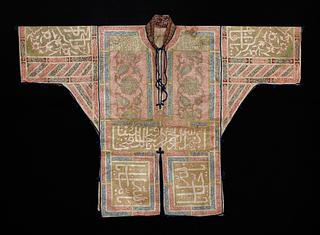
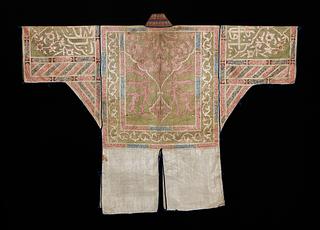
In the Islamic world, religious texts such as prayers, blessings, and special Koranic passages have historically been attributed apotropaic properties – the ability to ward off evil. For example, it was believed that such texts could protect believers from the dangers of the battlefield, and accordingly some warriors wore thin shirts covered in religious inscriptions on top of or underneath their actual armour. A large number of such shirts dating between the fifteenth and the nineteenth centuries have been preserved. They were created in the Ottoman Empire, Iran and in India, from which the present specimen originates.
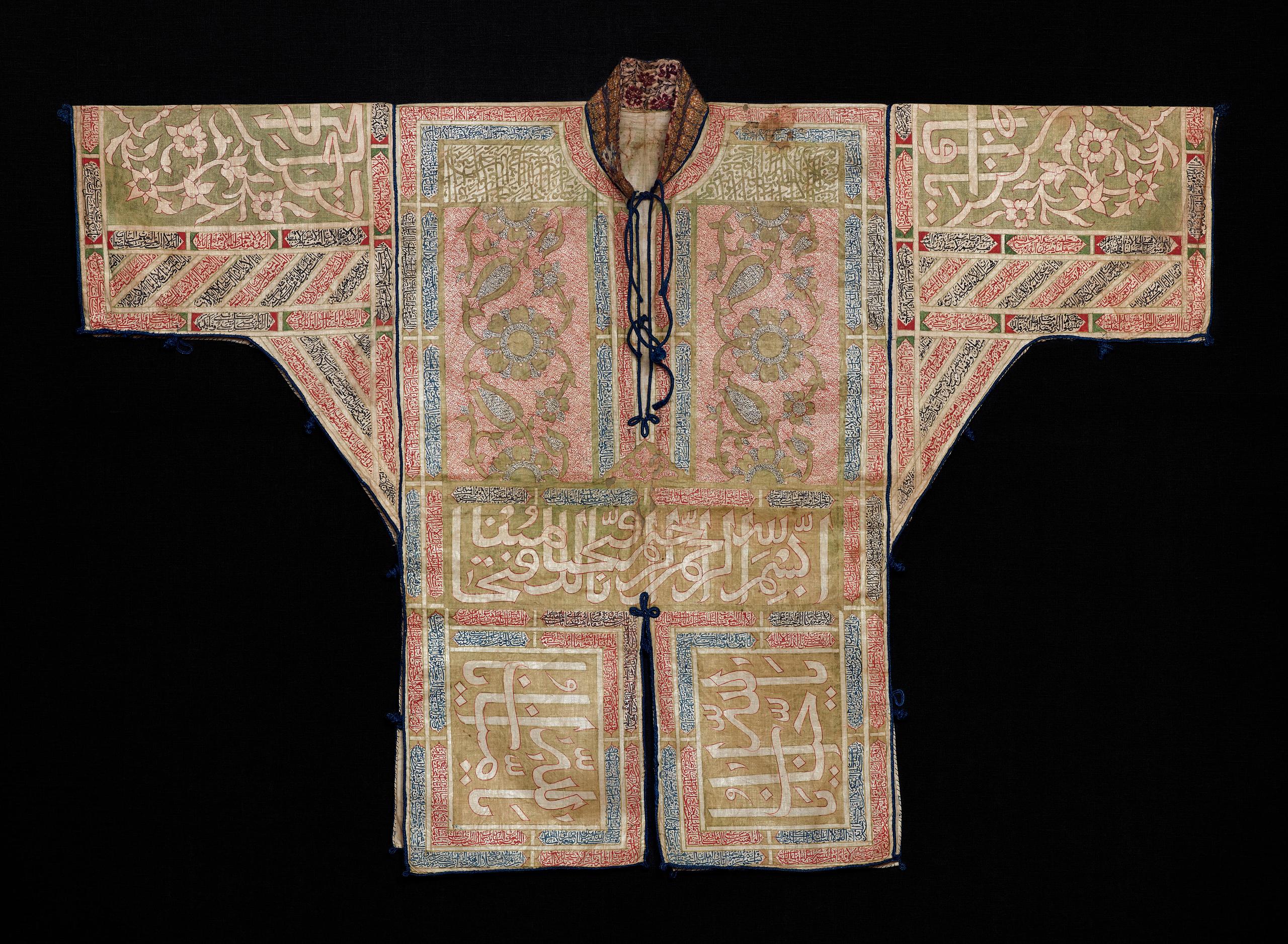
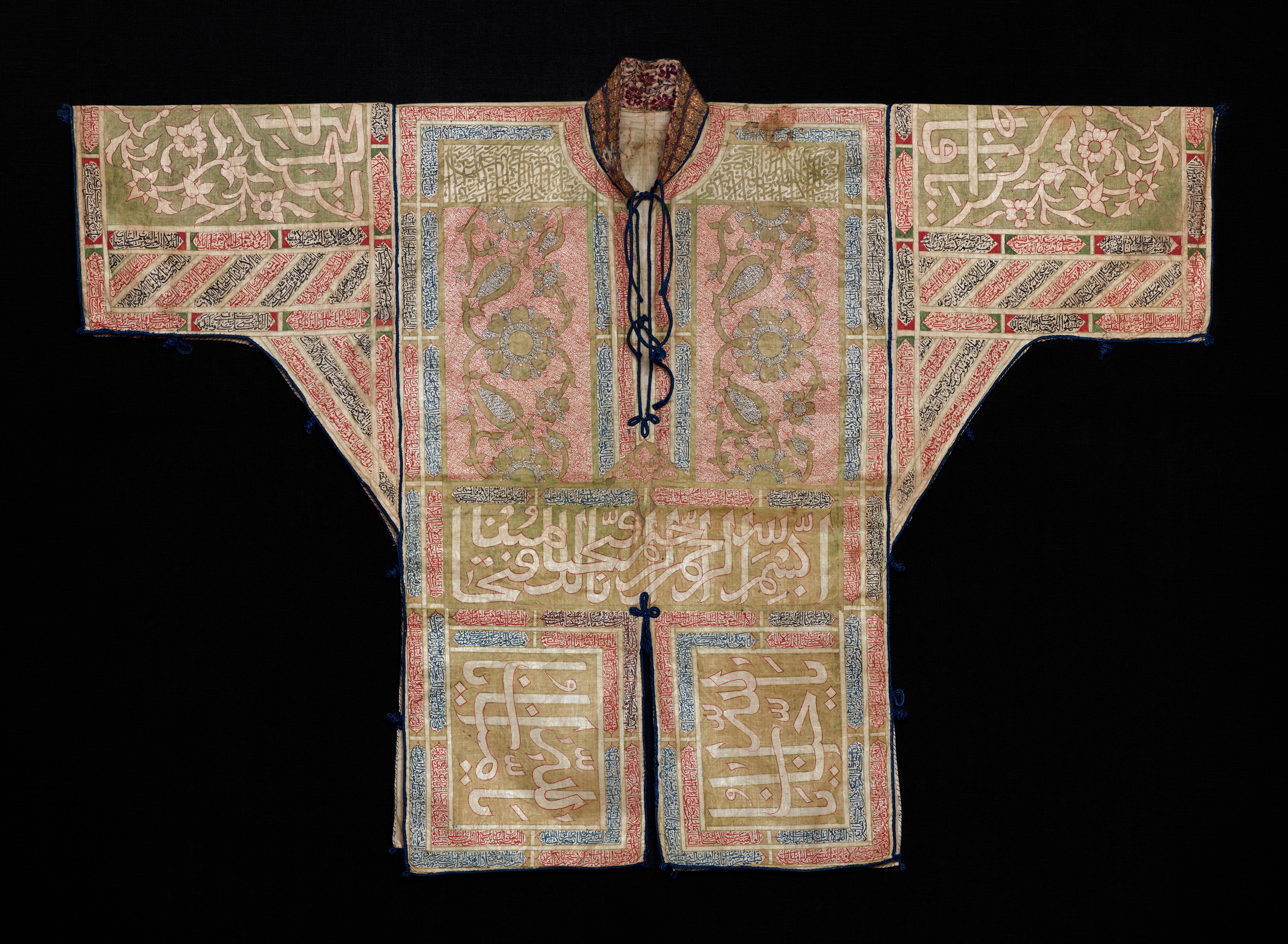
The shirt shown here consists of three pieces of cotton fabric and an embroidered collar. It is one of the few of its kind to have buttons on both sides, making it easier to put on and take off. The front and back are decorated with painted Arabic inscriptions in various colours, sizes and scripts. These are complemented by fields of arabesques and stylised tulips. In several of these fields the background is also completely covered in writing.
The inscriptions include several excerpts from the Koran, including sura 36 and sura 110 as well as the first verse of sura 48, which reads ‘Verily We have granted thee a manifest Victory’.
The most extensive text on the shirt is a prayer of 100 verses called al-Jawshan al-kabir (The Great Armour), which mentions no less than 1,000 different attributes and qualities of God. The prayer is repeated several times in Thuluth script in the narrow cartouches on the front and back of the shirt and in a diminutive script known as Ghubar between the arabesques and the flowers on the chest and back.1
The shirt was acquired in India and taken to England in the nineteenth century. The prayer covering most of the shirt, al-Jawshan al-kabir, was mainly used in Shia Islam, indicating that the piece was made in northern India where several of the ruling dynasties adhered to Shiism in the eighteenth and nineteenth centuries.
The shirt shown here consists of three pieces of cotton fabric and an embroidered collar. It is one of the few of its kind to have buttons on both sides, making it easier to put on and take off. The front and back are decorated with painted Arabic inscriptions in various colours, sizes and scripts. These are complemented by fields of arabesques and stylised tulips. In several of these fields the background is also completely covered in writing.
The inscriptions include several excerpts from the Koran, including sura 36 and sura 110 as well as the first verse of sura 48, which reads ‘Verily We have granted thee a manifest Victory’.
The most extensive text on the shirt is a prayer of 100 verses called al-Jawshan al-kabir (The Great Armour), which mentions no less than 1,000 different attributes and qualities of God. The prayer is repeated several times in Thuluth script in the narrow cartouches on the front and back of the shirt and in a diminutive script known as Ghubar between the arabesques and the flowers on the chest and back.1
The shirt was acquired in India and taken to England in the nineteenth century. The prayer covering most of the shirt, al-Jawshan al-kabir, was mainly used in Shia Islam, indicating that the piece was made in northern India where several of the ruling dynasties adhered to Shiism in the eighteenth and nineteenth centuries.
Published in
Published in
Kent Antiques: Selected Works of Art from the Islamic World and Orientalist Paintings, [texts by Bora Keskiner], London 2018, cat. 17;
Kjeld von Folsach, Joachim Meyer and Peter Wandel: Fighting, Hunting, Impressing: Arms and Armour from the Islamic World 1500–1850, The David Collection, Copenhagen, cat. 54 and Appendix, p. 276;
Joachim Meyer, Rasmus Bech Olsen and Peter Wandel: Beyond words: calligraphy from the World of Islam, The David Collection, Copenhagen 2024, cat. 123, pp. 296-297;
Kjeld von Folsach, Joachim Meyer and Peter Wandel: Fighting, Hunting, Impressing: Arms and Armour from the Islamic World 1500–1850, The David Collection, Copenhagen, cat. 54 and Appendix, p. 276;
Joachim Meyer, Rasmus Bech Olsen and Peter Wandel: Beyond words: calligraphy from the World of Islam, The David Collection, Copenhagen 2024, cat. 123, pp. 296-297;
Footnotes
Footnotes
1.
An overview of the inscriptions and their placement is provided in Kjeld von Folsach, Joachim Meyer, Peter Wandel: Fighting, Hunting, Impressing: Arms and Armour from the Islamic World 1500–1850, Copenhagen 2021, Appendix, p. 276.