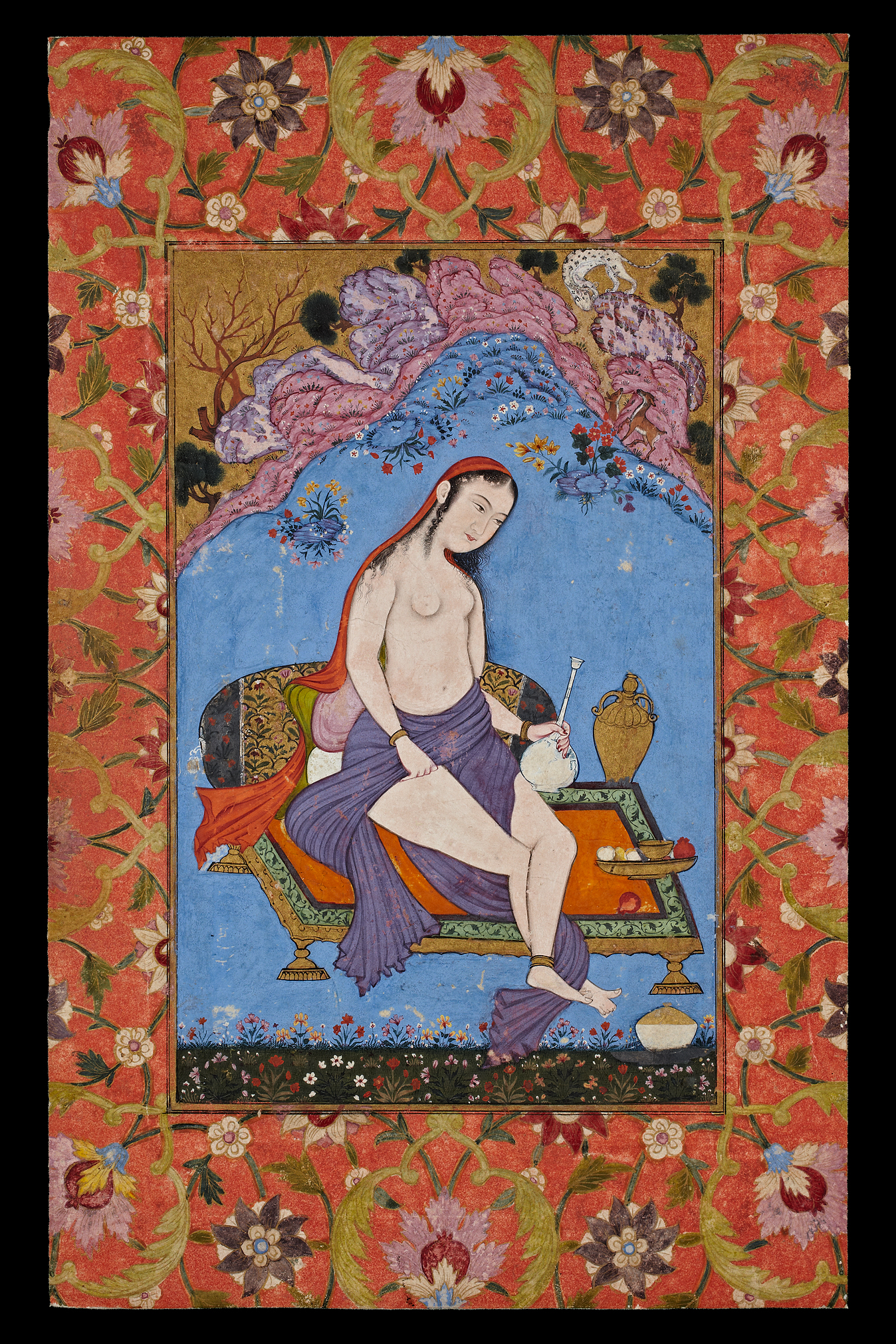
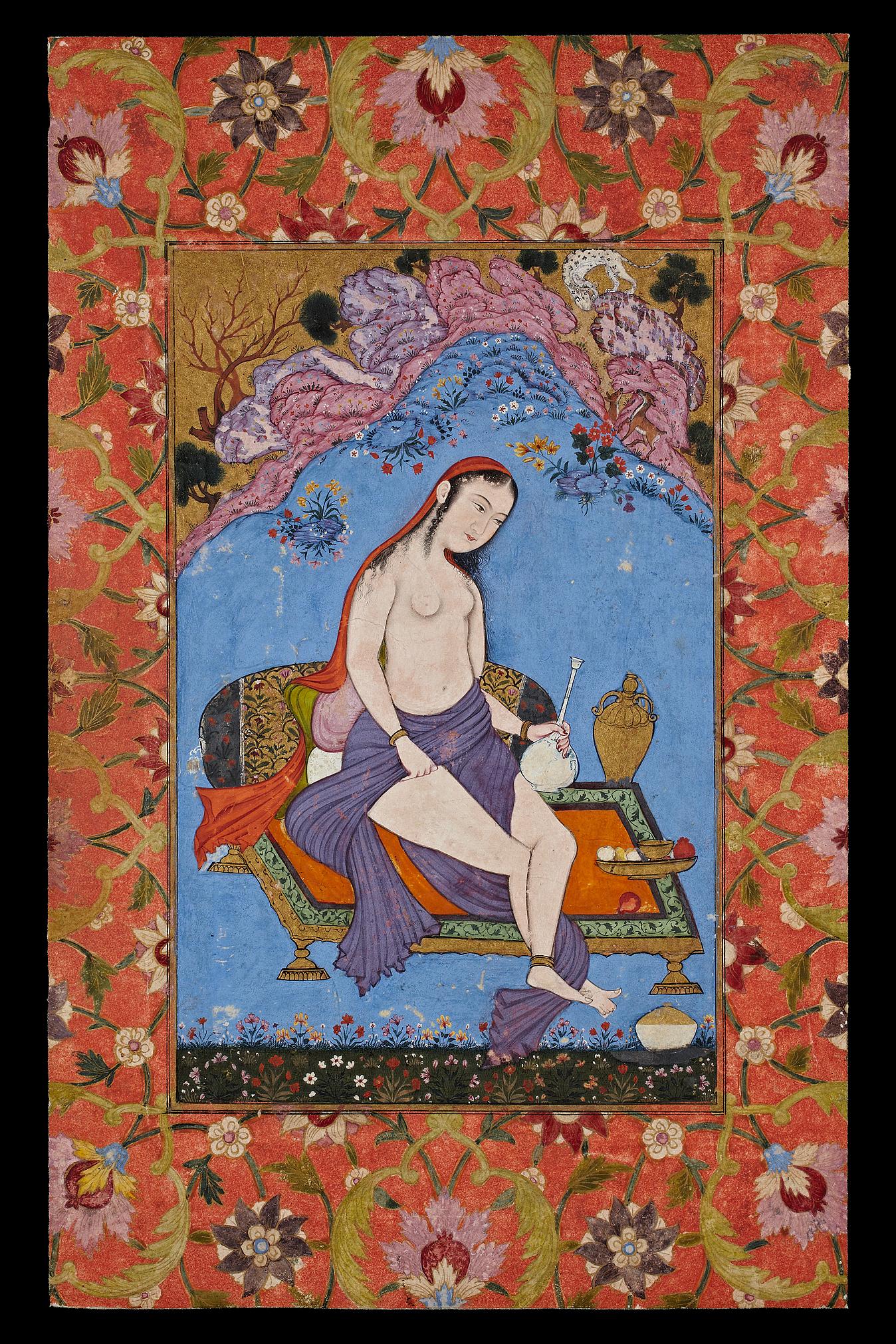
Miniature pasted on an album leaf. ‘Scantily Clad Woman in a Landscape’
India, Deccan, Golconda; c. 1630-1650
Miniature: 20 × 12.6 cm
Inventory number 11/2011
Islamic miniature painting is customarily rather modest, although women in scanty attire appear in illustrations to literary works. Portrayals of virtually naked women, in contrast, are quite unusual. They emerged in a sub-genre in 17th-century Iran that was influenced by engravings from Western Europe.
This depiction of a woman conforms closely to Iranian models, having curly locks in front of the ears, for example. Elements such as rings around the ankles and wrists, as well as bold color contrasts do, however, show that the painting was made in the Deccan in India; these two Shiite regions namely had close ties. The woman’s wistful pose is echoed more dramatically on the upper right in the leopard, looking down greedily at two frightened gazelles.
This depiction of a woman conforms closely to Iranian models, having curly locks in front of the ears, for example. Elements such as rings around the ankles and wrists, as well as bold color contrasts do, however, show that the painting was made in the Deccan in India; these two Shiite regions namely had close ties. The woman’s wistful pose is echoed more dramatically on the upper right in the leopard, looking down greedily at two frightened gazelles.
Published in
Published in
Kjeld von Folsach: Art from the World of Islam in The David Collection, Copenhagen 2001, cat.no. 11;
Kjeld von Folsach, Joachim Meyer: The Human Figure in Islamic Art – Holy Men, Princes, and Commoners, The David Collection, Copenhagen 2017, fig. 48, p. 196;
Kjeld von Folsach, Joachim Meyer: The Human Figure in Islamic Art – Holy Men, Princes, and Commoners, The David Collection, Copenhagen 2017, fig. 48, p. 196;
.jpg)