Miniature pasted on cardboard. ‘Erotic Scene on a Terrace’
India, Bikaner; c. 1690–1700
Leaf: 19.8 x 13.6 cm
Inventory number 10/2020
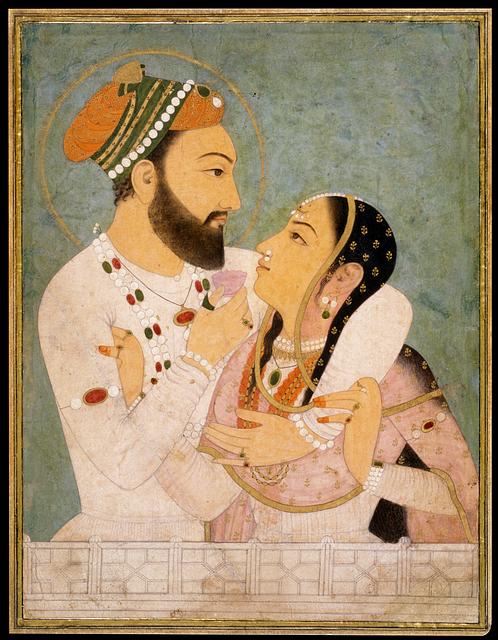
The miniature depicts an act of sexual intercourse between a man and a woman on a palace terrace at night. Both figures are naked except for pearl necklaces and small pieces of jewellery. The man also wears a turban. Placed in front of the couple are containers with perfumes and stimulants intended to aid and heighten sexual congress; the vessels include a long-necked rosewater sprinkler and a tray with mildly intoxicating betel leaf rolls known as pan.
The miniature originates from the Hindu principality of Bikaner, whose ruler, Maharaja Anup Singh (r. 1669–1698), was a close ally of the Mughals. Stylistically, there are clear affinities with both Mughal and Deccan painting, but the explicit motif is unusual for these two traditions. In Bikaner, such subjects were far more widespread, which may be seen as a manifestation of the central role played by (erotic) love, called sringara rasa, in Hindu art of the period.1
From Anup Singh’s court atelier, there exists a series of forty similar miniatures, depicting named Indian rulers and princes having sex with their mistresses. One of those portrayed is Anup Singh himself.2 However, an even closer affinity to the present painting can be observed in a series of nineteen miniatures representing unidentified couples making love.3 The two series are attributed respectively to the head of the Bikaner workshop, Ruknuddin (active c. 1650–1697), and the circle around this artist.
The miniature originates from the Hindu principality of Bikaner, whose ruler, Maharaja Anup Singh (r. 1669–1698), was a close ally of the Mughals. Stylistically, there are clear affinities with both Mughal and Deccan painting, but the explicit motif is unusual for these two traditions. In Bikaner, such subjects were far more widespread, which may be seen as a manifestation of the central role played by (erotic) love, called sringara rasa, in Hindu art of the period.1
From Anup Singh’s court atelier, there exists a series of forty similar miniatures, depicting named Indian rulers and princes having sex with their mistresses. One of those portrayed is Anup Singh himself.2 However, an even closer affinity to the present painting can be observed in a series of nineteen miniatures representing unidentified couples making love.3 The two series are attributed respectively to the head of the Bikaner workshop, Ruknuddin (active c. 1650–1697), and the circle around this artist.
Published in
Published in
Bonhams, London 26/10 2020, lot 186;
Footnotes
Footnotes
1.
Terence McInerney: “The Kronos Collections and Rajput Court Paintings” in Terence McInerney, Steven Kossak and Navina Najat Haidar: Divine Pleasures. Paintings from India’s Rajput Courts, The Kronos Collections, New York 2016, pp. 39-49.
2.
The series is housed at the Fitzwilliam Museum in Cambridge, UK. Imma Ramos: “Private Pleasures of the Mughal Empire” in Art History, 37:3, 2014, pp. 409–427.
3.
The series is housed at the British Museum, inv. nos. 1880,0.413 -–1880,0.423 and 1880,0.428 – 1880,0.435.


_sort.jpg)
_sort.jpg)