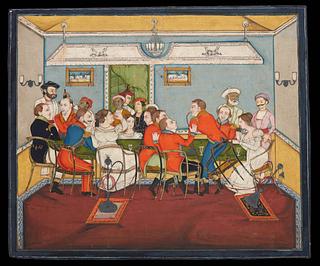
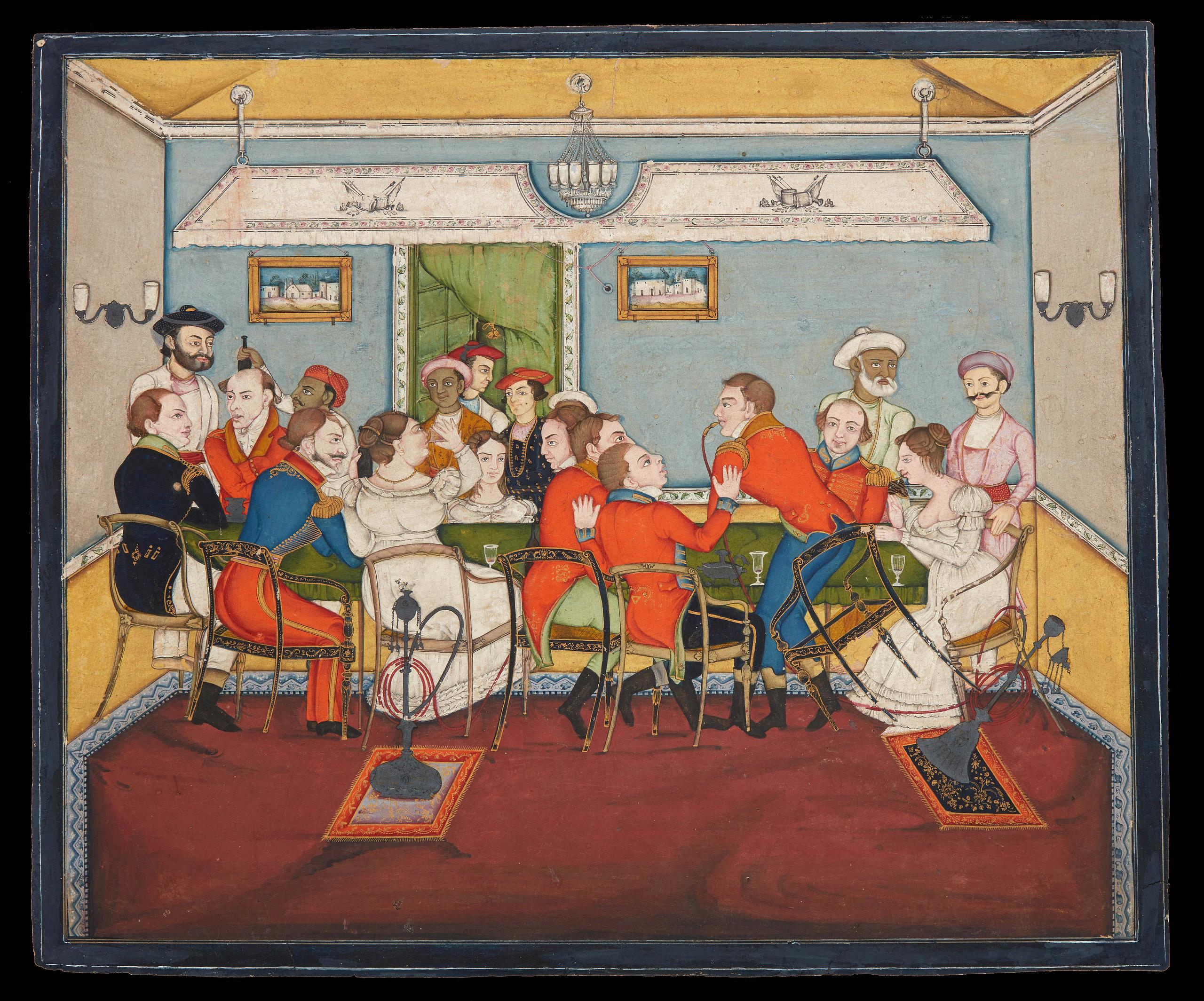
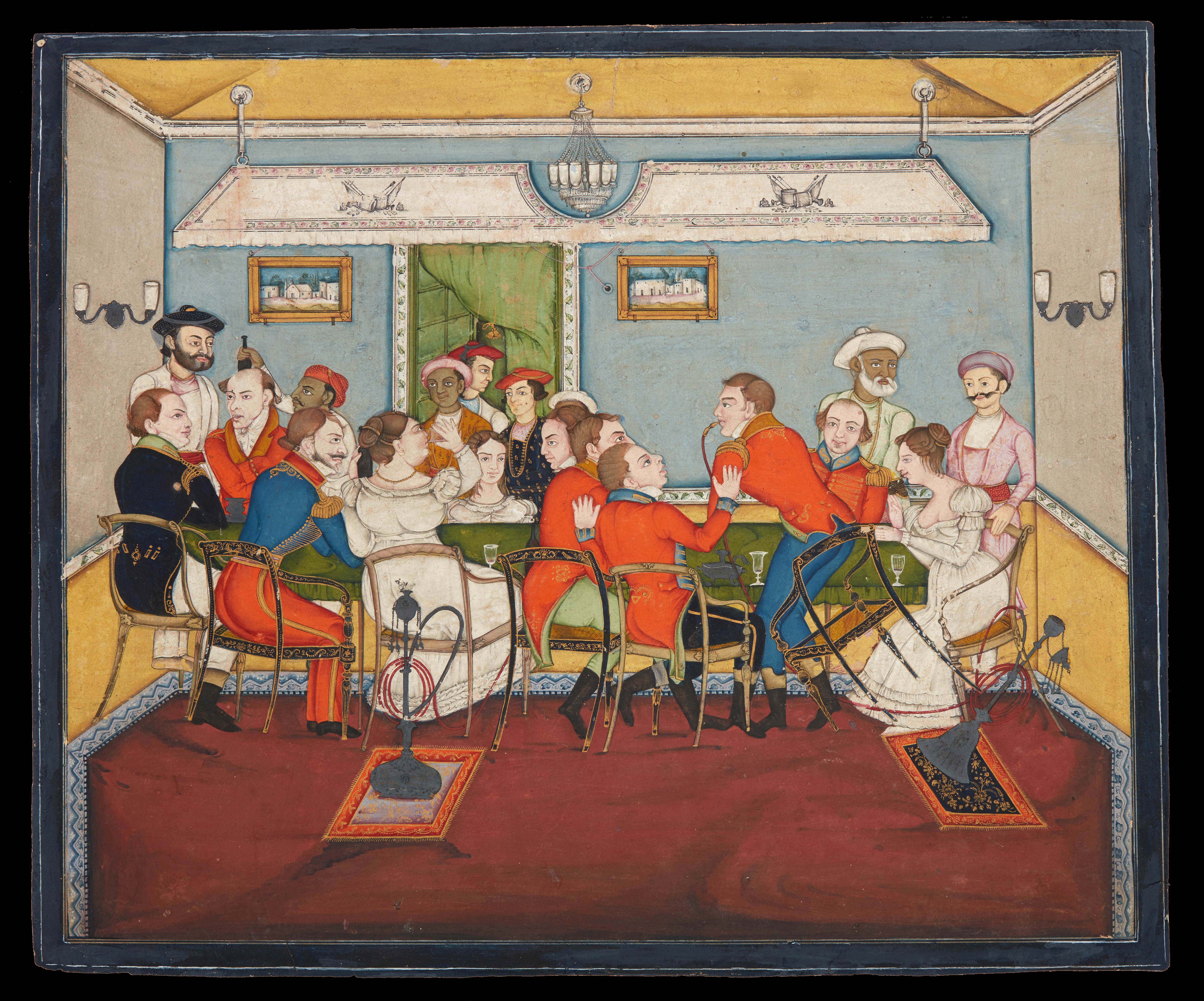
Miniature mounted on cardboard. ‘A Company of Englishmen’
India, Patna; c. 1830
The leaf: 23.5 x 28.3 cm
Inventory number 5/2017
This painting is based on a work made by the English civil servant and amateur artist Charles D’Oyly (1781–1845), who worked for the East India Company in Patna between 1821 and 1833.
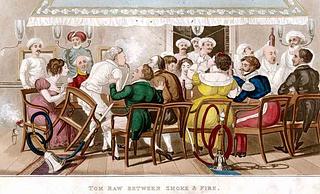
D’Oyly drew and painted landscapes and architecture, but also scenes of local life, and in the satirical series Tom Raw, the Griffin, printed as aquatints in London in 1828, he portrays the British in India and their local servants with humour and sarcastic bite. In Patna, he founded an art society known by the locals as The Bihar School of Athens, and he had connections to local artists whom he introduced to European styles and techniques.1.
This miniature depicting the young, clumsy Tom Raw overturning a huqqa during a dinner party is made by an Indian artist. He has, in slightly subdued form, reproduced the drama from D’Oyly’s original Tom Raw between Smoke & Fire while at the same time giving his copy bolder, stronger colours. And while the emphasis in D’Oyly’s aquatint is clearly on the English figures, the portrayal of Indians and Europeans is more even-handed in the miniature. While smoke from the toppled hookah seen in the original is omitted, overall this scene has more details. The greater richness of detail and the fact that the miniature is reversed compared to the published aquatints suggest that the artist has worked from D’Oyly’s now-missing original.
While the identity of the Indian artist is unknown, we do know of another surviving work from his hand based on D’Oyly’s series.2
D’Oyly drew and painted landscapes and architecture, but also scenes of local life, and in the satirical series Tom Raw, the Griffin, printed as aquatints in London in 1828, he portrays the British in India and their local servants with humour and sarcastic bite. In Patna, he founded an art society known by the locals as The Bihar School of Athens, and he had connections to local artists whom he introduced to European styles and techniques.1.
This miniature depicting the young, clumsy Tom Raw overturning a huqqa during a dinner party is made by an Indian artist. He has, in slightly subdued form, reproduced the drama from D’Oyly’s original Tom Raw between Smoke & Fire while at the same time giving his copy bolder, stronger colours. And while the emphasis in D’Oyly’s aquatint is clearly on the English figures, the portrayal of Indians and Europeans is more even-handed in the miniature. While smoke from the toppled hookah seen in the original is omitted, overall this scene has more details. The greater richness of detail and the fact that the miniature is reversed compared to the published aquatints suggest that the artist has worked from D’Oyly’s now-missing original.
While the identity of the Indian artist is unknown, we do know of another surviving work from his hand based on D’Oyly’s series.2
Published in
Published in
Kjeld von Folsach, Joachim Meyer: The Human Figure in Islamic Art – Holy Men, Princes, and Commoners, The David Collection, Copenhagen 2017, cat.no. 75
Footnotes
Footnotes
1.
Regarding D’Oyly’s work and impact on contemporary Indian art, see e.g. Mildred Archer: Company Paintings. Indian Paintings of the British Period, Victoria and Albert Museum, London 1992, pp. 84–85.
2.
Sotheby’s, London, 7/10 – 2015, lot 293.
Miniature Paintings
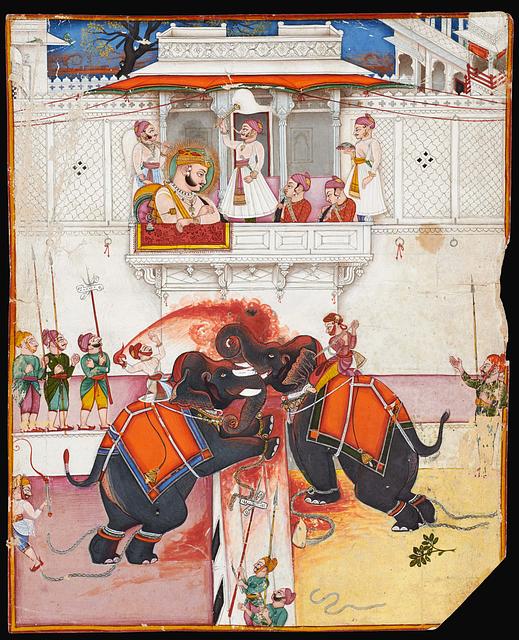
Miniature painted on cardboard. ’Maharajah Ram Singh Watching an Elephant Fight’
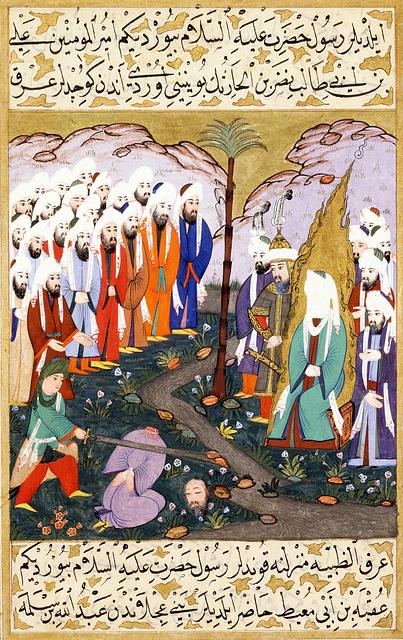
Miniature from volume 4 of a copy of Mustafa al-Darir’s Siyar-i-Nabi (Life of the Prophet). ’Ali Beheading Nadr ibn al-Harith in the Presence of the Prophet Muhammad’
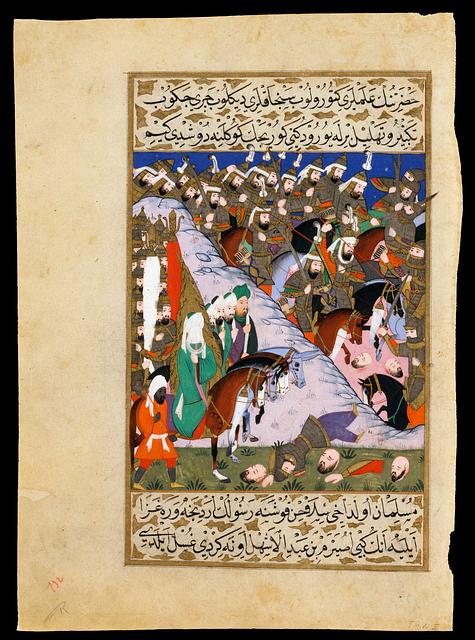
Miniature from volume 4 of a copy of Mustafa al-Darir’s Siyar-i Nabi (Life of the Prophet). ’The Prophet Muhammad and the Muslim Army at the Battle of Uhud’
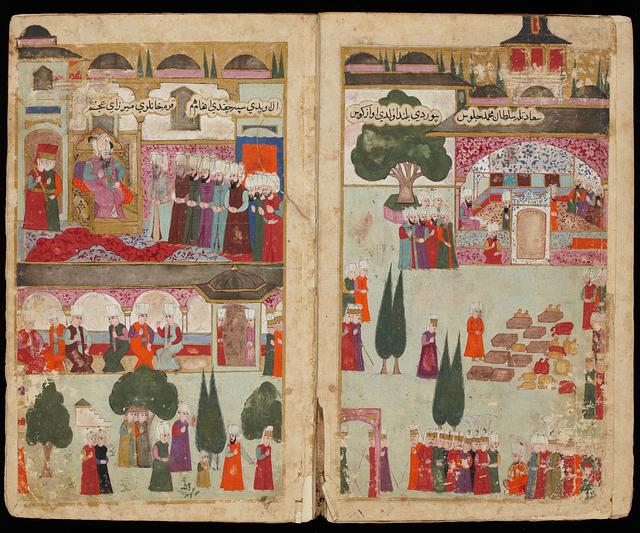
Manuscript written by Seyyid Lokman on Mehmed III’s Campaign in Hungary. First double miniature fol. 15v-16r, ’Mehmed III’s Coronation in the Topkapi Palace in 1595’