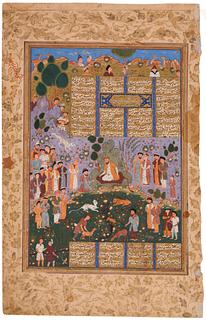
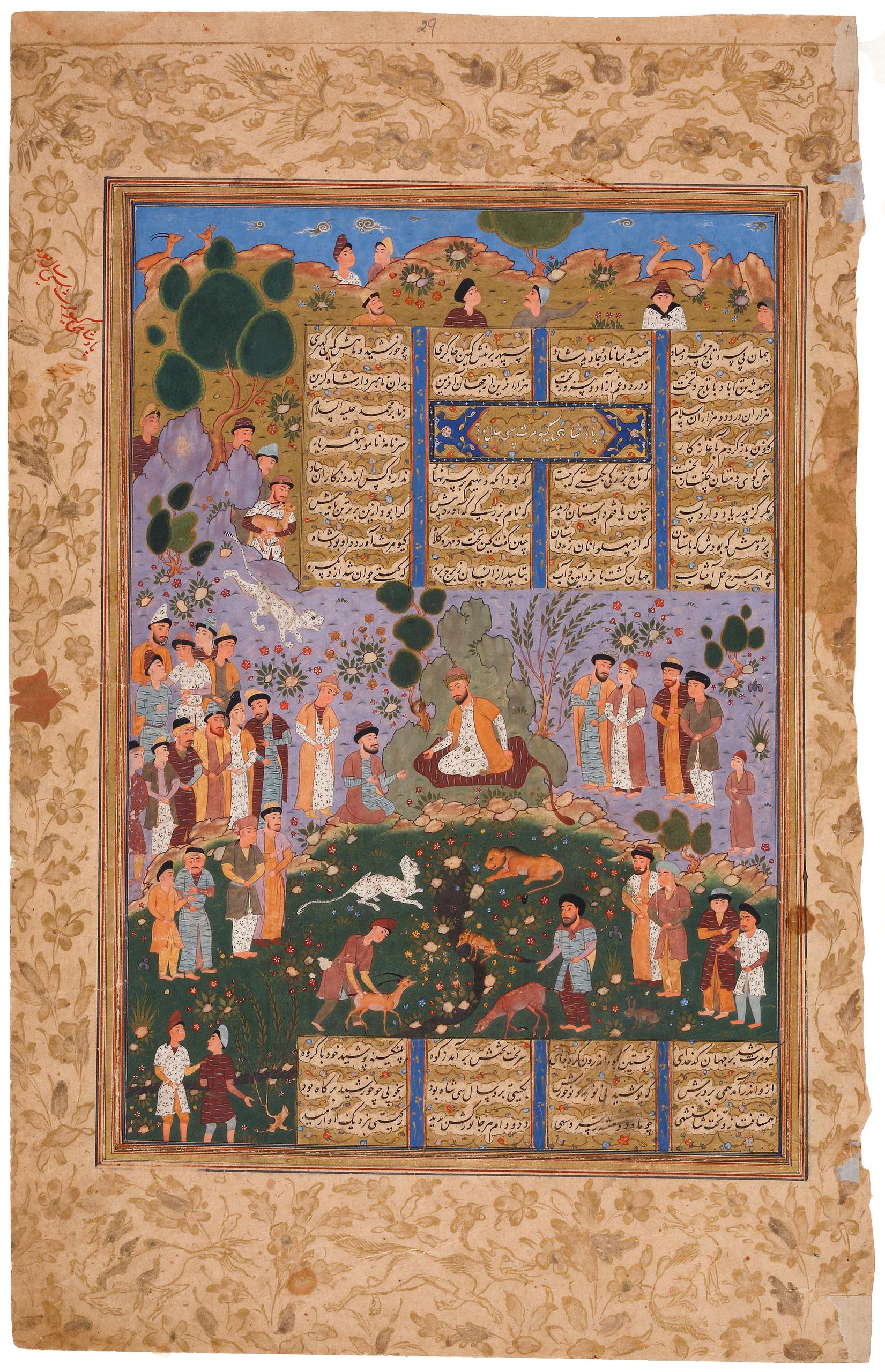
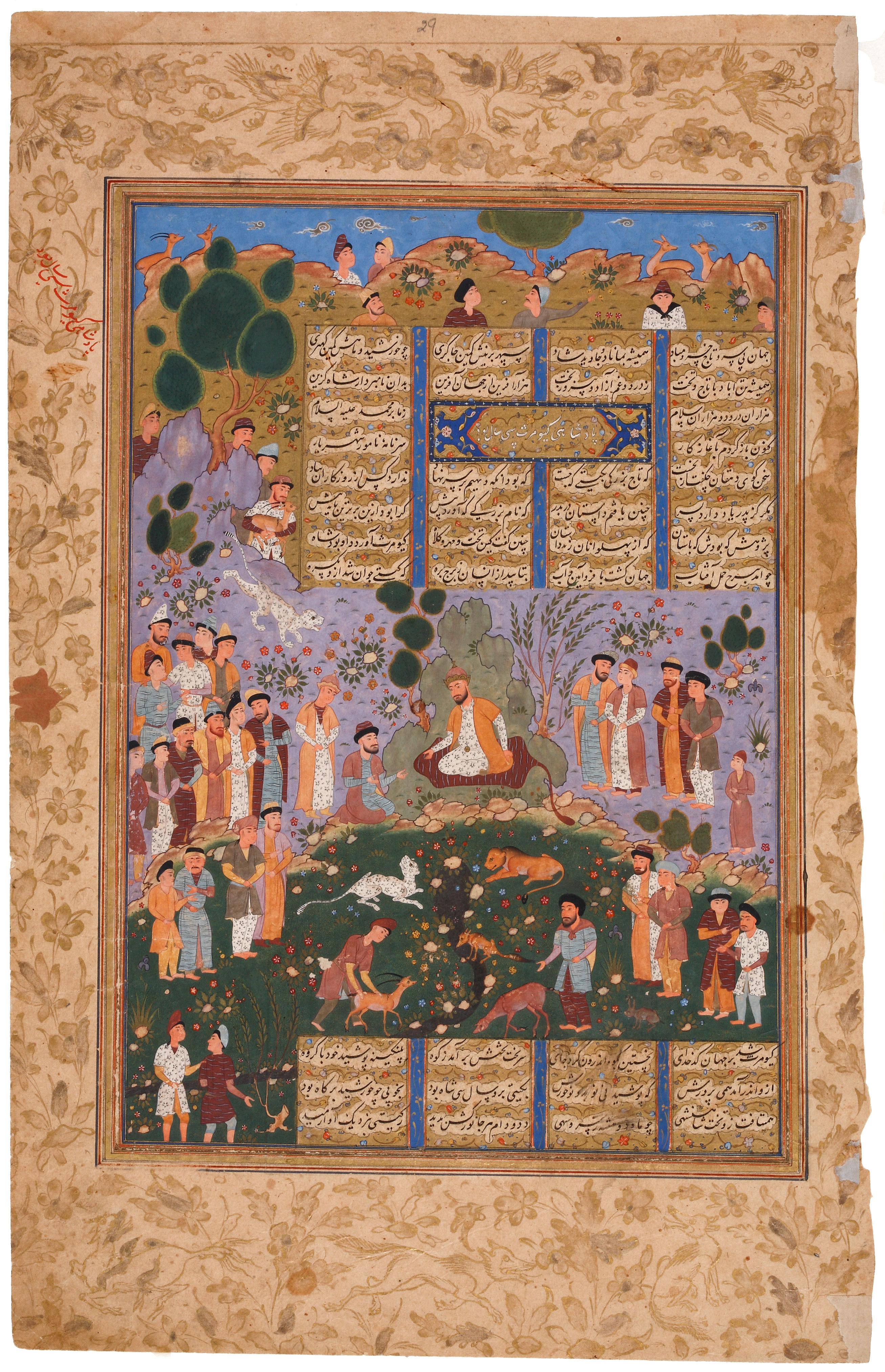
Miniature from a copy of Firdawsi’s Shahnama. ‘The Court of Gayumarth’
Iran, Shiraz; 1575-1590
Leaf: 42.5 × 27.3 cm
Inventory number 56/2007
Gayumarth was the first of Iran’s mythical kings. Under his rule, men learned to clothe themselves in animal skins, but otherwise lived in harmony with their four-legged fellow creatures. The idyll was shattered when Ahriman, the symbol of evil, sent his son, the Black Div, to conquer Iran.
Gayumarth’s son, Siyamak, goes forth to fight the div, but is killed. Then Gayumarth himself and his grandson, Hushang, go to war and slay the div.
In the center of the picture is Gayumarth, seated on a throne of boulders. On his right, Hushang is standing, while Siyamak is seated, announcing to the king and the people that the div has attacked.
Gayumarth’s son, Siyamak, goes forth to fight the div, but is killed. Then Gayumarth himself and his grandson, Hushang, go to war and slay the div.
In the center of the picture is Gayumarth, seated on a throne of boulders. On his right, Hushang is standing, while Siyamak is seated, announcing to the king and the people that the div has attacked.
Published in
Published in
Joachim Meyer and Peter Wandel: Shahnama: the Colorful Epic About Iran’s Past, The David Collection, Copenhagen 2016, cat.nr. 2;
Kjeld von Folsach, Joachim Meyer: The Human Figure in Islamic Art – Holy Men, Princes, and Commoners, The David Collection, Copenhagen 2017, fig. 39, p. 151;
Kjeld von Folsach, Joachim Meyer: The Human Figure in Islamic Art – Holy Men, Princes, and Commoners, The David Collection, Copenhagen 2017, fig. 39, p. 151;
Miniature Paintings
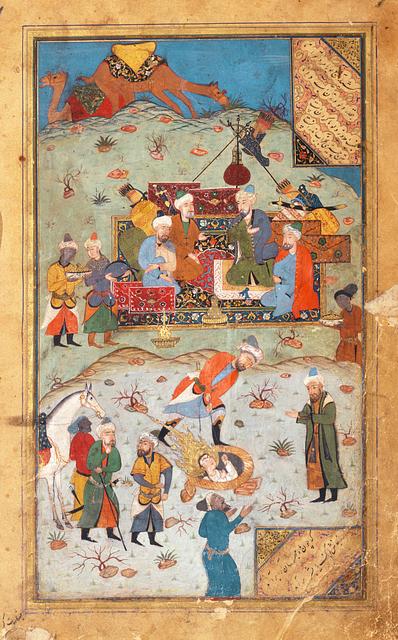
Miniature from a copy of Jami’s Yusuf wa Zulaykha. ‘Yusuf Pulled from the Well’
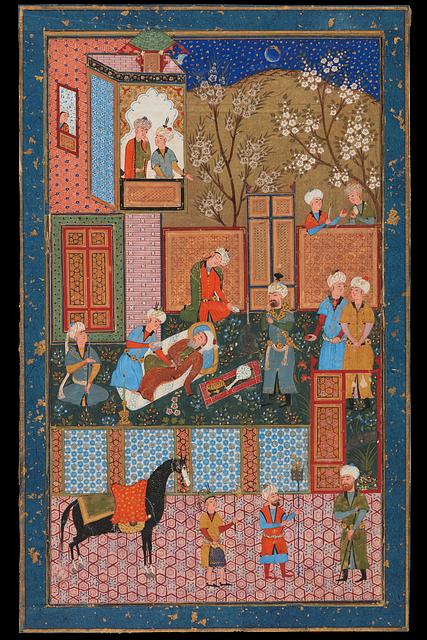
Miniature from a copy of Sadi’s Gulistan, pasted on cardboard. ‘The Sultan Wakes the Drunk Judge at Sunrise’.
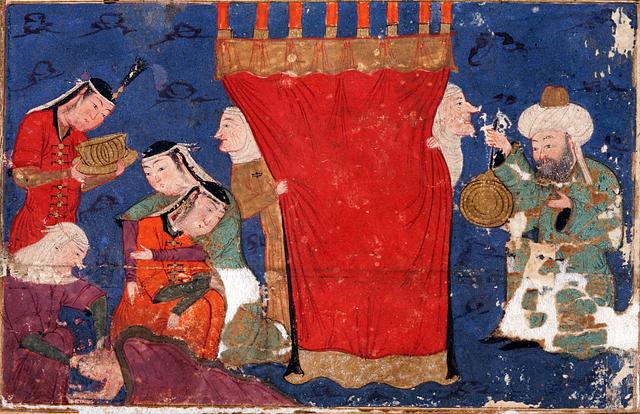
‘The Birth of Alexander the Great’. Miniature in a copy of Nizami’s Iskandarnama (Book of Alexander the Great)
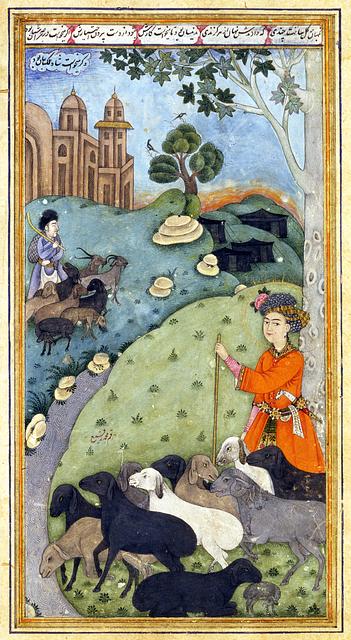
Miniature from a copy of Jami’s Yusuf wa Zulaykha