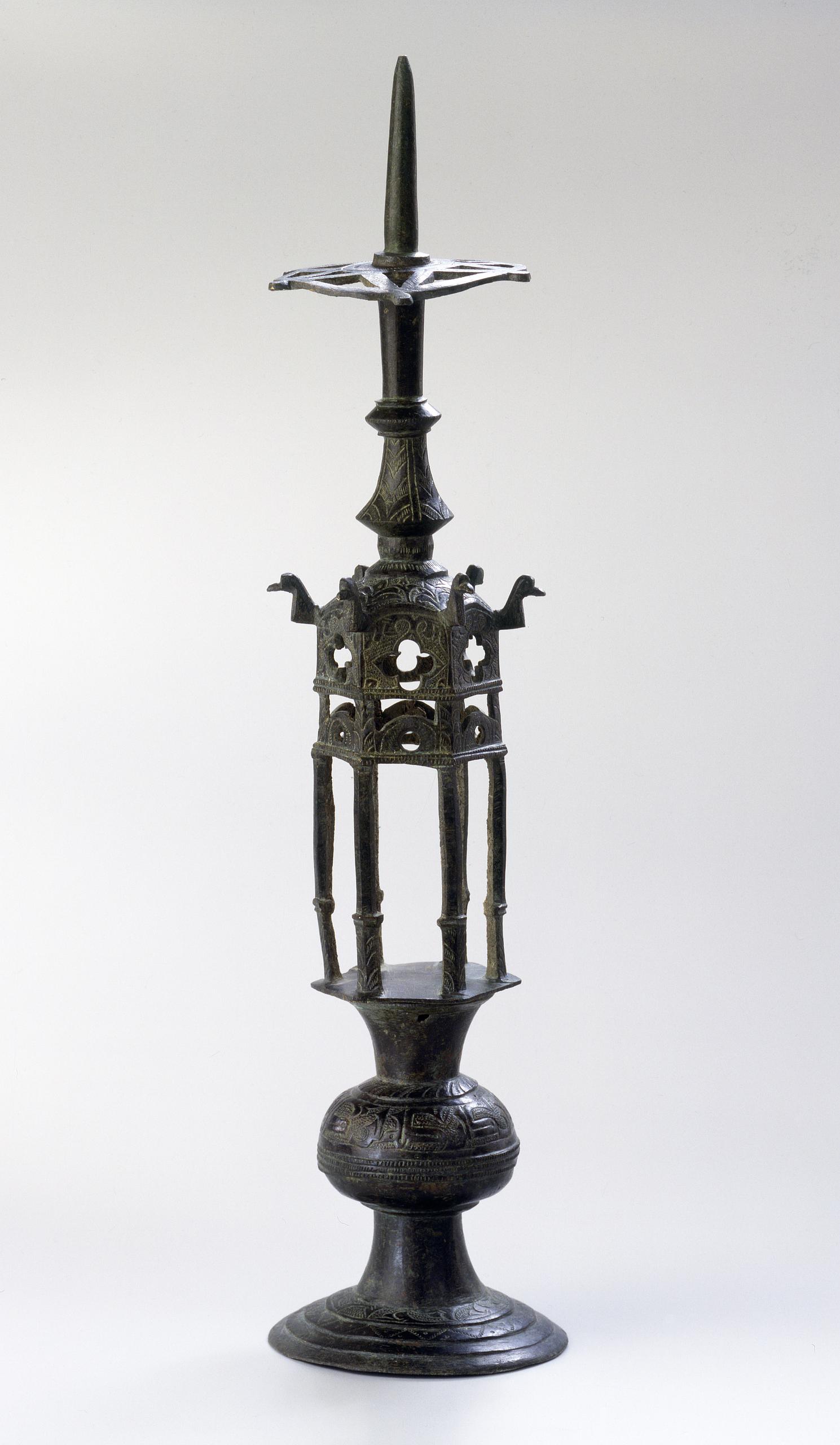
Lamp holder, cast bronze with openwork, engraved, and punched decoration
Spain, Andalusia; 10th century
H: 50.5 cm
Inventory number 11/1987
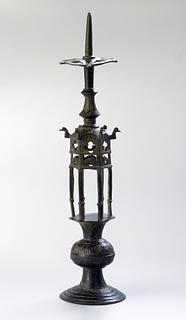
This candlestick – or perhaps lamp holder – is of a type that was only found in Umayyad Spain. The central, temple-like architectural section, in particular, brings to mind Byzantine art, which in fact also exerted a major influence on architecture, mosaics, and other decorative art in Cordoba under the caliphs. The Arabic word baraka (blessing) is repeated around the base.
There are a number of fragmentary lamp holders of this type, some of which feature more a detailed treatment of the architectural elements and the birds that crown them. The museum’s piece, in contrast, is the most complete.
There are a number of fragmentary lamp holders of this type, some of which feature more a detailed treatment of the architectural elements and the birds that crown them. The museum’s piece, in contrast, is the most complete.
Published in
Published in
Sotheby’s London, 17/10-1984, lot 165;
James W. Allan: Metalwork of the Islamic world: the Aron Collection, London 1986, p. 20;
Kjeld von Folsach: Islamic art. The David Collection, Copenhagen 1990, cat.no. 299;
Jerrilynn D. Dodds (ed.): Al-Andalus: the art of Islamic Spain, Metropolitan Museum of Art, New York 1992, cat.no. 11;
Kjeld von Folsach, Torben Lundbæk and Peder Mortensen (eds.): Sultan, Shah and Great Mughal: the history and culture of the Islamic world, The National Museum, Copenhagen 1996, cat.no. 194;
Markus Hattstein and Peter Delius (eds.): Islam: art and architecture, Berlin 2000, p. 214;
Éric Delpont (ed.): Les Andalousies de Damas à Cordoue, Institut du monde arabe, Paris 2000, cat.no. 93a;
Kjeld von Folsach: Art from the World of Islam in The David Collection, Copenhagen 2001, cat.no. 455;
Juan Zozaya: ”Aeria de transición: objectos con base de cobre de los siglos VII al IX en al-Andalus” in Arqueología medieval, 11, 2011, pp. 11-24;
Venetia Porter and Mariam Rosser-Owen (eds.): Metalwork and material culture in the Islamic world: art, craft and text: essays presented to James W. Allan, London 2012, pp. 289-291, 293 note 11 (no photo);
Joachim Meyer: “The body language of a parrot: an incense burner from the Western Mediterranean” in Journal of the David Collection, 4, 2014, p. 34, fig. 11;
Rafael Azuar Ruiz: Metales de al-Andalus. 1, Candiles, candeleros, lamparas y almenaras, Alicante 2022, fig. 2.12, p. 113;
James W. Allan: Metalwork of the Islamic world: the Aron Collection, London 1986, p. 20;
Kjeld von Folsach: Islamic art. The David Collection, Copenhagen 1990, cat.no. 299;
Jerrilynn D. Dodds (ed.): Al-Andalus: the art of Islamic Spain, Metropolitan Museum of Art, New York 1992, cat.no. 11;
Kjeld von Folsach, Torben Lundbæk and Peder Mortensen (eds.): Sultan, Shah and Great Mughal: the history and culture of the Islamic world, The National Museum, Copenhagen 1996, cat.no. 194;
Markus Hattstein and Peter Delius (eds.): Islam: art and architecture, Berlin 2000, p. 214;
Éric Delpont (ed.): Les Andalousies de Damas à Cordoue, Institut du monde arabe, Paris 2000, cat.no. 93a;
Kjeld von Folsach: Art from the World of Islam in The David Collection, Copenhagen 2001, cat.no. 455;
Juan Zozaya: ”Aeria de transición: objectos con base de cobre de los siglos VII al IX en al-Andalus” in Arqueología medieval, 11, 2011, pp. 11-24;
Venetia Porter and Mariam Rosser-Owen (eds.): Metalwork and material culture in the Islamic world: art, craft and text: essays presented to James W. Allan, London 2012, pp. 289-291, 293 note 11 (no photo);
Joachim Meyer: “The body language of a parrot: an incense burner from the Western Mediterranean” in Journal of the David Collection, 4, 2014, p. 34, fig. 11;
Rafael Azuar Ruiz: Metales de al-Andalus. 1, Candiles, candeleros, lamparas y almenaras, Alicante 2022, fig. 2.12, p. 113;
.jpg)
.jpg)
.jpg)
.jpg?disposition=attachment)