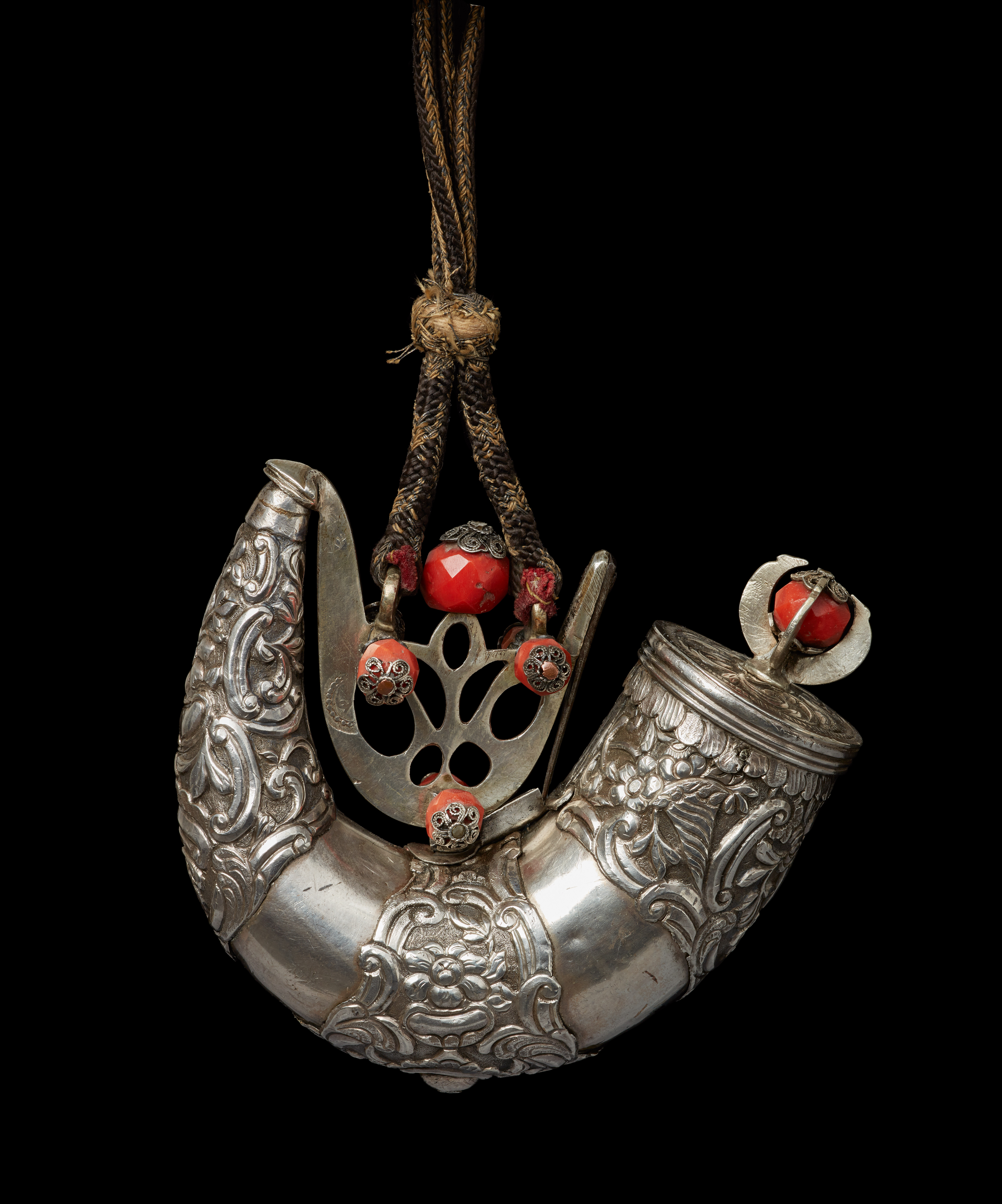
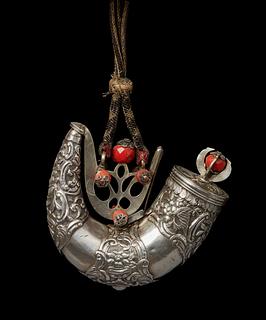
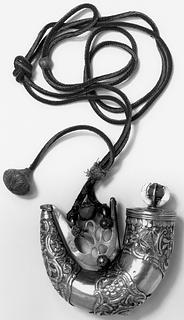
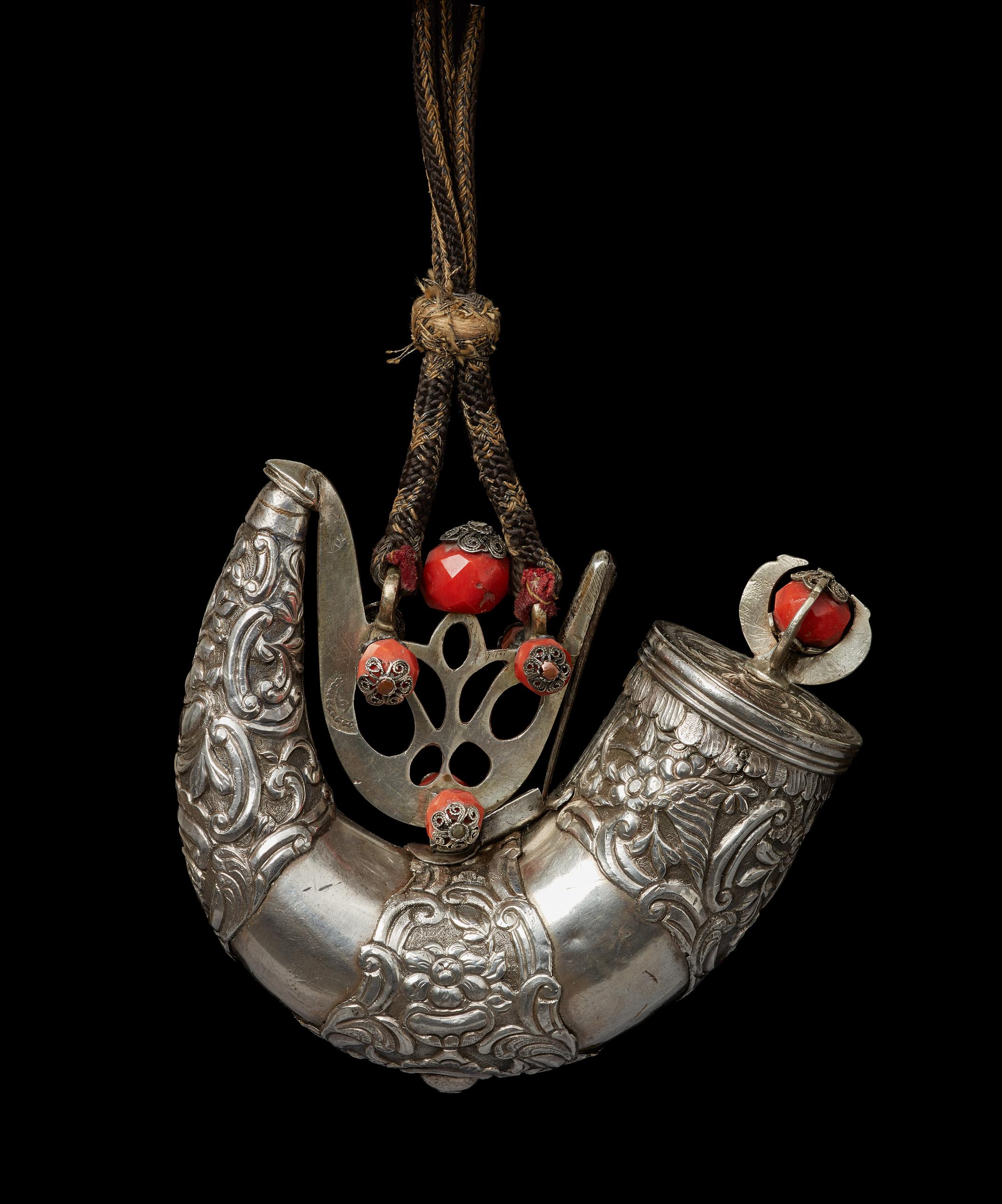
Powder horn, silver, with coral beads and the original hanging
Turkey; c. 1750
Maximum W: 12.5 cm
Inventory number 31/1987
In the course of the 18th and 19th century, Western Europe exerted increasing influence on Ottoman art. The embossed, chased areas on this powder horn feature the magnificent floral ornamentation and curved shapes that are typical of the late Baroque and Rococo. The hanging and the fitting with large coral beads, in contrast, are more in keeping with a traditional Ottoman style.
The powder horn is said to have been acquired by Lord Cathcart when he was British ambassador to Russia (1768-1771), after which he presented it to the writer Horace Walpole.
The powder horn is said to have been acquired by Lord Cathcart when he was British ambassador to Russia (1768-1771), after which he presented it to the writer Horace Walpole.
Published in
Published in
Kjeld von Folsach: Islamic art. The David Collection, Copenhagen 1990, cat.no. 356;
Kjeld von Folsach, Torben Lundbæk and Peder Mortensen (eds.): Sultan, Shah and Great Mughal: the history and culture of the Islamic world, The National Museum, Copenhagen 1996, cat.no. 167;
Kjeld von Folsach: Art from the World of Islam in The David Collection, Copenhagen 2001, cat.no. 535;
Kjeld von Folsach, Joachim Meyer and Peter Wandel: Fighting, Hunting, Impressing. Arms and Armour from the Islamic World 1500-1850, The David Collection, Copenhagen 2021, cat.no. 49;
Kjeld von Folsach, Torben Lundbæk and Peder Mortensen (eds.): Sultan, Shah and Great Mughal: the history and culture of the Islamic world, The National Museum, Copenhagen 1996, cat.no. 167;
Kjeld von Folsach: Art from the World of Islam in The David Collection, Copenhagen 2001, cat.no. 535;
Kjeld von Folsach, Joachim Meyer and Peter Wandel: Fighting, Hunting, Impressing. Arms and Armour from the Islamic World 1500-1850, The David Collection, Copenhagen 2021, cat.no. 49;
.-The-David-Collection_Copenhagen_photo-Pernille-Klemp.jpg)