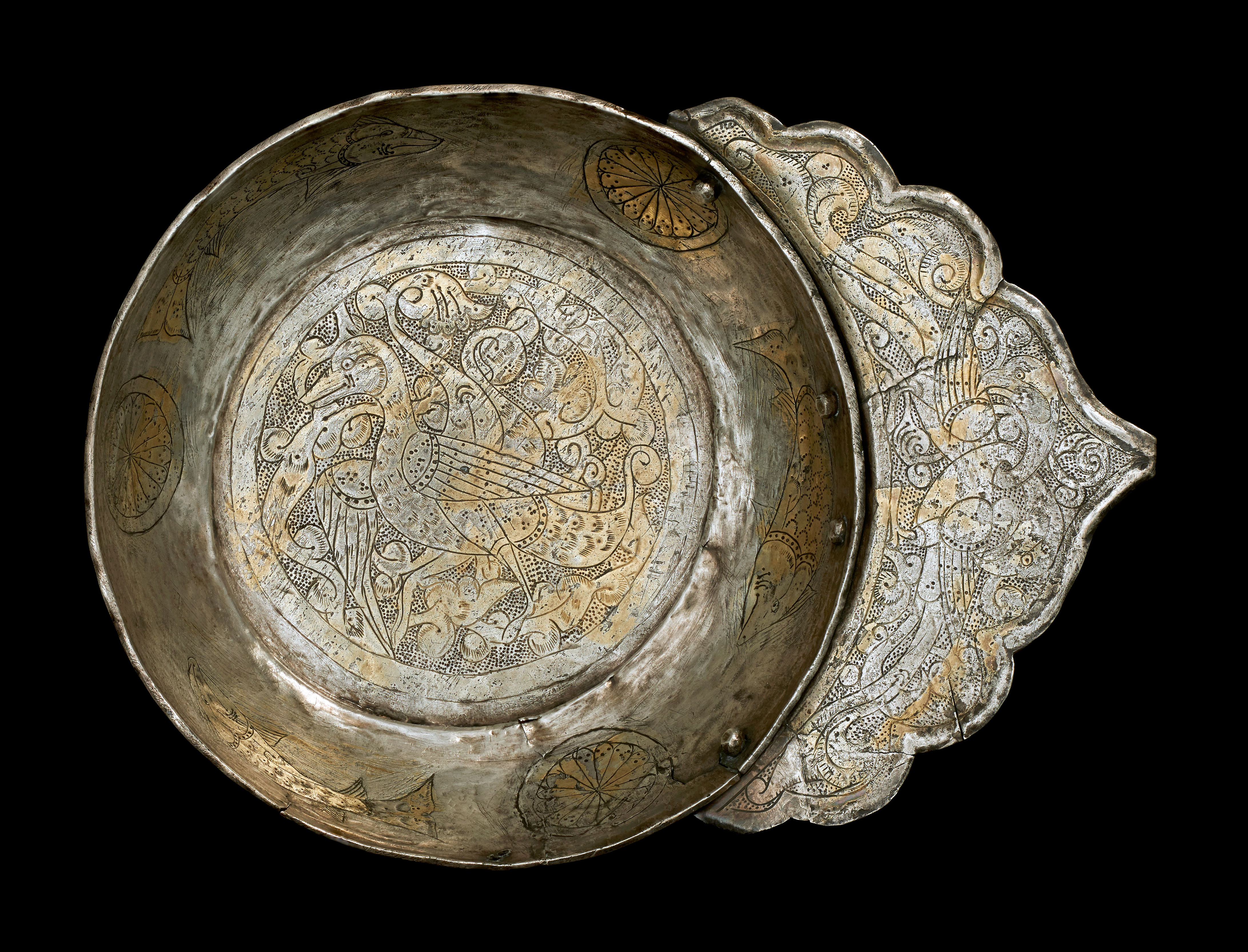
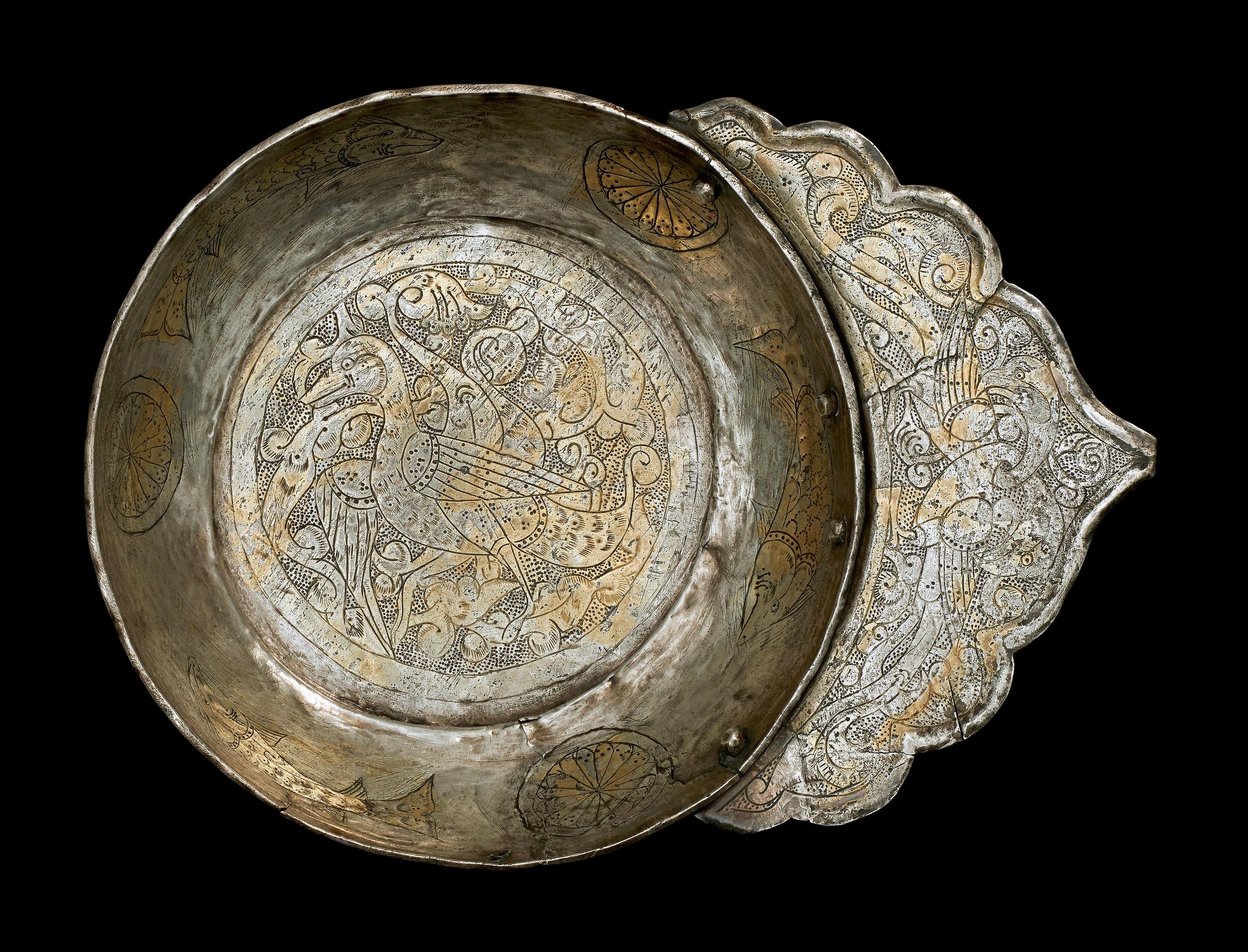
Silver cup, beaten, engraved, and gilded
Southern Russia or Kazakhstan; c. 1300
H: 3.3; Diam: 15.2 cm
Inventory number 48/1979
A cup like this was probably kept by its owner in a pouch, attached to his belt. With its Chinese-inspired, scalloped handle, it is a characteristic example of the type made from c. 1230 in the realm of the Golden Horde. The slightly coarser engraving technique is also typical of Golden Horde metalwork.
The handle is decorated with two birds with long tails whose necks are entwined. Three fish swim among circular ornaments on the outside of the bowl, and inside is a waterfowl, a favorite motif taken from Chinese art that is also frequently found on contemporary ceramic bowls.
The handle is decorated with two birds with long tails whose necks are entwined. Three fish swim among circular ornaments on the outside of the bowl, and inside is a waterfowl, a favorite motif taken from Chinese art that is also frequently found on contemporary ceramic bowls.
Published in
Published in
Kjeld von Folsach: Islamic art. The David Collection, Copenhagen 1990, cat.no. 333;
Kjeld von Folsach, Torben Lundbæk and Peder Mortensen (eds.): Sultan, Shah and Great Mughal: the history and culture of the Islamic world, The National Museum, Copenhagen 1996, cat.no. 253;
Kjeld von Folsach: Art from the World of Islam in The David Collection, Copenhagen 2001, cat.no. 507;
Kjeld von Folsach, Torben Lundbæk and Peder Mortensen (eds.): Sultan, Shah and Great Mughal: the history and culture of the Islamic world, The National Museum, Copenhagen 1996, cat.no. 253;
Kjeld von Folsach: Art from the World of Islam in The David Collection, Copenhagen 2001, cat.no. 507;
Metalwork, Weapons and Jewelry