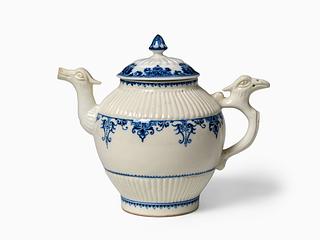
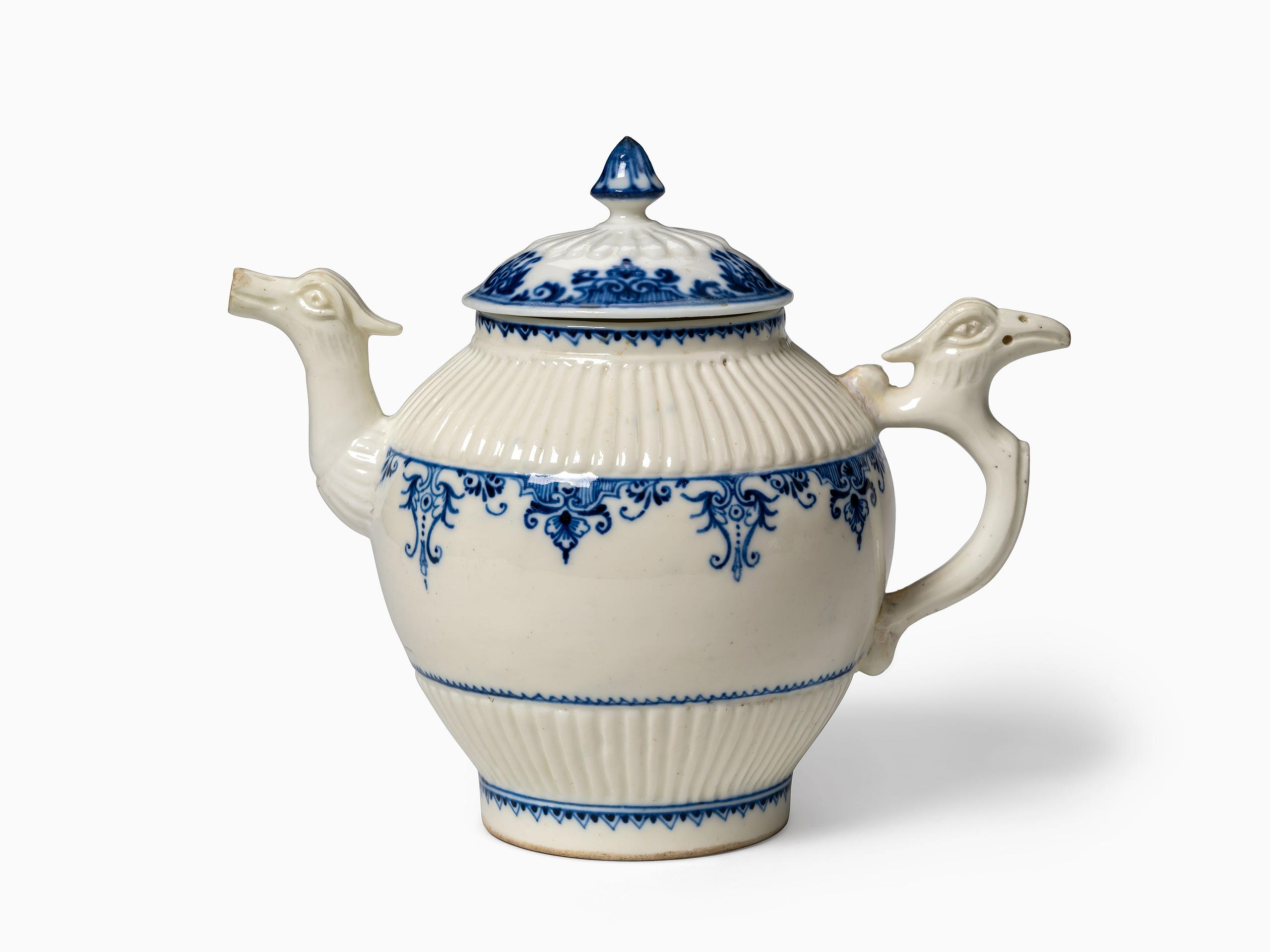
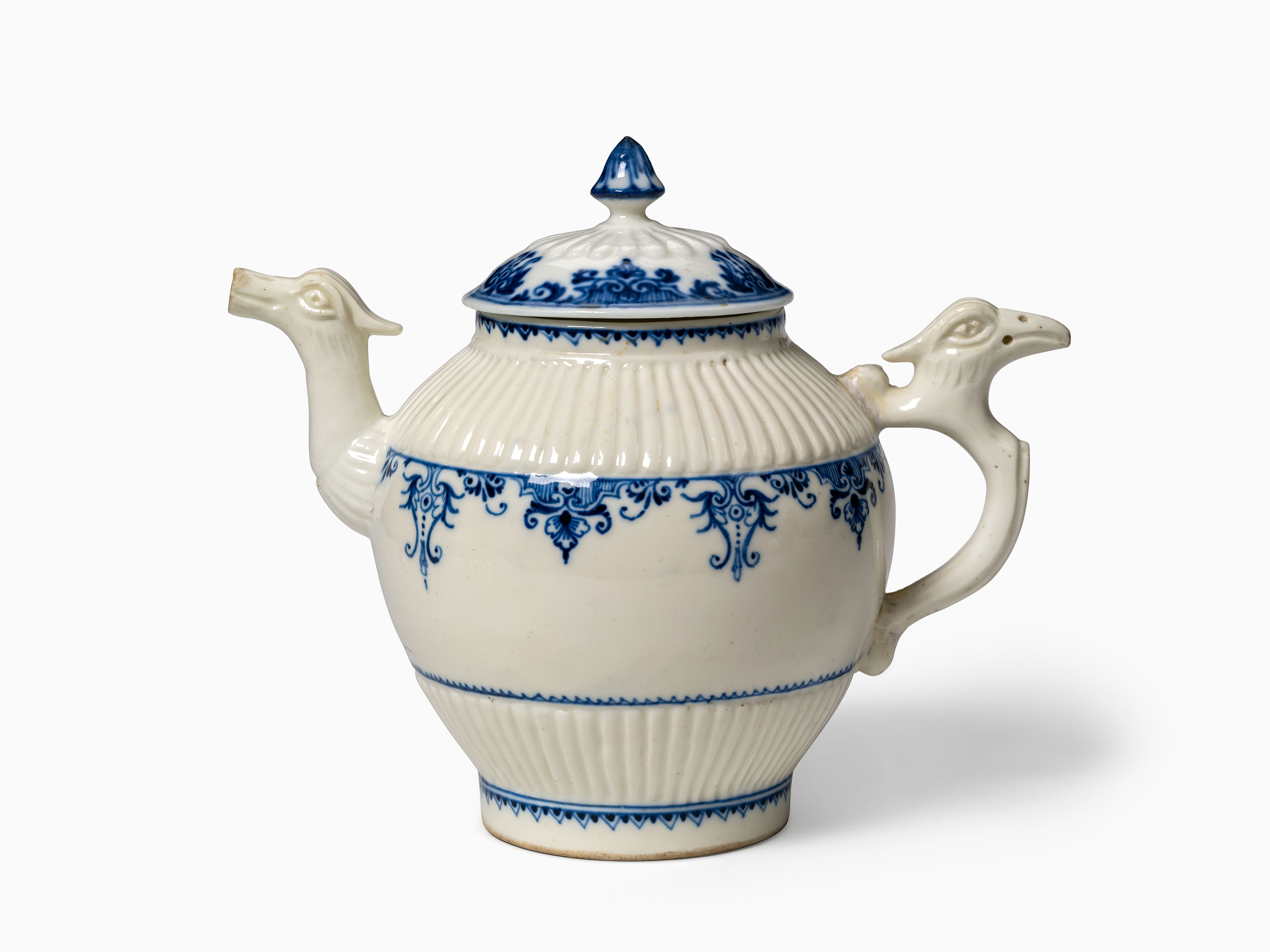
Teapot; soft-paste porcelainSaint-Cloud Manufactory, c. 1725
The Saint-Cloud Manufactory, situated west of Paris near the village of Saint-Cloud, was the first in Europe to produce soft-paste porcelain on a commercial basis, beginning in the early 1690s. It thus became France’s first major porcelain factory. Initially, its wares imitated Chinese porcelain, but the factory quickly developed its own distinctive style, which brought it considerable success in the early eighteenth century. Saint-Cloud soft-paste porcelain is particularly distinguished by its faint ivory tone and by decoration combining Chinese and European patterns and motifs. Blue was the colour most used in its painted ornamentation.
Right from the outset, the factory used a strong dark blue, directly referencing the imported Chinese hard-paste porcelain arriving across Europe at the time. There were, however, other reasons for choosing this colour. Blue was better suited than any other pigment to underglaze decoration, since it could withstand high firing temperatures. It also created a striking contrast to the white porcelain body, allowing the material itself to be shown to greater advantage.[1]
In its decorative schemes, the factory initially adhered closely to Chinese motifs. However, it soon moved away from straightforward imitation in favour of developing its own designs. In the early eighteenth century, the Saint-Cloud Manufactory produced larger soft-paste porcelain vessels with a pronounced relief effect created through gadrooning; a decorative profiling of repeated vertical or slightly curved flutes running rhythmically around a form. This became the basis for a new artistic idiom featuring stylised scrolling ornaments, foliage and ribbon-like forms.[2] These designs drew on engravings by the French architect and printmaker Jacques Androuet du Cerceau (c. 1520–1586) and the French engraver Jean Berain (1640–1711), whose work the porcelain painters adapted and interpreted to varying degrees. This type of decoration was particularly well suited to smaller pieces such as jars and salt cellars, though it also appears on selected larger objects.
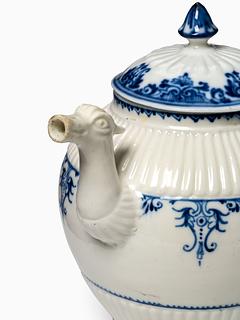
This round teapot is a fine example of this type of design, with its circular footrim and a body ornamented with gadrooning in relief at both the lower and upper sections. The curved spout is shaped as a bird’s head with a cut-off beak, while the handle ends in a corresponding bird’s head with a pointed beak. The lid is topped with a finial modelled as a small bell set on a short stem. The blue decoration on the smooth central section of the body and on the plain area of the lid stands out clearly – as do the horizontal markings highlighted with narrow serrated borders in blue.
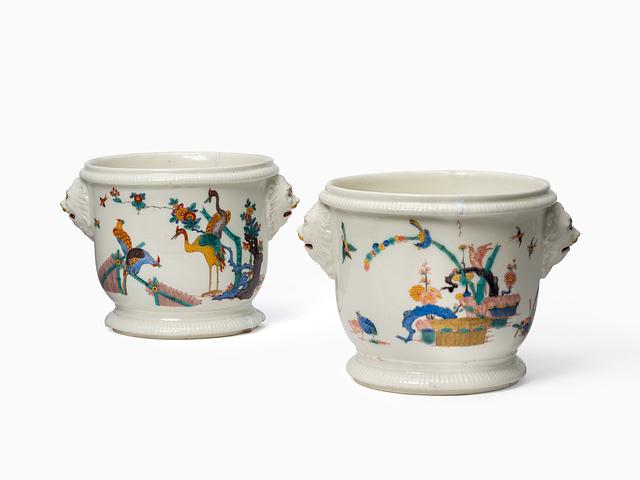
The teapot’s shape was widely reproduced at the factory and is known in several different colourways and decorative variants.[3]
Published in
Published in
Ole Hæstrup: Europæisk keramik. Håndbog for antikvitetssamlere, Copenhagen 1981, p. 91.
Footnotes
Footnotes
Bertrand Rondot (ed.): Discovering the Secrets of Soft-Paste Porcelain at The Saint-Cloud Manufactory ca. 1690–1766, New Haven 1999, pp. 255–260.
Bertrand Rondot (ed.): Discovering the Secrets of Soft-Paste Porcelain at The Saint-Cloud Manufactory ca. 1690–1766, New Haven 1999, p. 259.
Two related examples are known in the collection of The Metropolitan Museum of Art, New York, inv. nos. 2015.503a, b and 2004.354a, b respectively. The bodies of those teapots are plain, however, and their decoration differs in both design and colour.